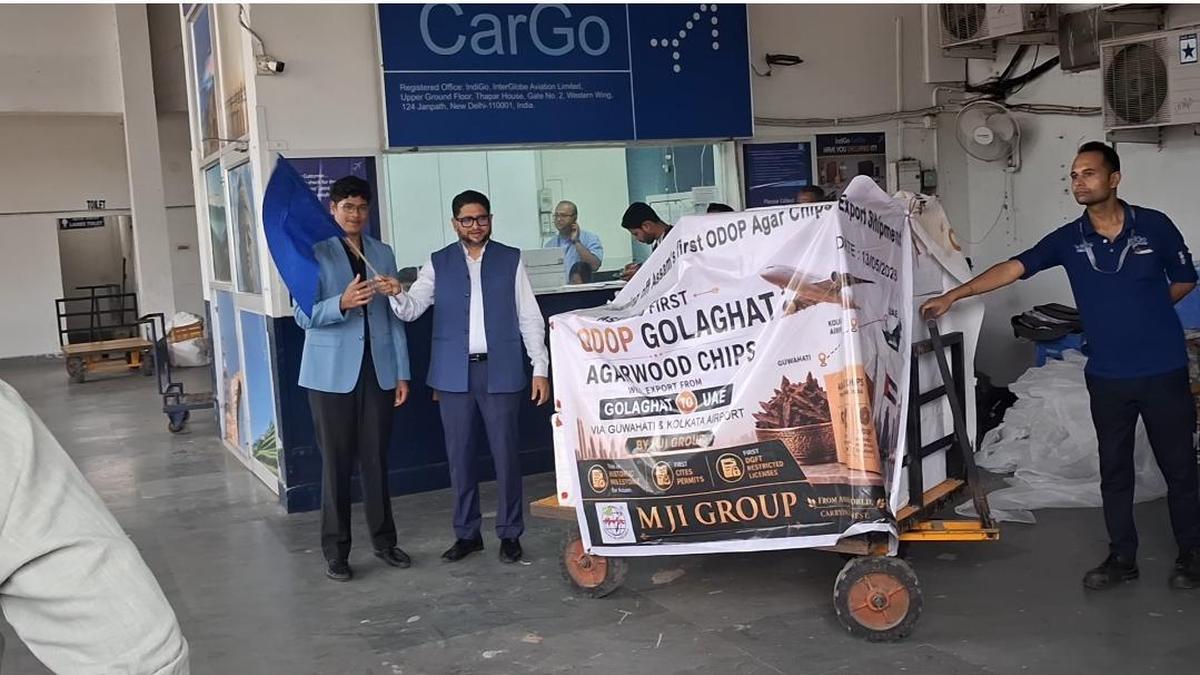
The inaugural legal shipment of agarwood chips from Assam to West Asia marks the transition of a high-value botanical asset from an informal, black-market dominated economy to a regulated global trade flow. While the event is reported as a logistics milestone, the underlying shift is actually one of regulatory arbitrage and institutional de-risking. By formalizing the export of Aquilaria malaccensis, the Indian government is attempting to capture the significant "Green Gold" premium that has historically leaked into clandestine supply chains through neighboring borders.
The Value Multiplier Paradox
Agarwood is not a commodity in the traditional sense; it is a pathological byproduct. The resinous heartwood forms only when the Aquilaria tree is infected by specific fungal pathogens (primarily Phaeoeutypa and Aspergillus species). This creates a unique economic profile where the value of the asset is inversely proportional to the health of the biological host.
The economic value chain is governed by three primary variables:
- Infection Density: The percentage of heartwood saturated with oleoresin.
- Scent Profile: The chemical complexity of the sesquiterpenes, which varies by soil pH and moisture levels in the Brahmaputra valley.
- Regulatory Traceability: The presence of CITES (Convention on International Trade in Endangered Species of Wild Fauna and Flora) documentation, which determines whether the product can enter high-end luxury markets in Dubai and Riyadh or must remain in the discounted shadow market.
Legalization removes the "illegality discount" that local farmers previously faced. When a product is illegal, the producer bears the risk of seizure and prosecution, forcing them to sell to middlemen at a fraction of the global spot price. By establishing a legal corridor, the state effectively transfers that risk-premium back to the primary producer.
Structural Bottlenecks in the Agarwood Supply Chain
Despite the success of the first shipment, the industry faces structural constraints that prevent immediate scaling. The primary bottleneck is the Time-to-Yield lag. Unlike traditional timber, agarwood requires an incubation period. A tree typically reaches physical maturity in 8–10 years, but the valuable resin may take another decade to develop naturally.
The industry is currently bifurcated into two production models:
The Natural Inoculation Model
This relies on random ecological factors (insect boring or lightning strikes) to introduce fungi. While it produces the highest quality "Grade A" chips, the yield is statistically unpredictable. This unpredictability makes it impossible to build a standardized futures market or stable export contracts.
The Artificial Induction Model
Assam's strategy now pivots on artificial inoculation—the deliberate wounding of trees and injection of fungal stimulants. This shifts the production function from a biological lottery to a predictable manufacturing process. The first legal shipment signals that the government has finally harmonized the technical standards for these artificial processes with international CITES Appendix II requirements.
The Geopolitical Demand Sink: West Asia
The choice of West Asia as the primary export destination is a calculated move based on the region's massive Consumer Surplus for agar products. In the Gulf Cooperation Council (GCC) markets, agarwood (Oudh) is an essential cultural and religious utility.
The demand in these markets is inelastic. Because there are no viable synthetic substitutes for the complex chemical profile of natural agarwood oil, price increases do not significantly deter consumption among high-net-worth individuals in the UAE or Saudi Arabia. By targeting this region, Assam is tapping into a market where the price ceiling is governed by luxury status rather than utility.
The logistical framework of this first shipment—originating from the Golaghat district and moving through established export channels—serves as a proof-of-concept for Special Economic Zones (SEZs) dedicated to agarwood. These zones allow for the consolidation of smallholder yields into bulk shipments, reducing the per-unit cost of certification and testing.
The CITES Compliance Frontier
The most significant barrier to the global agarwood trade is not logistics, but the rigorous verification of Non-Detriment Findings (NDFs). To export Aquilaria malaccensis legally, the exporting nation must prove that the trade does not threaten the survival of the species in the wild.
Assam's "Agarwood Promotion Policy 2020" laid the groundwork for this by distinguishing between "wild-grown" and "plantation-grown" resources. This distinction is critical. The international community views wild agarwood as a conservation crisis, but plantation agarwood is viewed as a sustainable agricultural product. The first legal shipment confirms that the Indian regulatory machinery can now successfully verify the plantation origin of the wood, providing the transparency required by international banks and customs authorities.
Impact on the Local Unit Economics
Prior to this liberalization, the profit distribution in the Assam agarwood trade was heavily skewed toward the "Export-Gate" phase. The farmer typically captured less than 15% of the final retail value. The opening of legal channels enables a Vertical Integration strategy for local cooperatives.
- Standardization of Grading: Without a legal framework, grading was subjective and often used by middlemen to underpay farmers. A formal market forces the adoption of standardized moisture content and resin density metrics.
- Capital Infusion: Legal status allows farmers to use their standing agarwood stock as collateral for bank loans. This provides the liquidity needed to invest in better inoculation technology and distillation units.
- Secondary Processing: The chips sent to West Asia are raw materials. The higher-margin opportunity lies in the local distillation of agar oil (Dehn al Oudh). Legal export routes for chips are the precursor to establishing high-tech processing hubs within Assam, keeping the value-add within the state.
Risk Factors and Competitive Pressures
Assam does not hold a monopoly on the agarwood market. It faces stiff competition from Southeast Asian nations, particularly Vietnam and Thailand, which have had legalized, industrialized agarwood sectors for decades.
The primary competitive risk is Quality Dilution. As the industry scales, the pressure to use faster-acting, aggressive chemical inoculants increases. If these chemicals alter the scent profile or leave residues that fail international health standards, the "Assam Brand" will suffer a permanent valuation hit.
Furthermore, the "Illegal-to-Legal" transition is rarely smooth. The existing black-market networks, which avoid taxes and CITES fees, can still offer lower prices to unscrupulous buyers. The government’s challenge is to ensure that the costs of legal compliance (the "Regulatory Tax") do not exceed the benefits of legal market access.
Strategic Capital Allocation for Producers
For the Assam agarwood industry to move from a "first shipment" milestone to a dominant global position, the following strategic maneuvers are required:
- Investment in Genomic Mapping: Identifying the specific fungal strains that produce the most desirable scent profiles in the Brahmaputra climate. This creates a proprietary biological advantage that cannot be easily replicated by competitors in different geographies.
- Decentralized Distillation: Reducing the volume of raw wood transported by processing chips into oil at the farm gate. This lowers shipping costs and allows for the export of a more shelf-stable, higher-value product.
- Blockchain-Enabled Provenance: Utilizing digital ledgers to track a tree from the sapling stage to the final chip shipment. This provides the "Ethical Sourcing" guarantee that European and North American luxury perfume houses increasingly demand.
The focus must now shift from the novelty of legal export to the optimization of the Biological Asset Cycle. The first shipment proved the plumbing of the system works; the goal now is to increase the pressure and volume of the flow.
Establish a state-level "Agarwood Quality Control Bureau" that issues ISO-certified grades for every kilogram of exported material. This removes the information asymmetry between the Assamese farmer and the Dubai buyer, ensuring that the state captures the full premium for its unique ecological output. Success will be measured not by the number of shipments, but by the year-over-year increase in the price-per-kilogram of Assam-certified heartwood.