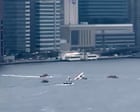
A seaplane clips a buoy, flips upside down, and submerges into the brackish, fast-moving currents of New York City’s East River. The mainstream media rushes to the scene with breathless headlines about a "miracle escape" and "narrowly avoided tragedy."
They are asking the wrong questions, as usual.
They focus on the dramatic splash, the shattered fiberglass, and the frantic scramble of first responders. They treat the incident like a near-miss catastrophe that demands immediate, sweeping bans on urban aviation.
They completely miss the point.
This incident wasn't a failure of aviation. It was a spectacular, real-world demonstration of engineering success. When a plane flips over in a high-density urban waterway and everyone walks away with only minor scratches, the system didn't break. The system worked exactly as designed.
The Myth of the Dangerous Water Landing
Every time a fuselage touches water outside of an airport runway, the public collective memory defaults to extreme anxiety. We are conditioned to view water as a hostile, unpredictable void.
The media exploits this. They interview terrified onlookers who talk about how "scary" it looked from their high-rise apartments. But look at the physics of a modern utility seaplane, like a Cessna 206 or a De Havilland Beaver configured with floats.
These aircraft are not fragile kites. They are built like tanks, specifically engineered to absorb massive kinetic energy during hydro-dynamic impacts.
When a seaplane capsizes at low speed—which is precisely what happens when a float digs into a wave or clips an obstruction during the landing rollout—the kinetic energy dissipates through the water and the collapse of the float struts. It looks violent. It looks messy. But for the occupants inside the cabin, it is a controlled deceleration.
I have spent years analyzing accident data and working alongside commercial operators who navigate strict visual flight rules (VFR) corridors. The hard truth that regulators and pearl-clutching city council members won't admit is this: you are statistically far safer flipping a seaplane into the East River at 40 knots than you are blowing a tire on the hard shoulder of the Long Island Expressway.
The Real Mechanics of a Submerged Evacuation
Let's address the flawed premise of the "trapped underwater" narrative.
People assume that once an aircraft flips upside down, it becomes a metallic coffin. This logic ignores decades of rigorous egress training that is mandatory for commercial sea pilots.
- Structural Integrity: The cabin structure of a certified aircraft must withstand immense load factors. Even inverted, the survival cell remains intact.
- Egress Protocols: Pilots are trained to maintain a physical reference point inside the cockpit, wait for water pressure to equalize, and then open the doors.
- Buoyancy Reserves: Modern floats are divided into multiple watertight compartments. Even if one compartment punctures, the remaining chambers keep the airframe buoyant enough to allow escape.
The East River incident proved these mechanics perfectly. The occupants did not survive because of luck. They survived because aviation regulations mandate a level of redundant safety engineering that makes modern flight almost ridiculously forgiving of human error.
The Knee-Jerk Regulatory Trap
Predictably, whenever an incident like this occurs in a major metro area, the immediate response from local politicians is a call to ban commuter seaplane operations entirely. They argue that the airspace above the East and Hudson rivers is too congested, too risky, and too close to dense populations.
This is a profoundly shortsighted perspective.
If you ban seaplanes from the East River, you don't eliminate the transport demand; you simply shift it. Those passengers will instead take helicopters, congested bridges, or high-speed ferries.
Let's compare the actual risk profiles:
| Transport Mode | Kinetic Energy Risk | Operational Redundancy | Emergency Landing Options |
|---|---|---|---|
| Seaplane (East River) | Low (Water absorbs impact) | High (Glides without engine power) | Unlimited (The entire river is a runway) |
| Helicopter (Urban) | High (Rotors require active power) | Medium (Autorotation requires altitude) | Highly limited (Helipads or rooftops) |
| Highway Vehicle | High (Hard barriers, oncoming traffic) | Low (No mechanical redundancy for tires/brakes) | None (Locked into a lane) |
When you look at the raw mechanics, an airplane operating over a wide body of water has a built-in safety net that no land-based vehicle can match: a continuous, flat emergency runway directly beneath it at all times.
The Downside We Have to Admit
To be entirely fair, urban seaplane operations are not without legitimate challenges. The contrarian view doesn't mean ignoring reality.
The real hazard in the East River isn't the airspace or the weather. It is the debris.
New York’s waterways are notoriously dirty. Submerged logs, discarded pallets, and tidal debris create a minefield for aircraft traveling at high speeds on the water step. A pilot can execute a flawless approach, only to strike an invisible piece of timber hidden just beneath the surface.
This is where the industry actually needs to improve. We don't need fewer flights; we need better harbor management, real-time debris scanning, and stricter enforcement of maritime waste laws. Blaming the aircraft for hitting a piece of floating trash is like blaming a motorist for hitting an unmarked, deep pothole on a city street. You fix the infrastructure, you don't ban the cars.
Stop Treating Safety as the Absence of Incidents
The biggest misconception in modern transportation is the belief that "perfect safety" means zero accidents. This is an impossible, utopian standard that paralyzes progress.
True safety is resilience. It is the ability of a system to experience a catastrophic failure—like a plane flipping upside down in a river—and still deliver the passengers safely to the shore with nothing more than wet clothes and an adrenaline rush.
The next time you see a dramatic photo of an aircraft nose-down in the water, ignore the hysterical commentary. Look at the passengers standing on the wings, waiting calmly for a police boat. Look at the intact cabin. Look at the fact that everyone walked away.
Stop calling it a tragedy avoided. Call it what it actually is: an engineering triumph.