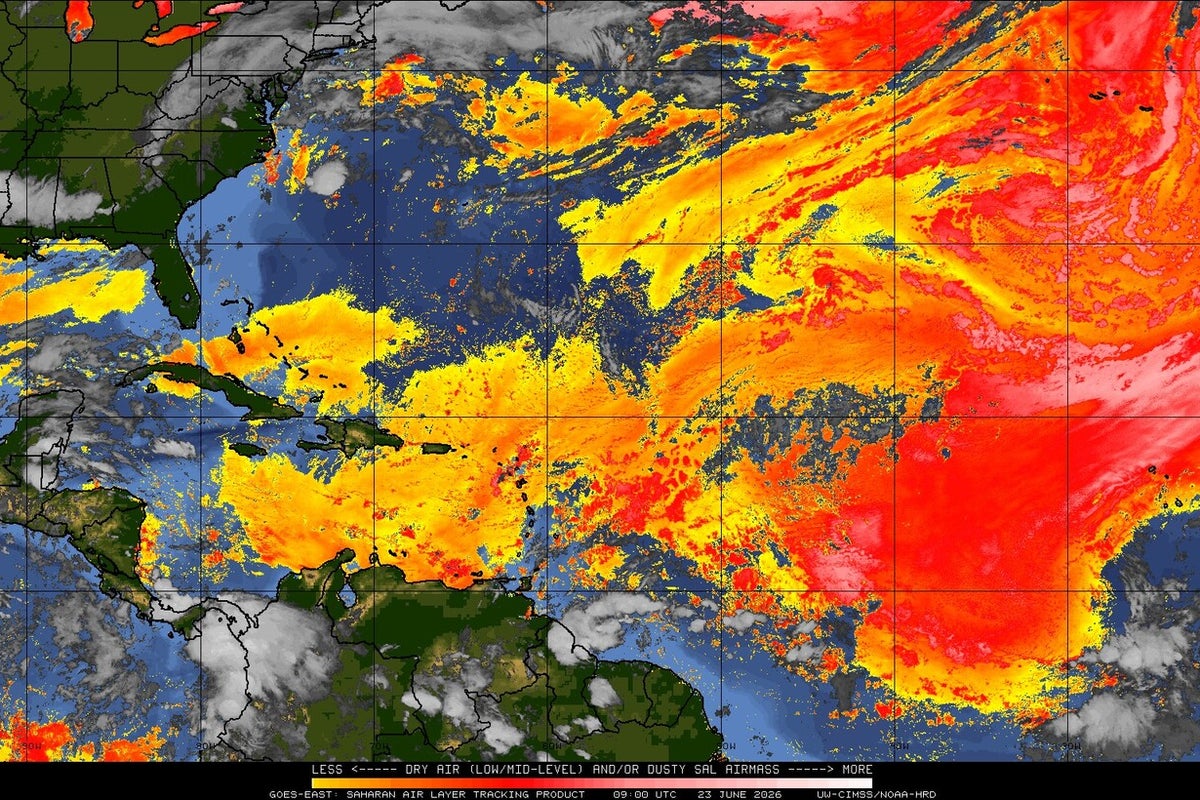
The arrival of a massive Saharan Air Layer (SAL) plume across the southeastern United States is not a mere weather novelty; it is a highly structured, continental-scale thermodynamic system. Originating from high-velocity surface winds over North African sand seas, or ergs, during the late spring and summer months, this specific air mass undergoes trans-Atlantic transport driven by the African Easterly Jet (AEJ). Rather than examining this event through localized, anecdotal observations of hazy skies or colorful sunsets, analyzing the phenomenon requires a rigorous breakdown of its three core vectors: thermodynamic stability, particulate mechanics, and public health impact models.
The Thermodynamic Mechanics of the Saharan Air Layer
The SAL operates as an elevated, hyper-dry reservoir of warm air, typically stabilizing between 5,000 and 20,000 feet above sea level. Understanding its behavioral footprint requires mapping how these specific air mass attributes intersect with the baseline tropical Atlantic atmosphere. If you enjoyed this piece, you should look at: this related article.
The Thermal Inversion Mechanism
The baseline tropical atmosphere over the Atlantic Ocean exhibits a standard lapse rate, where temperature decreases with altitude. When the SAL enters this system, it introduces a dense layer of hot, dry air that overrides the cooler, high-humidity marine boundary layer below. This spatial arrangement creates a strong thermal inversion layer.
============================================
Altitude: 20,000 ft
--------------------------------------------
Saharan Air Layer (SAL)
- Hot, hyper-dry air mass (50% less moisture)
- Mineral dust particles (absorb shortwave radiation)
--------------------------------------------
Thermal Inversion Layer (Cap) -> Suppresses updrafts
--------------------------------------------
Marine Boundary Layer
- Cool, high-humidity air mass
============================================
Sea Level
Because warm air is less dense than cold air at equivalent pressure levels, the warm SAL rides above the cooler marine layer. This creates an exceptionally stable atmospheric profile. Convective updrafts, which require cold air above warm surface air to sustain upward velocity, are mechanically suppressed by this thermal ceiling. For another angle on this story, see the latest update from The Guardian.
The Kinetic Disruption of Cyclogenesis
The operational impact of this thermodynamic cap manifests directly in the suppression of tropical cyclones. The SAL introduces two structural bottlenecks to storm development:
- Entrainment of Low-Moisture Plumes: The SAL contains approximately 50% less moisture than the standard tropical atmosphere. When an early-season tropical disturbance attempts to organize, it draws surrounding air into its core. The entrainment of this hyper-dry SAL air stimulates rapid evaporative cooling within the storm's convective towers. This generates severe, localized downdrafts that disrupt the central updraft core, effectively choking the storm's energy source.
- Baroclinic Wind Shear Generation: The boundary between the high-velocity African Easterly Jet carrying the SAL and the slower moving ambient tropical winds creates intense localized horizontal and vertical wind shear. This kinetic displacement tilts the vertical vortex of developing tropical low-pressure systems. If a system cannot maintain a vertically aligned core, latent heat release cannot concentrate over a singular geographical point, disabling the core engine required for cyclogenesis.
Particulate Composition and Radiative Forcing Variables
The structural properties of Saharan dust dictate both its visual presentation and its environmental footprint. The transport mechanism acts as a geographic filter, sorting particles by mass, aerodynamic diameter, and mineral composition during the 3,000-mile trans-Atlantic crossing.
Aerodynamic Classification
The plume consists of suspended mineral aerosols categorized by their particulate matter (PM) thresholds:
- Coarse Fraction (PM10): Particles with an aerodynamic diameter under 10 micrometers, primarily composed of feldspar, quartz, and heavy silicates. While a significant portion of this weight precipitates out over the eastern and central Atlantic due to gravitational settling, high-velocity transport channels can sustain PM10 concentrations over long distances, delivering them directly to the Gulf Coast and southeastern seaboard.
- Fine Fraction (PM2.5): Particles with an aerodynamic diameter under 2.5 micrometers, consisting predominantly of clay minerals, illite, kaolinite, and iron oxides. Due to their low terminal settling velocity, these fine particles remain suspended in the upper atmospheric guide-waves for weeks, dominating the downwind concentration profiles inside the United States.
Radiative Transfer Dynamics
The suspended dust alters the regional energy balance through a dual-mode radiative forcing framework. The primary mode involves solar shortwave attenuation. Mineral dust particles scatter and absorb incoming solar radiation, decreasing the net shortwave flux reaching the surface of the ocean by an estimated 25 watts per square meter under dense plumes.
The secondary mode involves longwave trapping. The dust layer acts as a greenhouse agent, absorbing outgoing longwave thermal radiation from the Earth's surface and re-radiating a fraction of it back downward, increasing the net longwave flux by roughly 3 watts per square meter. The net effect of this dual-mode framework is a cooled ocean surface paired with an intensely heated mid-troposphere, which further locks the atmospheric thermal inversion in place.
Public Health Exposure Models and Respiratory Pathogenicity
When the SAL descends into the lower troposphere via subsidence or is pulled down to the surface by localized precipitation events, it transitions from a meteorological variable to a serious public health risk. The structural composition of the dust triggers a clear sequence of physiological strains.
Dust Inhalation (PM2.5 / PM10)
       │
       ▼
Deposition in Deep Pulmonary Tissue
       │
       ▼
Activation of Innate Immune Cells (Macrophages/Neutrophils)
       │
       ▼
Release of Pro-inflammatory Cytokines (IL-6, IL-8, TNF-α)
       │
       ▼
Oxidative Stress & Cellular Damage ──► Acute Airway Hyperresponsiveness
The Cellular Inflammatory Cascade
Inhalation of fine particulate matter (PM2.5) bypassed the filtering mechanisms of the upper respiratory tract, settling deep within the pulmonary alveoli. Once deposited, these foreign mineral crystals interface directly with alveolar macrophages and epithelial cells. This contact triggers pattern recognition receptors, initiating an immediate cellular defense sequence:
- Cytokine Upsurge: Exposed immune cells release high concentrations of pro-inflammatory cytokines, specifically interleukin-6 (IL-6), interleukin-8 (IL-8), and tumor necrosis factor-alpha (TNF-α).
- Neutrophil Recruitment: Interleukin-8 acts as a chemical signal, recruiting neutrophils to the pulmonary tissue, which accelerates localized tissue inflammation.
- Oxidative Stress Generation: The presence of iron oxides on the surface of the Saharan dust particles drives the generation of Reactive Oxygen Species (ROS) via the Fenton reaction. This cellular oxidative stress causes lipid peroxidation of cell membranes and damages airway DNA.
The immediate systemic result is acute airway hyperresponsiveness and bronchoconstriction. For healthy populations, this manifests as transient upper respiratory irritation, coughing, and decreased lung clearance efficiency. For vulnerable demographics—specifically individuals managing asthma, chronic obstructive pulmonary disease (COPD), or compromised cardiovascular systems—this inflammatory cascade frequently triggers severe clinical exacerbations, driving measurable increases in emergency department admissions.
Operational Risk Management Matrix
Municipalities, healthcare infrastructure, and industrial operations within the target zone must approach an advancing SAL event with quantified risk mitigation frameworks. The following system design categorizes response priorities across vulnerable sectors.
| Operational Sector | Risk Vector | Quantifiable Metric | Mitigation Protocol |
|---|---|---|---|
| Municipal Healthcare | Surge in acute respiratory admissions | Emergency Department presentation tracking vs PM2.5 levels | Pre-allocation of bronchodilators; proactive deployment of targeted public health alerts to high-risk demographic registries. |
| HVAC & Building Management | Accelerated filter loading; indoor air degradation | Pressure differential ($\Delta P$) across MERV filters | Temporary reduction of outdoor air intake volumes; schedule premature replacement cycles for building air filtration systems. |
| Aviation Operations | Slant-range visibility reduction; particulate ingestion | Visual range minimums; turbine particulate accumulation | Transition to instrument flight rules (IFR); enforce post-flight compressor washes for aircraft operating in low-altitude plumes. |
| Agricultural Infrastructure | Surface solar radiation drop; topsoil contamination | Daily shortwave solar flux reduction | Adjust automated irrigation schedules to account for reduced evapotranspiration rates under the dust canopy. |
Strategic Forecast and Analytical Projections
The immediate progression of the current SAL plume indicates a distinct timeline for environmental and atmospheric shifts across the southeastern United States. Computational models track the high-density center of the plume advancing through the Caribbean basin, with direct impacts focused squarely on Florida and the wider Gulf Coast region.
The primary structural consequence over the next seven days will be a complete suppression of local convective rainfall. As the dry, warm air mass caps the regional atmosphere, afternoon thunderstorm patterns will drop significantly below historical June baselines. This lack of cloud cover, paired with the downward longwave radiation trapped by the dust layer, will push heat index values to a range of 105°F to 110°F across impacted metro areas. Concurrently, surface-level PM2.5 monitoring networks will spike, requiring sustained air quality alerts for inland and coastal zones.
The secondary outcome is an extended window of protection against tropical cyclogenesis. While the region recently managed the impacts of Tropical Storm Arthur, the incoming SAL plume ensures that the tropical Atlantic basin will remain dynamically locked down for the duration of its passage. The sheer volume of dry air and wind shear introduced by this event creates an environment where storm systems cannot scale. Environmental managers and infrastructure coordinators should utilize this temporary stabilization of tropical weather risks to execute critical repairs and reinforce logistics chains before the dust layer inevitably dissipates and opens the door for late-summer storm development.


