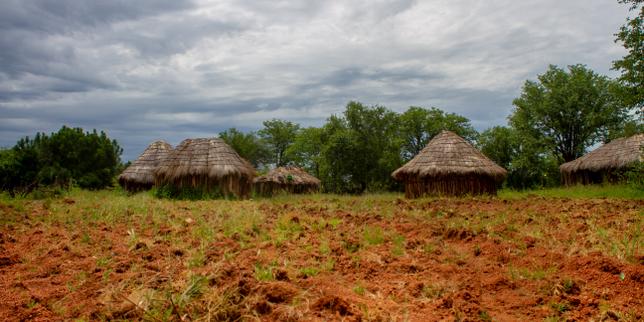
The earth across Cunene and Huíla does not crack all at once. It tightens in slow, agonizing stages until the topsoil turns to ash and the riverbeds become bleached bone-yards of smooth stone. For generations, pastoralists and smallholder farmers in southern Angola have danced a delicate, high-stakes waltz with marginal rainfall. They understood the rhythm of the dry seasons. They respected the capricious skies. But the rules of survival have been rewritten, and the margin for error has shrunk to absolute zero.
When international meteorological models began flashing crimson warnings about an intensifying climate anomaly across southern Africa, the usual bureaucratic machinery groaned into motion. Press releases warned of dry spells. Reports projected deficit yields for maize and sorghum. Yet numbers on a spreadsheet in Luanda or Geneva fail to capture the physical reality on the ground, where consecutive years of depressed precipitation have pushed rural ecosystems past critical tipping points. This is not merely a temporary weather fluctuation. It is a structural crisis that threatens to empty entire communities of their youth, their livestock, and their future. Meanwhile, you can explore related developments here: Prosecuting War Criminals The Mechanics of International Justice.
To understand why southern Angola is acutely vulnerable, one must look beyond the meteorological definitions of the recurring climate shocks. The region relies overwhelmingly on rain-fed agriculture and pastoralism. When the rains fail—as they have repeatedly over successive agricultural cycles—there is no systemic cushion. Boreholes dry up or turn brackish. Cattle, which serve as both living bank accounts and cultural cornerstones for families in provinces like Cunene and Namibe, grow thin, weak, and ultimately fall in heaps across the parched pastures. Every dead cow represents lost school fees, vanished dowries, and an irreversible slide into destitution.
The cascading failures of these dry years expose a profound disconnect between early-warning systems and anticipatory humanitarian response. For decades, international aid architecture has operated on a reactive model. Wait for the disaster to materialize, verify the catastrophic metrics, mobilize funds, and ship emergency rations months too late. By the time food insecurity crosses emergency thresholds, pastoralists have already sold off productive assets for pennies on the dollar, children have dropped out of school to help forage for wild roots, and families have begun the grim march toward displacement. To understand the full picture, we recommend the excellent article by Al Jazeera.
Local adaptation efforts face immense headwinds. While community-level water harvesting projects and drought-resistant seed distributions offer localized relief, they remain microscopic patches on a hemorrhage. Governmental programs struggle against massive infrastructure deficits. Transporting water via truck to remote settlements is a temporary bandage, not a hydraulic strategy. Without major capital investments in deep-aquifer management, solar-powered irrigation networks, and veterinary safety nets, every subsequent climate cycle will hit a more fragile population than the last.
The human cost of this systemic vulnerability is migration. Young men increasingly abandon depleted homesteads to seek informal labor in urban centers or across borders, leaving behind women, children, and the elderly to manage failing farms. This demographic hollowing out degrades traditional social support structures. When the able-bodied leave, communal land management breaks down, leaving the remaining population even more exposed to environmental shocks.
Blaming atmospheric phenomena alone is a convenient evasion of responsibility. While climate oscillations dictate the volume of moisture in the clouds, policy choices dictate whether a dry spell becomes a localized hardship or a humanitarian catastrophe. Agrarian policies that fail to prioritize pastoralist mobility, land tenure security, and localized water infrastructure leave millions defenseless against predictable environmental pressures.
As international agencies sound alarms about acute hunger risks climbing steeply through the coming seasons, the imperative shifts from monitoring vulnerability to forcing structural transformation. The spectral threat hanging over southern Angola is not just the immediate absence of rain, but the normalization of permanent crisis. Until regional development strategies match the brutal ecological reality of a warming continent, the dust will continue to claim what little remains.
Super El Niño pode agravar a seca no Sul de Angola: Alerta
This video provides additional context on how meteorological forecasts track these intensifying dry spells and their projected impacts on vulnerable agrarian communities in southern Angola.