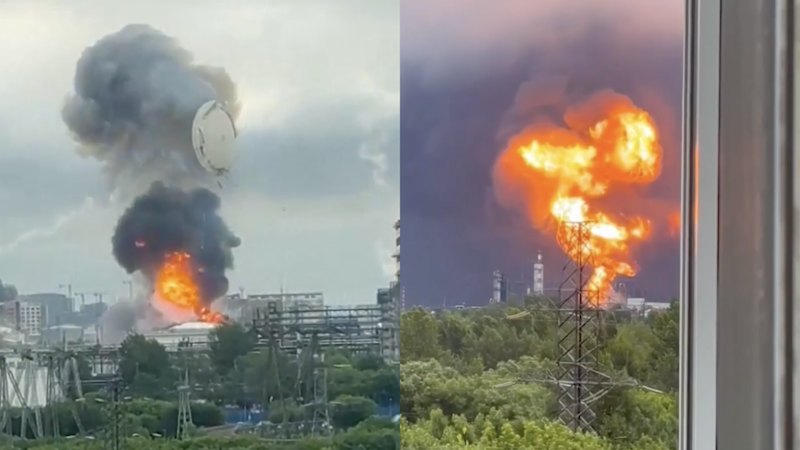
Smoke makes for great television. When a Ukrainian drone hits an oil refinery on the outskirts of Moscow, sending plumes of black soot into the European sky, Western media outlets rush to print the same predictable narrative: the Russian war economy is bleeding, fuel supplies are collapsing, and the Kremlin is panicking.
It is a comforting story. It is also completely wrong.
The lazy consensus among defense analysts and talking heads is that hitting downstream oil infrastructure is a shortcut to crippling a petro-state. They treat a localized fire at a refining unit as if it were a fatal blow to a centralized military machine.
They are confusing a temporary operational headache with a strategic crisis.
The harsh reality of energy logistics is that oil refineries are not fragile glass castles; they are massive, modular industrial networks built specifically to withstand heavy damage. If you want to understand why these headline-grabbing strikes are failing to shift the strategic balance of the war, you have to look past the smoke and look at the hard economics of petroleum engineering.
The Myth of the Fragile Refinery
To understand why a fire in Moscow does not equal a collapse at the front lines, you need to understand how a refinery actually works. Media reports frequently state that a facility has been "shut down" after a strike. This shows a fundamental misunderstanding of downstream oil architecture.
A modern refinery is not a single machine. It is a sprawling collection of independent processing units. The most frequent target of these drone strikes is the atmospheric distillation column—the tall tower where crude oil is split into basic components like naphtha, kerosene, and diesel.
Yes, if you hit a distillation tower, that specific section goes dark. But major facilities almost always feature multiple parallel processing lines, known as trains. When Train A goes down, engineers isolate the damage, reroute crude stocks to Train B, and draw down localized inventories to keep the trucks moving.
Furthermore, Russia has spent decades optimizing its heavy industrial repair cycles. Western sanctions were supposed to make replacing these components impossible. Yet, through robust domestic engineering and gray-market supply chains stretching across East Asia, broken heat exchangers and damaged control systems are routinely patched or replaced within weeks, not months.
Consider the economic data. Following major wave attacks on Russian refining capacity, global oil markets braced for a massive drop in Russian petroleum exports. What actually happened? Russia simply altered the mix. When domestic refining capacity dips slightly, Russia exports more crude oil instead of refined products. The cash keeps flowing into the Kremlin’s coffers; the color of the commodity just changes on the ledger.
The Diesel Delusion: Why the Red Army Isn't Running Dry
The most common "People Also Ask" question circulating online during these bombardment campaigns is simple: Will drone strikes on Russian refineries starve their tanks of fuel?
The short answer is no. The long answer requires a look at basic military consumption ratios versus industrial output.
Russia is one of the largest producers of diesel on the planet. Even with 10% to 15% of its refining capacity temporarily offline or disrupted due to seasonal maintenance and drone damage, the country still produces vastly more diesel than its domestic economy and its military could ever consume.
- The Military Footprint: A mobilized army consumes a massive amount of fuel, but it is a drop in the ocean compared to the civilian economy. Russia's agricultural sector, heavy logistics networks, and public transport systems consume the vast majority of its refined products.
- The Strategic Reserve: The Kremlin maintains deep underground refined-product reserves specifically insulated from aerial attacks. The military gets first dibs on every drop of fuel produced or stored in the country.
- The Export Buffer: Russia exports roughly half of its diesel output. If production drops due to a drone strike, the state does not cut off its own military units. It cuts off its foreign buyers.
The downside to this contrarian view is obvious: it means the war cannot be won cheaply from the air via cheap telemetry drones. I have analyzed corporate energy supply chains for years, tracking how corporate logistics adapt to catastrophic failures. Complex industrial systems are highly adaptive organisms. Treating a minor reduction in export-grade gasoline production as a systemic military failure is pure wishful thinking.
Capital Misallocation at 1,000 Kilometers
If these strikes do not starve the Russian war machine of fuel, what do they actually achieve? They force a misallocation of defensive resources—but they also represent a severe misallocation of offensive capital by the attacker.
Every long-range, precision-guided drone launched at a refinery in Moscow is a highly complex piece of engineering utilizing advanced guidance systems, composite materials, and expensive electronic counter-countermeasures. When these assets are spent blowing up a storage tank or scoring a superficial hit on a distillation unit, they are unavailable for tactical operations where they could directly alter the balance of forces on the ground.
Imagine a scenario where those same deep-strike capabilities were focused exclusively on localized military logistics hubs: ammunition dumps, rail switchyards, and forward repair depots within 150 kilometers of the front lines.
| Target Type | Repair Time | Strategic Impact | Economic Friction |
|---|---|---|---|
| Oil Refinery Column | 3 to 6 Weeks | Minimal (Rerouted through crude exports) | High financial cost, low military impact |
| Rail Switchyard / Bridge | Months | High (Halts troop and artillery movement) | Low financial cost, massive military impact |
| Forward Ammunition Depot | Instant Loss | Critical (Starves artillery batteries in real-time) | Immediate tactical collapse on the frontline |
When a rail junction is obliterated, an entire army corps loses its supply line for days. The tanks stop moving because the shells do not arrive, not because there is a shortage of diesel in the country. Yet, a twisted rail line or a cratered concrete bridge does not produce a dramatic, 300-foot fireball that looks good on social media. It yields dull, static satellite imagery.
By prioritizing visual spectacle over systemic disruption, the current strategy plays into a media loop that satisfies Western audiences but fails to change the math on the ground.
Stop Aiming for the Smoke
The ultimate flaw in the current coverage of the drone campaign is the belief that hitting the Russian energy sector at its weakest point of convenience will yield a systemic collapse. It ignores the fundamental law of resource-rich autocracies: the state will always cannibalize the civilian population and foreign trade to sustain its core security apparatus.
If the goal of deep strikes is to create structural economic friction that genuinely degrades military capability, the target selection must shift away from standard downstream oil targets.
Stop hitting the distillation towers. Start targeting the specialized electrical substations that power the heavy compressors inside petrochemical plants. Stop targeting the storage tanks that can be extinguished in 48 hours. Start targeting the unique, non-standard rail loading racks that allow heavy crude to be moved from the fields to the ports.
Until the strategy shifts from creating public relations victories to engineering actual logistic bottlenecks, the fires in Moscow will remain what they have always been: an expensive, spectacular illusion.


