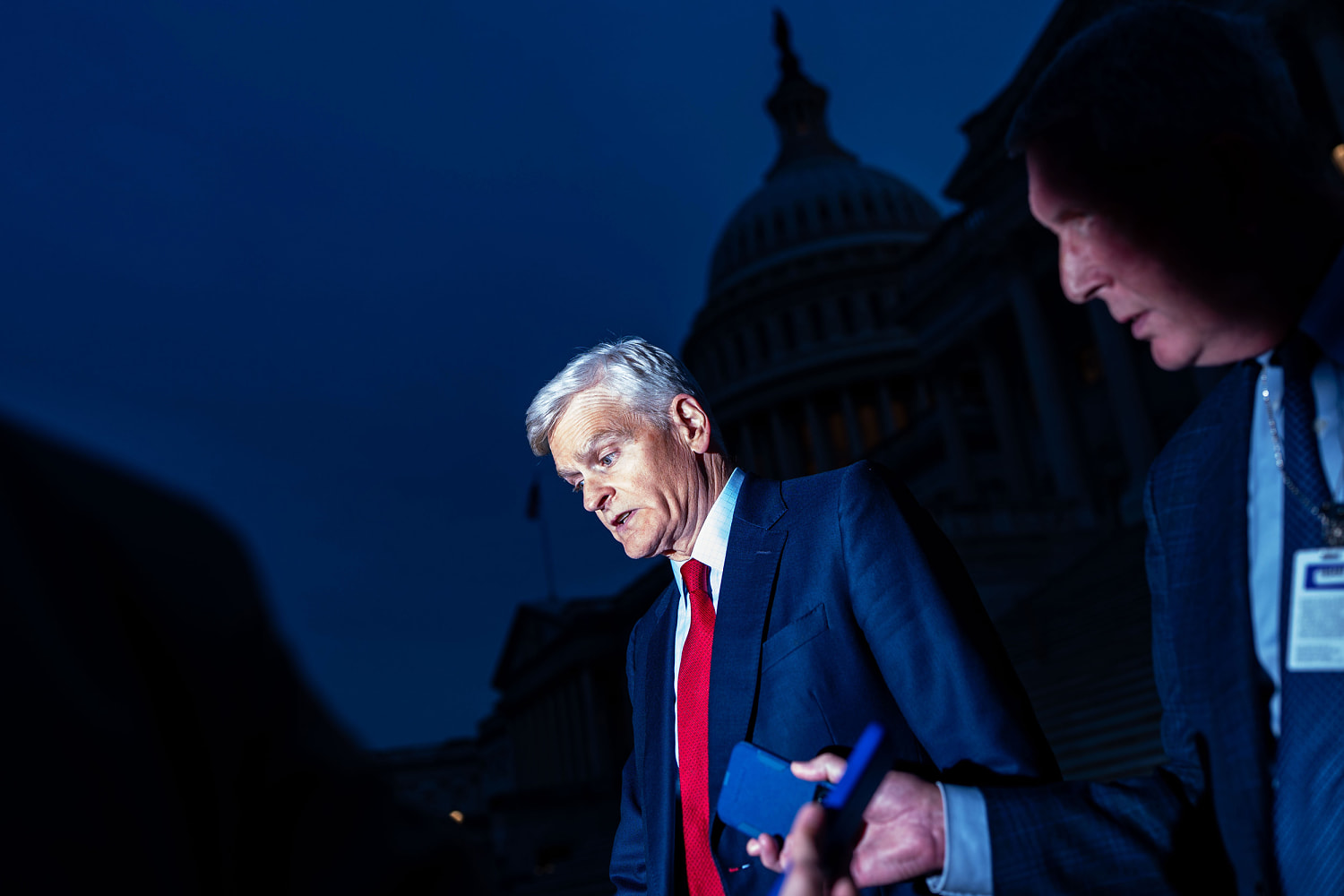
Bill Cassidy is a man who knows what it sounds like when a human body begins to fail. Before he was a United States Senator, he was a gastroenterologist. He spent decades in the quiet, sterile reality of clinics, treating patients who were yellowed by hepatitis or hollowed out by liver failure. In those rooms, the truth isn't a matter of political opinion or a trending hashtag. It is a measurement of enzymes, a scan of an organ, the steady beep of a monitor.
Now, he sits in a different kind of room.
The air in Washington and back home in Louisiana has grown thick with a new kind of fever. It isn't a biological pathogen this time, but a cultural one. It’s the "Make America Healthy Again" movement—MAHA for short. On the surface, the name sounds like common sense. Who wouldn't want a healthier nation? But beneath the branding lies a volatile cocktail of skepticism that is threatening to rewrite the rules of American public health and, in the process, end the career of one of the few doctors left in the Senate.
Consider a hypothetical woman named Sarah. She lives in a small parish outside of Baton Rouge. She trusts her local community, her church, and her social media feed more than she trusts any federal agency with a three-letter acronym. When she hears MAHA advocates talk about "medical freedom" and the "poisoning" of the food supply, it resonates. It feels like someone is finally listening to her anxiety about the chemicals in her kids' cereal or the mandates that felt like overreach during the pandemic.
But then there is the other side of Sarah’s reality. Her grandfather remembers the iron lung. He remembers the summer of 1952, when parents were too terrified to let their children go to public swimming pools because polio was a ghost that could snatch a child’s ability to walk overnight.
Bill Cassidy is standing in the gap between Sarah’s modern anxiety and her grandfather’s historical memory.
The Senator hasn't wavered on the basic math of immunology. He knows that vaccines are the most successful public health intervention in human history. He knows that without them, our hospitals would return to the dark ages of infectious disease. But for a Republican in 2026, saying this out loud is increasingly treated as an act of treason.
The political math is brutal.
To win a primary in Louisiana, you need the base. And the base is currently being swept up in a movement that views mainstream medicine not as a lifesaver, but as a subsidiary of a corrupt "Big Pharma" machine. When Cassidy defends the safety of the childhood immunization schedule, he isn't just citing peer-reviewed studies. He is walking into a buzzsaw of populist rage.
The irony is sharp enough to draw blood. Cassidy is a conservative. He has spent years fighting for lower taxes and less regulation. Yet, because he refuses to entertain the idea that polio vaccines are a conspiracy, he is being branded as a "RINO"—a Republican In Name Only.
The MAHA movement has found a powerful vessel in figures like Robert F. Kennedy Jr., whose rhetoric has migrated from the fringes of the left to the heart of the right. This isn't just about COVID-19 anymore. The skepticism has metastasized. It’s about measles. It’s about mumps. It’s about the very foundation of how we keep a civilization from falling ill.
Wait.
Think about the physical space of a Senate hearing room. It’s all marble and dark wood. It feels permanent. But the ideas being traded there are more fragile than we like to admit. Cassidy often looks like a man trying to explain the laws of gravity to people who have decided that floating is a matter of personal choice. He speaks with the cadence of a physician—measured, calm, grounded in evidence.
In politics, however, a calm voice is often drowned out by a loud one.
The MAHA advocates aren't just looking for better food labels. They are demanding a purge. They want the heads of the CDC, the FDA, and the NIH. They want to dismantle the systems that Cassidy spent his entire professional life navigating. For these activists, Cassidy represents the "Old Guard," a man too cozy with the establishment to see the "truth" about medical conspiracies.
But what happens if they win?
Let’s look at a different hypothetical. In this version of the future, the skeptics successfully dismantle the federal vaccine infrastructure. State-level mandates are stripped away. In a year or two, a single case of measles enters a school in a high-growth suburb. Because the "herd immunity"—that invisible shield we all provide for each other—has been thinned out, the virus spreads like fire through dry grass.
$R_0 \approx 12-18$
That is the mathematical reality of measles. For every one person infected, they pass it to twelve to eighteen others in an unvaccinated population. It is one of the most contagious substances on Earth. You don't even have to touch the person; you just have to breathe the air they left behind two hours ago.
Cassidy knows this number. He knows that a $95%$ vaccination rate is the threshold for safety. Below that, the shield breaks.
He is watching the shield break in real-time, not because of a lack of medicine, but because of a lack of trust.
The personal cost for Cassidy is rising. His approval ratings among the most active primary voters are shivering in the cold. He is being challenged by figures who promise to "tear it all down." These challengers don't have medical degrees, but they have something more valuable in a modern primary: a direct line to the lizard brain of the electorate. They trade in fear and the promise of a return to a "natural" world that never actually existed.
It is a lonely position to be a man of science in an age of storytelling.
Cassidy’s struggle is a microcosm of a much larger American fracture. It is the collision between the "Expertise Economy" and the "Attention Economy." In the Expertise Economy, your value is determined by what you know and what you can prove. In the Attention Economy, your value is determined by how much outrage you can generate and how many people you can get to click "share."
Science is slow. It’s boring. It’s full of caveats and "more research is needed."
Outrage is fast. It’s exciting. It’s full of certainty.
When Cassidy stands on the Senate floor and talks about the efficacy of vaccines, he is participating in a dialogue that half his audience has already tuned out. They aren't looking for efficacy. They are looking for an enemy. And by refusing to validate their fears, the doctor has made himself the antagonist in their story.
The tragedy of this political moment is that the people Cassidy is trying to protect are the ones most likely to vote him out. There is a specific kind of heartbreak in that. It’s the doctor who prescribes a life-saving antibiotic to a patient who throws the pills back in his face because a stranger on the internet told them the medicine was a poison.
You can see the weariness in the Senator’s eyes during interviews. He isn't just fighting for a seat in a building; he is fighting for the validity of his life’s work. If the MAHA movement successfully primary-positions him, it sends a chilling message to every other Republican with a background in science: Your expertise is a liability. Your facts are an insult.
The invisible stakes are the lives of children who haven't been born yet.
If we lose the ability to agree on how many inches make a foot, we can't build a house. If we lose the ability to agree on how a virus works, we can't maintain a civilization. This isn't a "policy debate" in the traditional sense. It’s an ontological crisis. It’s a fight over what constitutes reality.
Cassidy is leaning into the wind. He continues to hold town halls. He continues to answer questions from skeptical constituents with the patience of a man who has explained a terminal diagnosis a thousand times. He doesn't mock them. He doesn't call them names. He treats them like patients who are scared and misinformed.
But a Senator only gets one vote per person. And right now, the voices screaming the loudest are the ones telling the voters that the doctor is the one who is sick.
The "Make America Healthy Again" slogan is a powerful piece of marketing because it taps into a genuine sense of physical and spiritual malaise in the country. We are more obese, more anxious, and more medicated than ever before. The movement is right to question the influence of corporate lobbyists on our food supply. They are right to want more transparency.
But they are catastrophically wrong to think that the answer to our health crisis is to invite back the plagues of the 19th century.
Cassidy’s career is the sacrificial lamb on this altar. He is the man standing in the middle of a bridge, telling the mob that the structure is sound, while they try to saw through the cables because they’ve been told the bridge is a cage.
He might lose.
In fact, the political winds suggest he likely will. The momentum is with the iconoclasts, the disruptors, and the people who find comfort in the bonfire of the institutions.
If Cassidy falls, the Senate loses more than just a Republican from Louisiana. It loses a tether to the world of evidence. It loses a voice that can speak both the language of the clinic and the language of the law.
But perhaps the most terrifying part isn't what happens to Cassidy. It’s what happens to us.
When we finally finish tearing down the experts, when we’ve chased the doctors out of the halls of power and replaced them with the loudest voices on our screens, we will be left alone with our "medical freedom."
And in that silence, the viruses—the ones that don't care about our politics, our hashtags, or our primary elections—will begin to do what they have done for millions of years.
They will wait.
They will find a host.
And they will remind us, with a cold and brutal efficiency, why we used to listen to the men with the stethoscopes.
The doctor is still in the room, for now. He is still holding out the chart. He is still offering the cure. But the patient is already halfway out the door, convinced that the man who spent his life studying the body is the one who doesn't understand how it works.
The fever is rising, and the only man with the medicine is about to be shown the exit.