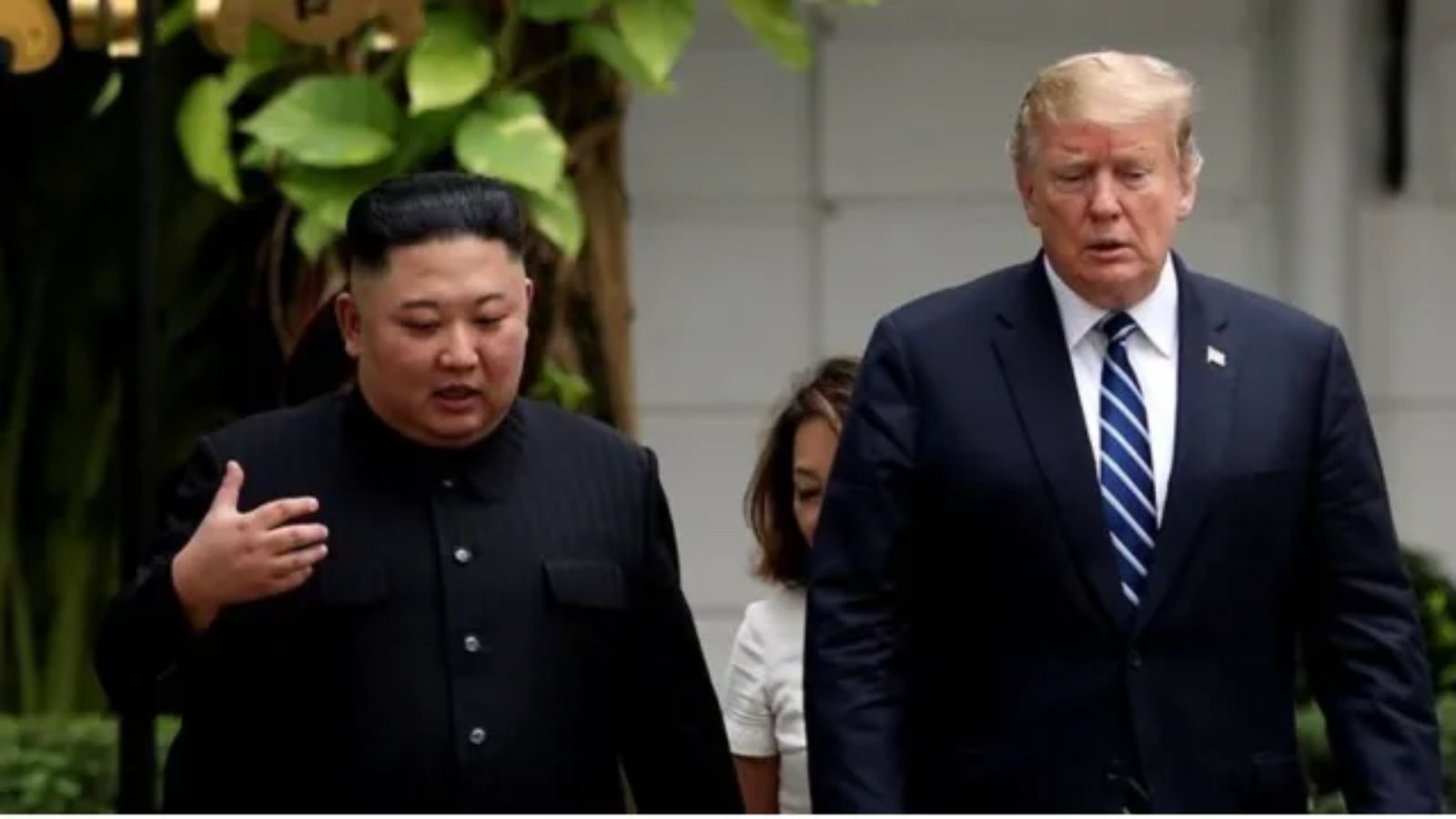
When Washington opens a direct backchannel to Pyongyang without South Korea in the room, officials in Seoul do not just feel snubbed. They feel exposed. For decades, the fundamental nightmare of South Korean foreign policy—known colloquially in diplomatic circles as "Korea passing"—has been the prospect of the United States cutting a bilateral deal with Kim Jong Un that protects the American mainland while leaving the South Korean peninsula under the shadow of tactical nuclear weapons.
That anxiety is flaring again. Whenever Washington signals a willingness to engage North Korea directly, the reassurance of the 70-year-old US-South Korea alliance collides with the cold, hard math of national self-interest. South Korea fears being sidelined not out of bruised diplomatic ego, but because a bilateral US-North Korea agreement risks trading away Seoul’s existential security for a temporary pause in Pyongyang’s intercontinental ballistic missile program.
To understand why a diplomatic breakthrough between Washington and Pyongyang triggers panic in Seoul, you have to look at the geography of deterrence, the history of broken promises, and the widening gap between what America needs and what South Korea cannot survive without.
The Anatomy of "Korea Passing"
Diplomacy on the Korean Peninsula has always operated on an asymmetrical axis. The United States is a global superpower separated from North Korea by the Pacific Ocean. South Korea is a middle power sitting thirty-five miles south of the Demilitarized Zone, with its capital city and economic engine squarely within range of thousands of conventional North Korean artillery tubes.
Because of that geographic reality, Washington and Seoul define a "successful" negotiation very differently.
For an American administration looking for a foreign policy win, neutralizing the threat to Los Angeles, Chicago, or New York is the primary objective. If Pyongyang agrees to freeze its intercontinental ballistic missile (ICBM) testing and cap its production of fissile material, Washington can claim it has taken the immediate nuclear threat to the American homeland off the table.
For Seoul, that same deal is a catastrophe.
North Korea does not need an ICBM to destroy South Korea. It already possesses an arsenal of short-range ballistic missiles, cruise missiles, and super-large multiple rocket launchers capable of saturating South Korean air defenses in minutes. More critically, Pyongyang has spent the past several years aggressively developing tactical nuclear weapons—smaller, battlefield-ready warheads specifically designed to strike South Korean airfields, ports, and command centers in the opening hours of a conflict.
If the United States signs an arms control agreement that freezes long-range missiles while tacitly accepting North Korea as a de facto nuclear power with a regional arsenal, Washington gets safety. Seoul gets permanent nuclear blackmail.
The Ghosts of Past Summits
South Korean diplomats have long memories. They remember the 1994 Agreed Framework, the Six-Party Talks of the 2000s, and the theatrical summits of 2018 and 2019 in Singapore and Hanoi. In each cycle, whenever Washington took the lead in direct negotiations, Seoul found itself reduced to a spectator waiting for readouts from American envoys.
During the 2018-2019 diplomatic sprint, the South Korean government initially acted as an eager matchmaker, facilitating meetings between Washington and Pyongyang. Yet once the two leaders sat across from each other, Seoul’s leverage evaporated. Pyongyang quickly realized it had no reason to negotiate with South Korea when it could speak directly to the commander-in-chief of the world’s only superpower. North Korean state media mocked Seoul as a "meddlesome mediator," and inter-Korean diplomacy collapsed entirely once the US-North Korea track stalled.
The lesson burned into the institutional memory of South Korea’s Ministry of Foreign Affairs was unmistakable. Once Washington and Pyongyang begin talking one-on-one, South Korea loses control over its own fate.
The Strategic Disconnect Between Washington and Seoul
The current friction is not merely a personality clash between leaders or a temporary failure of diplomatic coordination. It is a structural divergence in threat perception that has been widening for a decade.
The United States views the Korean Peninsula through the lens of global non-proliferation and great power competition. Washington’s primary strategic bandwidth is consumed by managing rivalry with China, containing Russian aggression in Europe, and maintaining stability in the Middle East. In that crowded strategic picture, a quiet Korean Peninsula—even one with a nuclear-armed North—is preferable to a crisis that pulls American aircraft carriers and troops away from the Taiwan Strait.
South Korea has no other theater. North Korea is not one item on a global checklist; it is the sole existential threat to the South Korean state.
Consider the mechanics of extended deterrence, the core promise of the US-South Korea alliance. Extended deterrence means the United States pledges to use its full range of military capabilities, including nuclear weapons, to defend South Korea as if it were American territory. It is a psychological bargain built entirely on credibility.
That credibility faces a brutal test the moment North Korea acquires the ability to strike the American mainland with a nuclear warhead. The classic Cold War question—would an American president really trade Seattle for Seoul?—is no longer an academic thought experiment in South Korean policy circles. It is the central question driving South Korean defense planning.
When Washington reaches out to Pyongyang unilaterally, it inadvertently feeds the suspicion in Seoul that America is looking for an off-ramp. South Korean officials worry that a bilateral US-North Korea dialogue could lead to:
- Sanctions relief without denuclearization: Washington easing economic pressure on Pyongyang in exchange for a testing moratorium, stripping away the primary non-military leverage Seoul has to compel North Korean restraint.
- Reductions in joint military exercises: Scaling back US-South Korea readiness drills as a goodwill gesture to keep Pyongyang at the table, which degrades the combined military's ability to fight together.
- Troop posture adjustments: Introducing the presence of the 28,500 US service members stationed in South Korea as a bargaining chip in broader security guarantees demanded by Kim Jong Un.
None of these outcomes require a formal betrayal by Washington. They can happen incrementally, concession by concession, in pursuit of a diplomatic breakthrough that looks reasonable from seven thousand miles away.
Pyongyang’s Playbook for Splitting the Alliance
Kim Jong Un understands this dynamic intimately. North Korean foreign policy has always operated on a simple, ruthless principle: drive a wedge between Washington and Seoul, extract concessions from the Americans, and isolate the South Koreans.
By designating South Korea as its "primary foe and invariable principal enemy" and formally abandoning the decades-old policy of peaceful unification, Pyongyang has codified this strategy. North Korea is no longer pretending that inter-Korean dialogue matters. Its entire diplomatic architecture is geared toward forcing the United States to deal with it as a peer nuclear state.
When Washington signals openness to talks without preconditions, Pyongyang reads it as validation. It confirms the North Korean leadership’s belief that building a credible nuclear deterrent works—not just to prevent an invasion, but to compel the United States to bypass its own treaty ally.
The Russia Factor
Complicating matters further is Pyongyang’s deepening military alignment with Moscow. By supplying Russia with millions of artillery shells and ballistic missiles for its war in Ukraine, North Korea has broken out of its diplomatic isolation and secured vital inflows of food, fuel, hard currency, and potentially advanced military technology.
This new geopolitical lifeline changes the negotiating math. Kim Jong Un is no longer negotiating from a position of economic desperation. If he engages with Washington, he will do so from a position of perceived strength, demanding nothing less than recognition as a nuclear weapons state and the dismantling of the US-led sanctions regime.
For Seoul, watching Washington contemplate outreach to a regime actively arming Russia—while Russia pledges mutual defense assistance to Pyongyang—feels like entering a high-stakes poker game where the rules have been rewritten behind closed doors.
The Nuclear Whisper in Seoul
The direct consequence of Seoul’s fear of being sidelined is a quiet but profound shift in South Korean domestic politics. For years, the idea of South Korea developing its own nuclear weapons was confined to fringe nationalist commentators. Today, it is discussed openly by mainstream lawmakers, defense analysts, and former government officials.
Public opinion polls in South Korea consistently show strong majorities—often exceeding 70 percent—in favor of an independent nuclear arsenal.
The logic among proponents in Seoul is brutally straightforward. If the United States is willing to negotiate directly with North Korea over Seoul’s head, and if America’s nuclear umbrella cannot be guaranteed with absolute certainty, then South Korea—an advanced industrial democracy with world-class civilian nuclear power infrastructure—must secure its own deterrent.
Washington is acutely aware of this sentiment. In recent years, the US has attempted to quell South Korea's nuclear ambitions by offering deeper institutional involvement in nuclear planning, such as the Nuclear Consultative Group (NCG), and by increasing the visibility of strategic assets like nuclear-armed submarines making port calls in Busan.
Yet those reassurances are fragile. Every time an American administration hints at bilateral outreach to Pyongyang without prior, lockstep coordination with Seoul, it undermines its own non-proliferation efforts. It tells South Korean strategists that their security remains subject to the shifting political winds in Washington.
What Real Coordination Actually Requires
The tension between Washington and Seoul is not unmanageable, but smoothing it over with standard diplomatic talking points about an "ironclad alliance" no longer works. The stakes are too high, and the weapons on the peninsula are too fast.
If the United States intends to pursue diplomatic engagement with North Korea, preventing a crisis of confidence in Seoul requires strict guardrails rather than vague promises of consultation.
First, Washington must reject the concept of a "nuclear freeze" that leaves North Korea’s short-range missile and tactical nuclear capabilities intact. Any arms control framework that fails to address the weapons specifically aimed at South Korea is not a peace deal; it is a transfer of risk onto an ally.
Second, diplomacy cannot be compartmentalized. Trilateral or bilateral tracks with Pyongyang must be explicitly linked to progress in inter-Korean risk reduction. Allowing Kim Jong Un to freeze out Seoul while chatting with Washington rewards Pyongyang’s hostility and legitimizes its division of the alliance.
Finally, transparency has to mean joint strategy formulation before outreach happens, not post-meeting briefings after the fact. In diplomacy, if you are not at the table, you are on the menu. South Korea has spent seventy years building a prosperous, democratic nation under the constant threat of annihilation. It will not quietly accept a backseat while Washington and Pyongyang decide what the future of the Korean Peninsula looks like.


