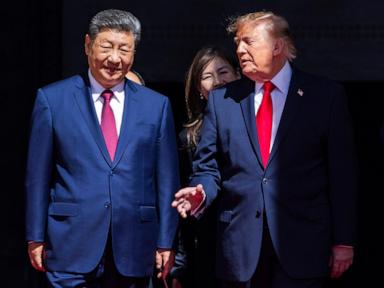
Ambassadors are paid to massage reality, not to manufacture geopolitical earthquakes on morning television. Yet when United States Ambassador to China David Perdue casually remarked that President Donald Trump had asked Chinese President Xi Jinping if Beijing wanted to buy American weaponry, he did more than breach protocol. He shattered a foundational taboo that has governed the Pacific theater for nearly four decades.
The fallout was swift. The White House scrambled to neutralize the shockwaves, issuing categorical denials while the President himself claimed the ambassador must have been talking about Taiwan. For a different view, consider: this related article.
Official disavowals aside, the episode laid bare the transactional undercurrents steering modern American foreign policy. When defense hardware is openly discussed as a potential bargaining chip rather than an ideological red line, the traditional architecture of great-power competition starts to groan under its own weight.
To understand why Perdue’s blunder caused immediate panic in national security circles, one must examine the absolute firewall that has separated the Pentagon from the People’s Liberation Army since the late Cold War. Following the normalization of relations and the passage of statutory restrictions, direct lethal technology transfers to Beijing were locked away behind an impenetrable legal wall. This was not merely about export controls. It was about preventing the technological cross-pollination of systems that could eventually be deployed against American carrier strike groups in the South China Sea. Further insight regarding this has been published by Associated Press.
When a handpicked envoy suggests that this red line is negotiable over a summit handshake, it signals a shift from grand strategy to real estate diplomacy.
The underlying friction stems from a White House that views every bilateral relationship through a commercial prism. In this worldview, a deficit is a personal insult, and a multi-billion-dollar military contract is just another ledger entry designed to correct trade imbalances. But hardware sales to a strategic competitor are not standard commercial transactions. They carry embedded intelligence, software vulnerabilities, and strategic signaling value.
Offering advanced military gear to Beijing—even hypothetically—undermines the entire deterrence posture Washington has spent billions constructing alongside regional partners like Japan, Australia, and Taiwan.
Speaking of Taipei, the timing of the ambassador's revelation could not have been more sensitive. Just months prior, the administration paused a major fourteenth-billion-dollar weapons package destined for Taiwan, explicitly labeling the delay a negotiating tool for broader trade talks with Beijing.
When the primary deterrent material meant for a self-governing democracy is treated as leverage, allies take notice. Taipei’s planners are forced to recalculate their security guarantees based on the whims of a transactional executive.
The denial issued by Washington was meant to reassure nervous allies in the Indo-Pacific that foundational policies remain intact. Yet the damage is already done. Foreign ministries from Tokyo to Canberra do not evaluate American commitments based on boilerplate press releases issued by spokespersons doing damage control. They evaluate them based on unscripted slip-ups that reveal the internal monologue of the administration.
If a senior envoy believes that offering offensive or defensive systems to China is a plausible conversation starter for a bilateral summit, it means the taboo has already been broken inside closed-door strategy sessions.
The diplomatic cleanup will take months, but the strategic confusion will linger much longer. Beijing now knows that Washington views its military supply chains as flexible instruments of a broader economic deal. That realization changes how future crises will be managed, how defense budgets in contested zones will be allocated, and how seriously adversaries will take American security commitments.
The official line is that no weapons will ever be sold to China. The reality is that the boundary between ally and adversary is being redrawn in real-time, one unscripted comment at a time.