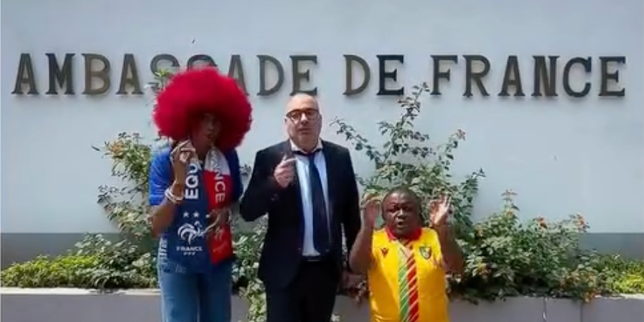
State-sponsored communication functions under a strict operational constraint: message alignment must survive cross-cultural translation without structural degradation. When a diplomatic mission releases visual media that triggers an immediate public backlash, the failure rarely stems from a single poorly worded phrase. Instead, it exposes a systemic breakdown in risk assessment, audience segmentation, and institutional quality control. The resurgence of a controversial promotional video originating from the French embassy in the Republic of the Congo offers a clean diagnostic case study for examining how state communication strategies fail when they ignore local political dynamics and perceptual asymmetries.
Diplomatic outreach operates on the assumption of shared cultural norms between the sending state and the host population. In post-colonial environments, this assumption introduces high operational vulnerability. The friction generated by historical power imbalances means that any soft-power initiative from a Western diplomatic mission is subject to intense scrutiny. When state communication minimizes or misjudges this sensitivity, it triggers immediate resistance.
To deconstruct the mechanism of this failure, we must examine the intersection of institutional messaging, recipient-state socio-political context, and the feedback loop of digital media distribution.
The Mechanics of State Communication Breakdown
Diplomatic missions maintain dedicated public diplomacy units designed to project influence, foster cultural ties, and maintain bilateral goodwill. However, the internal incentive structure of these units typically prioritizes output volume over structural vetting.
The production pipeline for a standard embassy promotional campaign follows a predictable path:
- Conceptualization by communications personnel influenced by domestic preferences of the sending country.
- Outsourcing or internal execution without localized focus groups representing the full spectrum of the host population.
- Approval via a hierarchical chain of command where career diplomats assess political safety rather than audience resonance.
- Digital deployment on platforms where algorithmic amplification favors sensational reactions over nuanced intent.
In the case of the French embassy video in Brazzaville, the content attempted to lean into a lighthearted or universally relatable theme. Yet, the framing ignored the asymmetric power dynamic inherent in bilateral relations. What the creators likely intended as an exercise in charm or relatability was received by the local public as patronizing or tone-deaf.
This perceptual gap exposes a foundational error in audience segmentation. Public diplomacy must account for multiple distinct strata within the host nation: the political elite, urban youth, intellectual classes, and marginalized populations. A message optimized for one group can easily alienate another. When a campaign lacks granular audience modeling, it creates a zero-sum communication failure where the sender loses credibility across all demographics simultaneously.
The Cost Function of Reputational Damage in Foreign Service
In corporate strategy, brand equity translates directly to market share and valuation stability. In international relations, institutional credibility functions as diplomatic capital. Every diplomatic mission operates with a finite reserve of this capital. When a communications asset backfires, the entity incurs immediate and deferred costs.
The immediate cost is informational. The narrative shifts out of the control of the embassy's public relations apparatus and into hostile or cynical digital channels. Independent commentators, political opposition groups, and foreign competitors amplify the misstep, reframing a tactical communications error into a strategic indictment of foreign policy intentions.
The deferred cost is institutional friction. Future policy initiatives—ranging from educational exchanges and trade agreements to security cooperation—must clear a higher psychological and political barrier. Local stakeholders become primed to view subsequent diplomatic actions through a lens of skepticism.
Measuring the return on investment for soft power requires tracking this friction coefficient. Traditional metrics used by embassies, such as view counts, social media impressions, or event attendance, measure output rather than outcome. A video that generates high engagement driven by negative sentiment represents a net-negative return on diplomatic capital. The absence of a rigorous pre-testing framework ensures that embassies remain blind to these variables until public backlash forces a reactive posture.
Information Asymmetry and the Illusion of Control
A core vulnerability in modern statecraft is the persistence of top-down communication habits in a decentralized information ecosystem. Historically, embassies operated as gatekeepers of information between the capital and the host nation. The local media landscape was controllable, and narrative management relied on formal press releases and direct engagement with designated editors.
The digital transition dismantled this monopoly. Social media platforms collapse the distance between local reactions and international exposure within minutes. A video uploaded to an official channel can be archived, clipped, re-contextualized, and weaponized by actors entirely outside the sphere of diplomatic influence.
This shift alters the risk profile of every public-facing asset. State entities frequently fail to update their operational security protocols to match this reality. They treat digital platforms like broadcast television, assuming the audience sits passively absorbing the intended meaning. In practice, modern audiences act as active deconstructors who strip away intended messaging to interrogate the subtext, funding sources, and institutional biases of the sender.
When the French embassy video resurfaced, the outrage was not simply about the content of the clip itself, but about what the clip symbolized to a population navigating complex socio-economic realities. The underlying resentment toward perceived neo-colonial attitudes provides a high-voltage current that activates any dormant misstep by Western diplomatic posts. Ignoring this structural voltage is equivalent to building electrical infrastructure without grounding; a single surge destroys the system.
Re-Engineering Diplomatic Public Relations
To prevent structural communication failures, foreign ministries must overhaul their approach to informational risk management. The traditional model of relying on generalist diplomats to oversee specialized communications functions is obsolete.
A resilient public diplomacy framework requires three distinct structural adjustments:
First, implementation of decentralized red-teaming. Before any state-sponsored media asset goes live, it must be evaluated by a multidisciplinary panel specifically tasked with finding points of offense, historical blind spots, and misinterpretations. This team must include local experts who understand the granular nuances of the host country political lexicon.
Second, transition from output-based KPIs to sentiment-tracking frameworks. Diplomatic performance evaluations should penalize tone-deaf communication as severely as they penalize diplomatic protocol breaches. If the primary metric shifts from volume of content produced to net-positive sentiment retained, communications teams will naturally adopt a more cautious and rigorous pre-production process.
Third, adoption of rapid-response containment protocols. When an asset backfires, the standard bureaucratic reflex of silence or delayed damage control exacerbates the crisis. Modern information warfare requires institutional agility where unviable campaigns are retracted within hours, accompanied by transparent acknowledgments of misjudgment rather than defensive justifications.
The vulnerability exposed in Brazzaville is not an isolated incident, but a predictable output of legacy institutions attempting to navigate a high-speed, hyper-critical digital ecosystem with outdated tools. Until state ministries treat public diplomacy with the same analytical rigor applied to intelligence assessments or economic forecasting, these self-inflicted crises will continue to erode their strategic standing.
Implement a mandatory stress-testing protocol for all cross-border media assets that simulates worst-case reception across diverse socioeconomic demographics before authorization, tying digital communication clearance directly to regional risk assessment officers rather than internal public affairs staff.