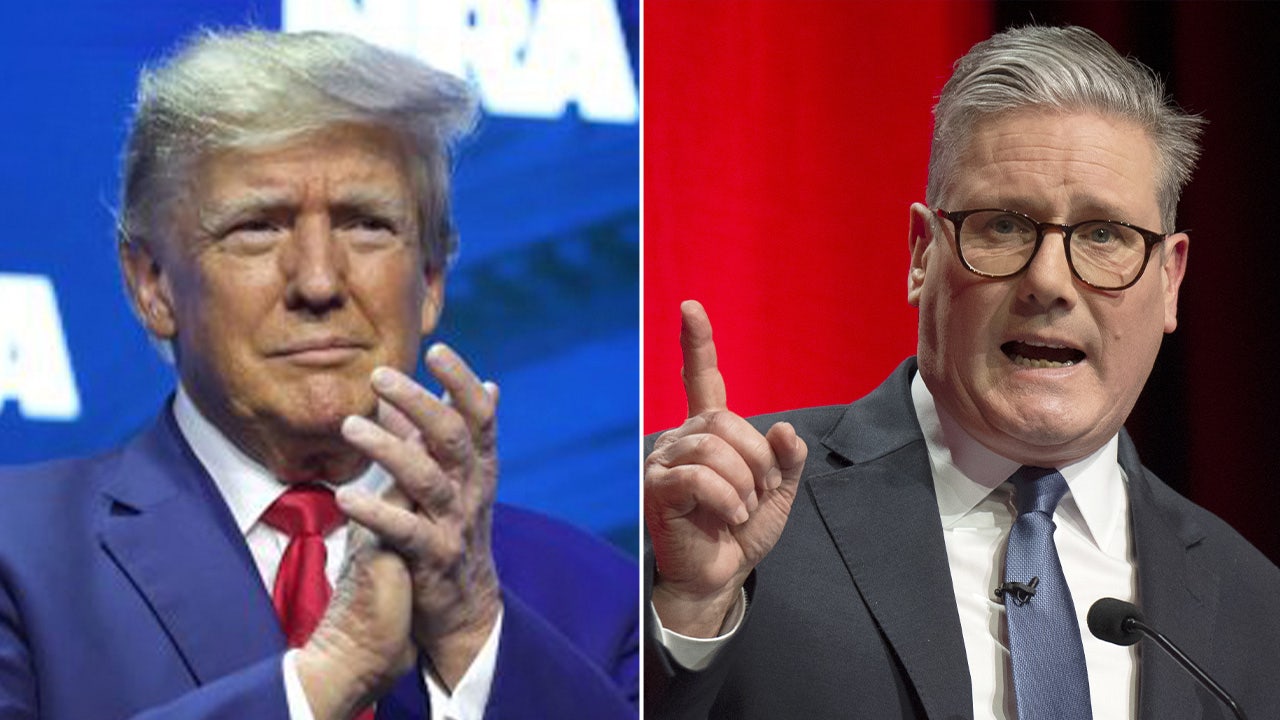
British Prime Minister Keir Starmer is currently trapped between a geopolitical hammer and a domestic anvil. While his government scrambles to lead a coalition of European and Middle Eastern allies in a desperate bid to prevent an all-out war between Israel and Iran, he is simultaneously dodging a barrage of criticism from across the Atlantic. Donald Trump’s public broadsides against the UK government aren't just social media noise; they represent a fundamental fracturing of the "Special Relationship" at the exact moment global stability requires it to be rock solid. Starmer’s team is learning the hard way that back-channel diplomacy with Tehran is easy compared to managing the ego of a potential future US president who views the current British leadership as an ideological enemy.
The crisis in the Middle East has reached a tipping point where traditional de-escalation tactics are failing. For weeks, UK Foreign Office officials have been engaged in "shuttle diplomacy," working with counterparts in France, Germany, and Jordan to establish a corridor of restraint. The objective is simple but the execution is grueling: convince Iran that a massive retaliatory strike against Israel will result in a regional conflagration that Tehran cannot win, while simultaneously urging Israel to limit its response to avoid a cycle of perpetual kinetic exchange.
The Fragile Architecture of British Mediation
Starmer is betting his international reputation on the UK’s ability to act as a bridge. Unlike the United States, which maintains a policy of maximum pressure and no direct diplomatic channels with the Iranian regime, the UK still holds a thin line of communication. This makes London a vital, if uncomfortable, intermediary.
However, this role is being undermined by a narrative of weakness being broadcast from Florida. Donald Trump has taken to his social media platforms to characterize Starmer’s approach as "feeble" and "subservient to radical interests." By attacking the British Prime Minister during a live security crisis, Trump isn't just venting; he is signaling to Middle Eastern hardliners that the West is divided. When the presumptive Republican nominee mocks the British government, he gives Tehran a reason to ignore London's warnings. Why listen to a Prime Minister who might be dealing with a hostile White House in less than a year?
The internal mechanics of this diplomatic effort are grueling. British intelligence suggests that Iran’s internal leadership is split. There are the pragmatists who fear the total destruction of their infrastructure, and the ideological hawks who believe they must restore "deterrence" regardless of the cost. Starmer’s strategy relies on empowering the pragmatists. Every time an American political figure of Trump’s stature suggests the UK is a "junior partner" with no real influence, the Iranian hawks gain ground.
Redefining the Special Relationship Under Duress
Historically, the UK has been the "bridge" between Europe and America. Under Starmer, that bridge is swaying. The tension isn't just about rhetoric; it’s about the fundamental philosophy of power. Starmer’s Downing Street believes in multilateralism—the idea that you solve a crisis by bringing everyone to the table, even the people you despise. Trump’s worldview is transactional and unilateral.
This creates a paradox for British civil servants. They are trying to coordinate with the Biden administration on sanctions and military posture, while simultaneously trying to "Trump-proof" their long-term foreign policy. It is a exhausting balancing act. If the UK leans too far into the Biden camp, they risk being frozen out of a future Trump administration. If they attempt to appease Trump, they lose their standing with European allies who are already skeptical of Britain's post-Brexit relevance.
The reality on the ground in the Middle East doesn't wait for election cycles. British assets in the region, including the Royal Air Force base in Cyprus (RAF Akrotiri), are on high alert. The UK’s involvement isn't just diplomatic; it is logistical. They are providing the intelligence and the "eyes in the sky" that help define where the red lines are. When Starmer speaks of de-escalation, he is backed by the threat of British military participation in defensive operations. Trump’s dismissal of this contribution as "insignificant" is a tactical error that emboldens regional actors to test those very red lines.
The Iranian Calculation and the Trump Factor
Tehran is a master at reading the room. They see a UK government struggling with a sluggish economy and a fractured political landscape. They also see a US political system that is effectively two different countries operating under one flag.
The Iranian Revolutionary Guard Corps (IRGC) benefits from Western discord. If they perceive that Starmer cannot deliver the United States to the negotiating table—or worse, that a future US president will tear up any deal Starmer helps broker—they have zero incentive to show restraint. The "Trump lash out" is more than a headline; it is a variable in the IRGC’s war-gaming.
British officials have been quietly briefing that their goal is a "contained response." They know Israel will strike back; they just need it to be a strike that Iran can "absorb" without feeling the need to launch a thousand drones. This requires a level of nuance that is frequently destroyed by the blunt-force trauma of Trump’s "America First" rhetoric.
Why the UK Stays in the Game
You might ask why the UK bothers. Why not step back and let the superpowers fight it out?
The answer is found in the Strait of Hormuz and the Suez Canal. The UK is more vulnerable to energy price spikes and shipping disruptions than the US. A full-scale war between Iran and Israel would send the British economy into a tailspin that no amount of domestic policy could fix. Starmer isn't just playing world leader for the sake of his ego; he is trying to prevent a domestic catastrophe.
- Energy Security: 12% of UK seaborne oil passes through contested waters.
- Insurance Costs: Global shipping insurance premiums have tripled in response to regional tensions.
- Refugee Flows: Regional instability leads to migration patterns that become political dynamite in Westminster.
The Strategy of Quiet Contradiction
Starmer’s response to Trump has been uncharacteristically disciplined. He has refused to engage in a public mud-slinging match. Instead, his cabinet is following a policy of "quiet contradiction." They continue to issue statements emphasizing the "enduring nature" of the US-UK bond while ignoring the personal insults.
This is a high-stakes gamble. It assumes that Trump respects strength but will tolerate a partner who stays focused on the mission. However, history suggests that Trump views silence as submission. Within the Labour party, there is a growing faction of MPs who believe Starmer should be more forceful in defending British sovereignty against American interference. They argue that by staying silent, Starmer looks like the very thing Trump accuses him of being: a leader without a backbone.
But Starmer is a lawyer by trade. He knows that in a high-stakes negotiation, you don't react to the noise in the gallery; you stay focused on the person across the table. In this case, the person across the table is the Iranian leadership, and the prize is a Middle East that doesn't explode into flames before the end of the month.
The Intelligence Gap and Public Perception
There is a massive disconnect between what the public sees and what is happening in the "Situation Room" at 70 Whitehall. The public sees a Prime Minister being bullied on the world stage. The reality is a highly sophisticated intelligence-sharing operation.
The UK’s GCHQ and MI6 provide a level of regional granularity that even the CIA relies on. This is the "hidden currency" of the Special Relationship. No matter what Trump says on a stage in Pennsylvania, the US military and intelligence community still need the UK. Starmer’s leverage isn't in his polling numbers; it’s in the data packets his agencies share with Washington every hour.
The danger is that political rhetoric eventually poisons the operational well. If the American political right continues to paint the UK government as an adversary, that intelligence sharing could become a point of contention in Congress. We are seeing the beginning of a world where partisan politics doesn't stop at the water's edge.
A Diplomatic Dead End or a New Path
The "Iran crisis" is a misnomer. It is a permanent state of tension that has merely entered an acute phase. Starmer’s attempt to de-escalate is not a one-time event; it is the new baseline for British foreign policy. He is trying to carve out a "Third Way" between the total isolationism of the American right and the sometimes-directionless multilateralism of the European Union.
It is a lonely position to hold. The allies he is working with, such as France’s Macron, are also facing domestic upheaval. The coalition is a "coalition of the wounded." They are all leaders fighting for their political lives at home while trying to prevent a global war abroad.
Trump’s attacks on Starmer serve a specific purpose: they define the UK as a failed state in the eyes of the "MAGA" movement. This makes it easier for a future administration to ignore British interests in favor of a purely transactional relationship. For Starmer, the task is to prove that Britain is still a "force multiplier." He has to show that the UK can do things the US cannot—like talking to the Iranians without losing face.
The Brutal Reality of the Modern Alliance
We are witnessing the end of the polite era of diplomacy. The idea that "politics stops at the water's edge" is a relic of the 20th century. In the 21st century, every foreign policy crisis is an extension of a domestic culture war.
Starmer’s struggle to manage the Middle East while under fire from the American right is the template for the next decade. There will be no more unified "West." There will only be shifting constellations of interests, held together by duct tape and desperate phone calls.
The Prime Minister’s success or failure won't be measured by whether Trump likes him. It will be measured by whether the missiles stay in their silos in Isfahan and Tel Aviv. If Starmer can keep the peace, the insults from Mar-a-Lago will be a footnote. If he fails, those insults will be the epitaph of the Special Relationship.
The UK must now decide if it wants to be a sovereign mediator or a satellite of a polarized Washington. There is no middle ground left to occupy.
Examine the specific intelligence-sharing protocols between the UK and the US to see if political rhetoric is actually slowing down the flow of data. ---