Archaeologists at the Pompeii Archaeological Park have shifted from brushes and trowels to neural networks to reconstruct the physical identity of a victim from the 79 AD eruption. This is not a simple artist’s sketch. By feeding craniometric data and DNA fragments into machine learning models, researchers have generated a hyper-realistic visualization of a middle-aged man trapped by the ash. This breakthrough moves beyond the hollow plaster casts that have defined the site for centuries, offering a direct, unsettling look at the people behind the catastrophe. While the technology provides a face for the nameless, it also triggers a fierce debate over the accuracy of digital reconstruction and the ethics of disturbing the dead for the sake of a high-resolution render.
Beyond the Plaster Shell
For over a century, our primary visual connection to the tragedy of Pompeii was the work of Giuseppe Fiorelli. His technique of pouring plaster into the voids left by decomposed bodies captured the final, agonizing moments of the victims. We saw the shapes, the poses, and the desperate shielding of faces, but we never saw the features. The plaster was a mask. It was a silhouette of a person, frozen in a state of permanent anonymity.
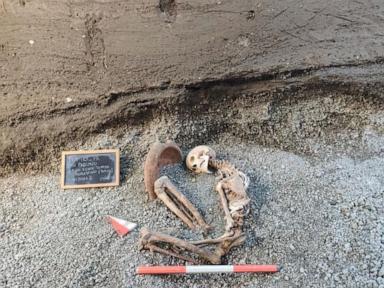
The recent push to use artificial intelligence changes the fundamental nature of how we interact with history. We are moving from the macro to the micro. Researchers took the skeletal remains of a male found in the "House of the Lovers" and subjected the skull to high-resolution 3D scanning. These scans mapped thousands of data points—the depth of the eye sockets, the bridge of the nose, the specific protrusion of the jawline.
This data acts as a biological blueprint. In the past, a forensic artist would use clay to estimate muscle and skin thickness based on averages. Now, algorithms trained on thousands of contemporary and ancient skull-to-soft-tissue datasets can predict facial morphology with a statistical precision that humans cannot match. The result is a face that feels lived-in. It has the uneven skin tone of a Mediterranean laborer and the structural wear of a man who survived five decades in a pre-industrial world.
The Algorithmic Bias of History
The reliance on technology brings an inherent risk that many observers choose to ignore. AI is not an objective window into the past. It is a mirror of the data it was fed. When we instruct a model to "reconstruct" a face, we are asking it to make a series of educated guesses about melanin, hair texture, and even emotional expression.
If the training data for these archaeological models is skewed toward modern European populations, the "Roman" face we see might look more like a 21st-century Italian than a citizen of a cosmopolitan, multi-ethnic empire. The Roman Empire was a massive, churning engine of migration. Pompeii was a port town. Its streets were filled with people from North Africa, the Levant, and Northern Europe.
There is a danger that we are using high-tech tools to create a sanitized, "expected" version of the past. If the AI predicts a certain nose shape or skin tone because that is what is most common in its database, we risk erasing the diversity that actually existed in the shadows of Vesuvius. We aren't just revealing a face; we are potentially inventing one that fits our modern aesthetic of what an ancient Roman "should" look like.
The DNA Conflict
The most accurate reconstructions are those that marry skeletal data with genomic sequencing. In this specific case, fragments of DNA recovered from the petrous bone—the densest part of the skull—offered clues about the victim’s ancestry and physical traits. This is where the science gets gritty.
Extracting viable DNA from a body that was essentially baked at several hundred degrees is an immense challenge. The heat often shears the DNA strands into useless bits. However, when a clean sample is found, it provides the "hex code" for the individual. It tells the researchers the likely color of the eyes and the curl of the hair.
When the AI integrates this genetic information with the 3D skull map, the margin for error shrinks significantly. We are no longer looking at a generic "Roman Man." We are looking at a specific individual with a specific genetic heritage. This level of detail is what separates this project from the CGI characters seen in big-budget documentaries. This is a forensic autopsy performed two millennia too late.
Technical Hurdles in the Ash
- Thermal Degradation: The extreme heat of the pyroclastic flow often warps bone structure, which can lead to "digital hallucinations" where the AI attempts to correct a deformity that was actually caused by the eruption itself.
- Incomplete Data: Most skulls are not found in perfect condition. Algorithms must "fill in the blanks" for missing fragments of the zygomatic bone or mandible, which can drastically alter the perceived weight and age of the face.
- Soft Tissue Variables: No amount of bone scanning can perfectly predict the shape of an earlobe or the thickness of a lip. These remain the "best guesses" of the software.
The Ethics of the Digital Ghost
There is something inherently voyeuristic about this process. These victims did not consent to have their remains digitized and displayed to millions of people on social media. In the museum world, there is an ongoing struggle over the display of human remains. Some argue that the plaster casts are acceptable because they are "artistic representations," while others believe the actual bones should be reburied.
By creating a hyper-realistic digital face, we are heightening the humanity of the victim, which paradoxically makes the display of their death even more complicated. When you see a skeletal hand, it is an object. When you see a face with pores, wrinkles, and a recognizable gaze, it is a person.
The administration at Pompeii argues that this technology is a tool for empathy. They believe that by putting a face to the tragedy, they make the history more accessible to a generation that is increasingly desensitized to traditional museum exhibits. It is a play for relevance in a digital-first economy. If a visitor can look into the eyes of a man who died two thousand years ago, they are more likely to care about the preservation of the site.
The Industrialization of Discovery
The use of AI at Pompeii is not limited to facial reconstruction. It is part of a broader, more aggressive strategy to manage the overwhelming amount of data the site produces. Thousands of fresco fragments, scattered like the world’s most complex jigsaw puzzle, are now being sorted by robotic arms and image-recognition software.
The "Re-Pair" project, for instance, uses robots to scan and match pieces of murals from the House of the Painters at Work. What would take a human archaeologist decades of painstaking labor now takes months. This is the industrialization of archaeology. We are moving away from the era of the lone scholar with a magnifying glass and into the era of the data scientist with a server farm.
This shift has profound implications for the labor market within the field. The skills required to be a top-tier archaeologist are changing. Knowing how to handle a trowel is still important, but knowing how to clean a dataset or tune a neural network is becoming the new standard. The "expert" of the future is someone who can mediate between the physical dirt and the digital cloud.
The Accuracy Trap
We must remain skeptical of the "definitive" nature of these reveals. The press releases often present these images as the final word on what a person looked like. In reality, they are one possible interpretation among many.
If we run the same skull data through three different AI models, we will likely get three different faces. One might emphasize the ruggedness of the jaw; another might soften the features based on a different set of assumptions about body fat percentage. The danger lies in the "CSI Effect"—the belief that technology provides a level of certainty that is beyond reproach.
In archaeology, certainty is a luxury. We are working with the scraps of a world that was largely destroyed. Every reconstruction is a narrative choice. By choosing to show this man as a weary, weathered individual, the researchers are telling a specific story about life in the Roman Empire. It is a compelling story, and one that is likely grounded in significant evidence, but it remains a story nonetheless.
The Future of the Past
The next step in this evolution is the integration of these digital personas into augmented reality environments. We are not far from a version of Pompeii where a visitor can wear a headset and see these reconstructed individuals walking the streets they once inhabited. You won't just see the ruins; you will see the crowd.
This is the ultimate goal of the "Digital Pompeii" initiative. It is the creation of a parallel, virtual city that exists alongside the physical ruins. It allows for a form of "non-destructive" tourism where the fragile environment is protected while the curiosity of the public is satisfied by high-fidelity digital proxies.
However, we must ask what is lost when we replace the mystery of the ruins with the certainty of a render. The power of Pompeii has always been in the silence of the ash and the gaps in our knowledge. By filling those gaps with pixels, we might be making the site more understandable, but we are also making it less haunting. We are trading the ghosts for avatars.
The reconstruction of the "House of the Lovers" victim is a technical marvel, a feat of data processing that would have been unthinkable twenty years ago. It proves that the earth still has secrets to give up, provided we have the processing power to extract them. But as we continue to peel back the layers of time with our algorithms, we should remember that a face is not just a collection of coordinates. It is the record of a life lived, and no matter how many teraflops we throw at a skull, some parts of that life will always remain in the dark.
The focus now turns to the thousands of other remains still waiting in the volcanic soil, each representing a data point in a grand, digital resurrection that shows no signs of slowing down. Archaeology has officially entered its post-human phase.