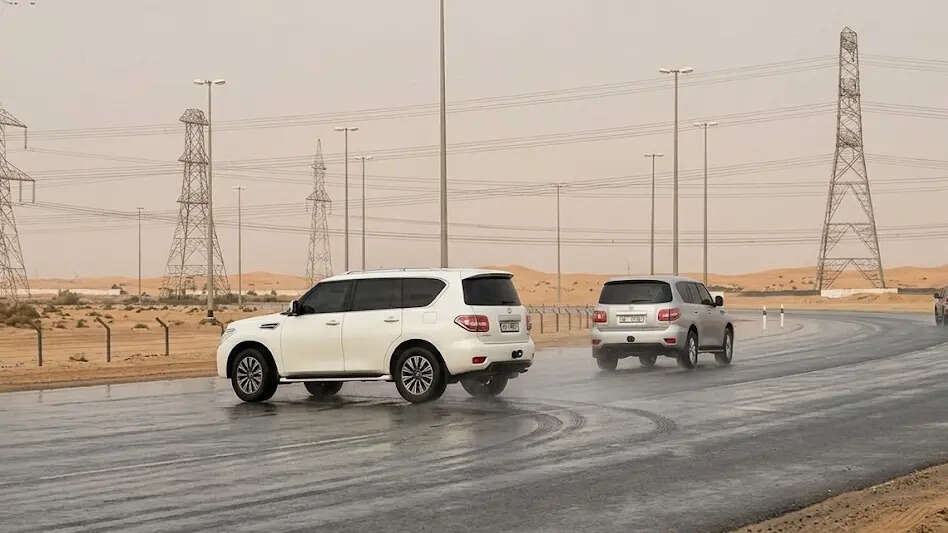
Rain in Dubai usually triggers a city-wide celebration. People rush to their balconies, cafes fill up, and social media turns into a gallery of gray skies and puddles. But for a specific group of drivers, a few seconds of "fun" just turned into a financial nightmare. Dubai Police recently proved they aren't playing around when it comes to wet-weather stunts. They seized a fleet of vehicles and slapped owners with Dh50,000 fines. If you think drifting in a rain-slicked parking lot is just harmless thrill-seeking, you're looking at a bill that costs more than many mid-range sedans.
It’s not just about the money. It's about a fundamental shift in how the city handles road safety during unstable weather. The authorities are tired of the same old story every time the clouds roll in. Reckless driving isn't a hobby. It's a public safety hazard.
Why the Dh50,000 Fine is Here to Stay
Most drivers in the UAE are familiar with standard speeding tickets. You go a bit over, you pay a few hundred dirhams, and you move on. This is different. The Dh50,000 fee isn't just a "fine" in the traditional sense; it’s the release fee required to get your car back after it’s been impounded for serious violations under Decree No. 30 of 2023.
Dubai Police recently released footage showing exactly why they're being so aggressive. The video shows SUVs and modified cars spinning in circles, losing control on slippery asphalt, and narrowly missing other motorists. When the ground is wet, the friction coefficient drops significantly. Your high-end tires don't matter as much as physics. A car weighing two tons becomes a sliding projectile the moment the driver decides to "show off."
The police targeted these specific individuals because their actions weren't accidental. This wasn't a hydroplaning incident where someone lost control due to a deep puddle. These were intentional stunts. The message is clear. If you treat public roads like a private racetrack during a storm, the city will take your car and your savings.
The Reality of Decree No 30
The legal framework behind these seizures isn't new, but its application during rainstorms is getting more frequent. Decree No. 30 was specifically designed to target "grave" traffic violations. This includes:
- Racing on public roads without permission.
- Driving in a way that endangers lives or property.
- Intentionally colliding with police vehicles.
- Reckless driving and drifting.
When the rain starts, the risk factor for all these behaviors triples. Visibility drops. Braking distances double. The police aren't just being "strict" for the sake of it. They're preventing the inevitable pile-ups that happen when one person decides to do a donut in the middle of a busy intersection. Honestly, if you're the one drifting while families are trying to get home safely in a storm, the fine feels pretty justified.
What Happens When Your Car is Seized
If you're caught performing these stunts, the process is swift. The police don't just give you a paper ticket and let you drive home. The vehicle is towed immediately.
Once your car is in the impound lot, the clock starts. You can't just pay a small fee to get it out. Under the updated laws, for these specific reckless acts, the release price is a flat Dh50,000. For many, that's a year's worth of rent or a significant portion of their salary. If the owner doesn't pay the fine within a certain timeframe—usually three months—the vehicle can be put up for public auction.
I've seen people think they can argue their way out of this by saying the road was empty or they "had control." It doesn't work. The cameras are everywhere. Dubai’s command and control center uses a massive network of AI-integrated sensors and high-definition cameras that can pick up a license plate even through heavy downpours. You're being watched long before the patrol car pulls you over.
Common Myths About Rain Driving in Dubai
People often get overconfident when the weather changes. Here are a few things I’ve heard on the ground that are flat-out wrong.
"My 4x4 can handle anything."
Wrong. Four-wheel drive helps you move, but it doesn't help you stop. On a wet road, an SUV’s weight actually works against it. The momentum makes it harder to steer out of a skid once you lose traction.
"The police won't see me in the dark and rain."
This is a massive mistake. Dubai’s "Ghiath" smart patrols are equipped with advanced night vision and 360-degree cameras designed specifically to track vehicles in low-visibility conditions. They see you better than you see them.
"It’s just a bit of water."
The first ten minutes of rain are the most dangerous. That's when the water mixes with the oil, dust, and fuel residue on the road surface. It creates a slick film that is essentially like driving on ice. Experienced drivers know this. Stunt drivers ignore it.
The True Cost of a Viral Video
Let's talk about the motivation behind these stunts. Most of the time, it's for social media. People want that perfect clip of a desert-ready Nissan Patrol drifting through a flooded street to post on TikTok or Instagram.
Think about the math for a second. Is a 15-second video worth Dh50,000? Is it worth a permanent mark on your traffic record that will skyrocket your insurance premiums for years? In 2026, insurance companies are more connected than ever. A "reckless driving" impoundment on your record means you'll likely pay double or triple the standard rate for your next policy—if they even agree to cover you at all.
Beyond the money, there's the social cost. Dubai thrives on its reputation for safety. When videos of reckless driving go viral, the authorities see it as a direct hit to the city's image. That's why they respond with such public and heavy-handed enforcement. They want the deterrent to be as visible as the crime.
How to Stay Safe and Keep Your Cash
It’s easy to avoid a Dh50,000 fine. Just drive like a normal person. But if you find yourself caught in one of Dubai's sudden heavy downpours, here’s what you actually need to do to stay out of trouble with both the law and physics.
Slow down immediately. This seems obvious, but people often try to "outrun" the storm. Don't. Speed limits are for dry conditions. When it's pouring, doing 100km/h in a 120km/h zone is still too fast.
Increase your following distance. You need at least three times the normal space between you and the car in front. If they slam on their brakes and you're too close, you'll slide right into their bumper, regardless of how good your brakes are.
Keep your lights on, but stay off the hazards. This is a huge pet peeve for Dubai Police. Hazard lights are for stopped vehicles. If you're moving, keep your regular headlights on so people can see your position. Using hazards while driving makes it impossible for the person behind you to know if you're braking or turning.
Check your tires before the season starts. Smooth tires are a death sentence on wet roads. If your tread is low, you'll hydroplane at even moderate speeds. The police often check tire conditions during rain-related stops. If your tires are bald, that's another fine added to your bill.
Stay away from "Wadi" areas and low-lying ground. While the city’s drainage has improved massively, some areas still flood. Driving through deep water can stall your engine or, worse, sweep your car away. If the police have to rescue you because you ignored a "Road Closed" sign, expect a very unpleasant conversation afterward.
The next time you hear thunder over the Burj Khalifa, enjoy the view. Take a walk if it’s safe. Grab a coffee. Just don't try to be a hero on the road. The Dubai Police are watching, and they have a very expensive receipt waiting for anyone who thinks the rules don't apply when it rains.
Keep your hands on the wheel and your car out of the impound lot. It’s the smartest financial decision you’ll make all year.