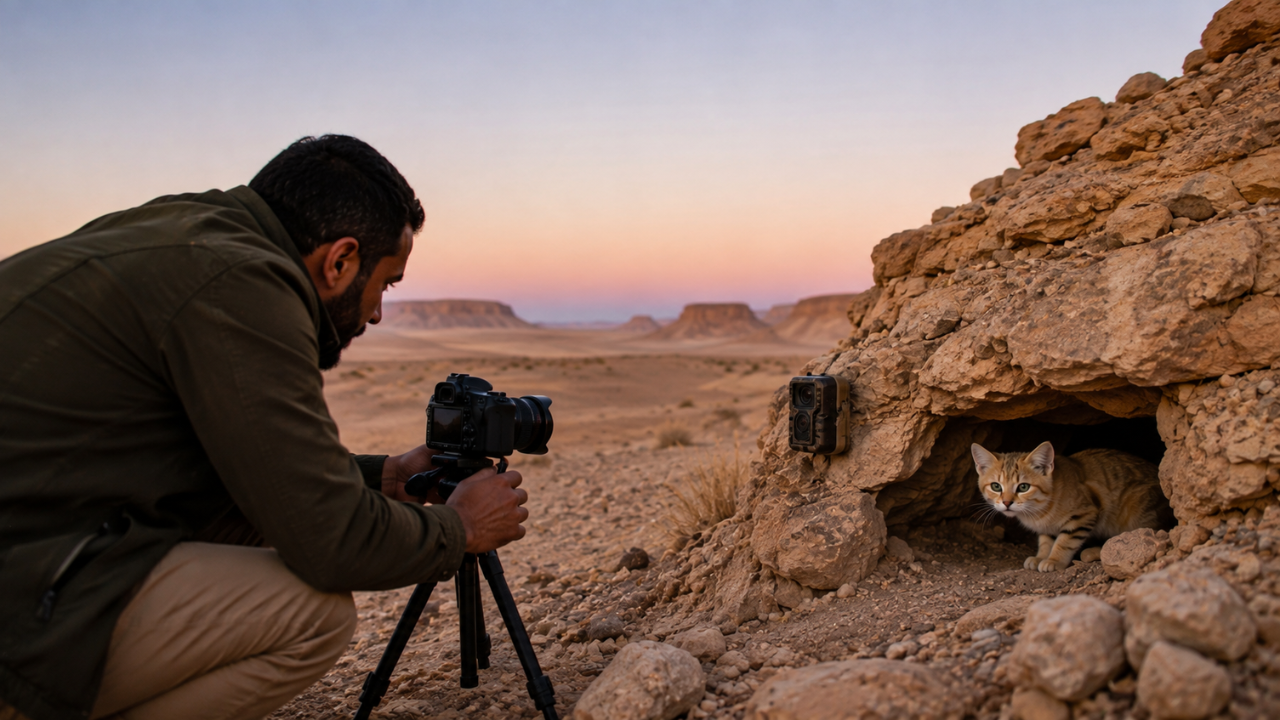
In the vast, shifting expanse of the Libyan Sahara, a solitary photographer accomplished what academic consensus insisted was impossible. Mohammed Almuntasir spent years capturing shadows in the night, only to be told by the scientific community that his targets were phantoms. They claimed the sand cat—a small, elusive predator perfectly adapted for the harshest terrain on Earth—was absent from the country. In 2017, an 18-second clip uploaded to YouTube silenced the skeptics. It was not a grand cinematic production, but a humble look at a creature sheltering under a desert shrub. That brief moment of digital evidence triggered an eight-year investigation that fundamentally altered our understanding of North African biodiversity.
The professional dismissal of Almuntasir’s earlier claims highlights a recurring tension between field observations and institutional records. For researchers who rely on rigorous, repeatable data sets, anecdotal evidence from local enthusiasts often fails to meet the threshold of scientific proof. Almuntasir, who had observed these animals during his nocturnal treks, lacked the specialized equipment required to produce a "verifiable" image. He was a witness without a lens, a man documenting a secret the world refused to acknowledge. His eventual success serves as a sharp reminder that the absence of evidence is not evidence of absence. Recently making news recently: Why Restoring Federal Gun Rights for Thirty Million Americans is a Bureaucratic Illusion.
When zoologist Firas Hayder first viewed the footage, his reaction was one of pure disbelief. He knew the biological stakes. A confirmed sighting in the Al-Hamada Al-Hamra region meant the species had maintained a foothold in a country where it was presumed extinct or nonexistent. This was not merely an update to a wildlife checklist; it was the identification of a population stronghold. Hayder and Almuntasir began an unlikely partnership, bridging the gap between local knowledge and formal zoological documentation.
This collaboration moved well beyond a single video. It evolved into a systematic survey of the desert floor. Hayder provided the training, teaching Almuntasir to log GPS coordinates and apply standardized recording techniques. In return, Almuntasir contributed his intimate familiarity with the landscape and the oral histories shared by the Tuareg communities. The result of this work is a growing database, now containing over three dozen confirmed sightings, with a significant cluster located in the remote Wadi Armet valley near the Algerian border. Further details regarding the matter are detailed by The Washington Post.
The physical reality of studying these animals is punishing. Sand cats are masters of evasion, utilizing fur-covered paws to traverse burning dunes without leaving deep imprints. Their coat mirrors the exact hue of the surrounding sand, rendering them nearly invisible even when one is standing a few meters away. They are strictly nocturnal, emerging from burrows only when the temperature drops, which makes traditional daylight fieldwork ineffective. Many of the sightings documented during the eight-year project were the result of exhausting, days-long tracking efforts through terrain that remains largely unmapped.
Beyond the logistical hurdles, the research team encountered a harsh reality regarding the environmental pressures facing these animals. Local markets have historically posed a significant threat, with individuals captured and sold as exotic pets. Hunters have also contributed to the decline, sometimes killing them accidentally during other activities. The presence of the sand cat is a fragile indicator of the desert’s health; as climate patterns shift and human encroachment into these remote areas increases, the cat’s survival is not guaranteed.
The skepticism Almuntasir faced early on reflects a deeper issue in wildlife conservation. Science often prizes the curated study over the messy, inconsistent reality of field reports. While institutional skepticism protects against misinformation, it can also create blind spots. If the community had not been willing to re-evaluate its stance based on the 2017 footage, these populations might have remained unmonitored and unprotected indefinitely. The "ghost cat" nickname is fitting not just for the creature’s camouflage, but for the status it held in scientific literature—a subject that was whispered about but never seen.
The success of this project proves that citizen science, when paired with professional guidance, can fill massive gaps in our environmental records. By training local observers like Almuntasir, researchers gain eyes on the ground in areas that are otherwise inaccessible due to geography or political instability. This is a model for future efforts in under-documented regions. We are only just beginning to map the true extent of these desert strongholds.
As the data continues to grow, the focus shifts toward sustainability. Conservation is not a singular achievement but a constant struggle against habit loss and illicit trade. The documentation of these cats is the first step, not the finish line. The challenge ahead lies in protecting the vast, rugged corridors where these animals migrate, ensuring that this population does not return to the status of a myth. The desert is not empty, and the evidence is finally catching up to the truth that local observers knew all along. There are more secrets buried in these dunes, waiting for the right moment to be brought into the light.


