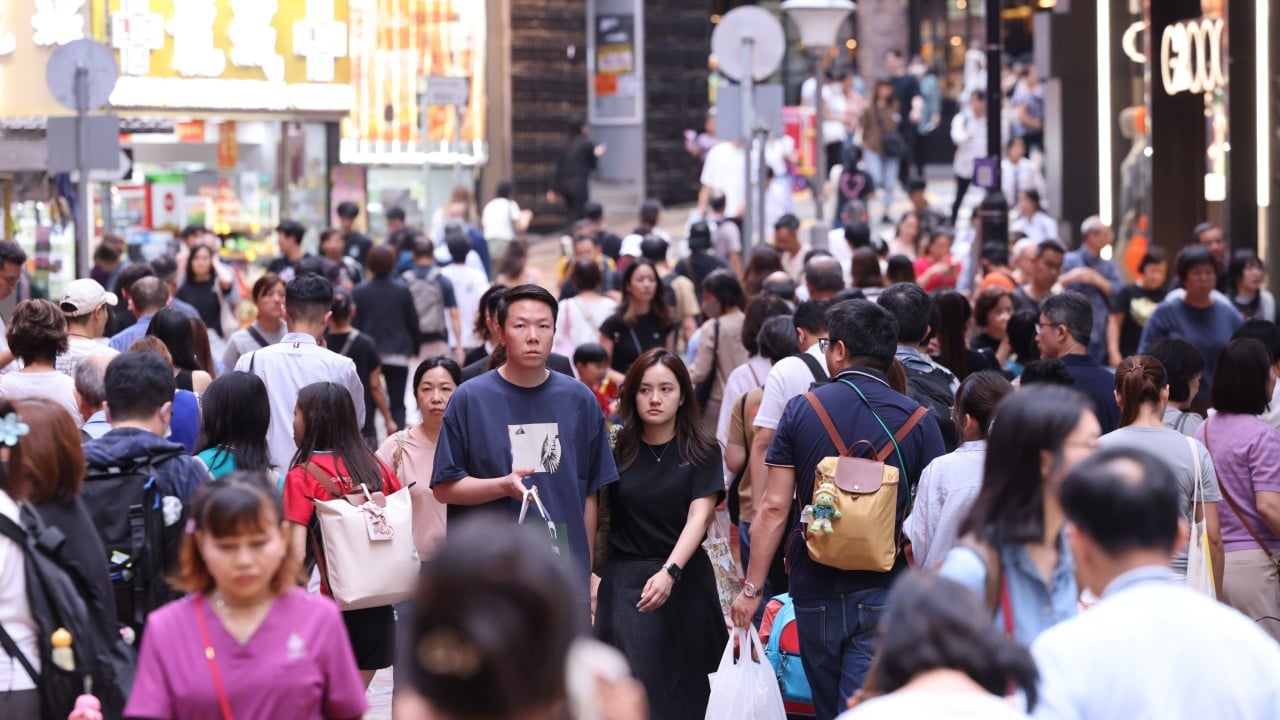
The recent 5.9% year-on-year expansion in Hong Kong’s Gross Domestic Product (GDP) represents the most significant growth trajectory since 2021, yet the headline figure masks a complex interplay of low-base effects and shifting sectoral dependencies. To understand the sustainability of this recovery, one must isolate the three primary drivers: the resumption of cross-border mobility, the stabilization of domestic consumption through fiscal intervention, and the diverging performance of the external trade sector. This growth is not a uniform acceleration but rather a corrective rebound following years of mobility-restricted stagnation.
The Base Effect and Statistical Normalization
Growth figures are inherently relative. The 5.9% surge is magnified by the contractionary environment of the previous year. When assessing the health of a high-density service economy like Hong Kong, the Year-on-Year (YoY) metric often obscures the underlying output gap. The economy is currently in a phase of Output Gap Compression, where the jump in percentage points reflects a return to a pre-disruption baseline rather than the creation of new, organic productive capacity.
This statistical phenomenon is particularly visible in the tourism and retail sectors. During periods of restricted entry, these sectors operated at a fraction of their theoretical maximum. The removal of barriers creates an immediate, vertical spike in activity that registers as explosive growth. However, this growth rate is mathematically destined to taper as the "catch-up" phase concludes and the economy hits the ceiling of its current structural constraints.
The Bifurcation of the Service Export Model
Hong Kong’s recovery is heavily skewed toward service exports, specifically those tied to the travel and transport sectors. The 5.9% growth is largely a product of a Re-open Beta, where the sudden influx of visitors generates high-velocity transactions in high-street retail and hospitality.
Inbound Tourism as a Liquidity Injection
The surge in visitor arrivals functions as a direct injection of external liquidity into the domestic economy. This is categorized by:
- A Shift in Spending Profiles: While visitor volume has returned significantly, the average spend per capita has transitioned from luxury-heavy consumption to experiential and dining-focused outlays. This shift impacts the margin profile of the retail sector, requiring higher volume to maintain previous profit levels.
- The Labor Supply Constraint: The rapid scaling of the service sector has exposed a critical bottleneck in labor availability. As demand spiked, the inability to scale the workforce at the same velocity led to wage push inflation within the hospitality sector, potentially capping the net economic gain of the volume increase.
Financial Services and the Interest Rate Lag
While tourism thrives, the financial services sector—a traditional pillar of the Hong Kong economy—faces a different set of variables. The high-interest-rate environment, dictated by the Hong Kong Dollar’s peg to the U.S. Dollar via the Linked Exchange Rate System (LERS), creates a dual-pressure system. While it attracts capital searching for yield, it simultaneously suppresses the local property market and increases the cost of capital for domestic SMEs. This creates a drag on the broader GDP figure that the 5.9% headline partially compensates for.
The Resilience of Private Consumption Expenditure
Private consumption grew by a staggering 13% during this period, acting as the internal engine of the recovery. This was driven by two distinct mechanisms:
- The Wealth Effect Neutralization: Despite a lukewarm property market, the government’s consumption voucher schemes and targeted fiscal support provided a psychological floor for consumer spending. This prevented a "balance sheet recession" at the household level, where consumers typically cut spending to offset declining asset values.
- Pent-up Demand Release: Domestic residents, having limited their discretionary spending for several years, engaged in a concentrated cycle of consumption. This is a finite driver; once the immediate desire for travel and high-end services is satiated, consumption patterns will likely revert to a more modest growth rate aligned with real wage increases.
External Trade and Global Demand Volatility
The external goods trade remains the most significant risk factor to Hong Kong’s economic stability. While services are booming, the export of goods has faced headwinds due to a cooling global manufacturing cycle and shifting supply chains.
The Transit Hub Vulnerability
Hong Kong’s role as a re-export hub means its GDP is highly sensitive to the China-Global Trade Velocity. As global demand for electronics and consumer goods softened in major Western markets, the throughput via Hong Kong’s ports and airports faced downward pressure. The 5.9% growth was achieved in spite of this drag, suggesting that the domestic and service-export engines were performing exceptionally well to overcompensate for the shortfall in physical goods trade.
The Inventory Cycle Adjustment
Global retailers have been moving through an inventory destocking phase. This reduction in new orders directly impacts the trade and logistics sector, which accounts for a substantial portion of Hong Kong’s employment. The stabilization of this cycle is a prerequisite for the next phase of economic expansion. Without a recovery in goods trade, the economy remains overly reliant on the volatile tourism sector.
Capital Investment and the Fixed Capital Formation Gap
A concerning data point within the growth narrative is the volatility in Gross Domestic Fixed Capital Formation. While machinery and equipment investment saw some recovery, the construction sector remains cautious. The reasons for this investment hesitancy are structural:
- Borrowing Costs: With the Prime Rate remaining elevated, the internal rate of return (IRR) on new infrastructure or property projects is harder to justify.
- Policy Uncertainty: Investors are closely monitoring the implementation of new land-use policies and the integration of the Northern Metropolis project. Until there is more clarity on the execution timeline of these mega-projects, private capital may remain on the sidelines.
The Role of Government Expenditure
Government spending showed a slight contraction during this period, reflecting a pivot from emergency pandemic-era outlays to a more disciplined fiscal stance. This is a necessary transition to maintain the long-term health of the fiscal reserves, but it means that the private sector must now carry the full burden of driving growth. The transition from a "state-supported" recovery to a "market-led" expansion is the current inflection point for the city.
Strategic Divergence in the Pearl River Delta
The growth of Hong Kong must be viewed through the lens of its integration with the Greater Bay Area (GBA). The 5.9% growth is partly a result of the Synergistic Catch-up occurring within the region. As Shenzhen and Guangzhou normalize their industrial output, the demand for Hong Kong’s professional services—legal, accounting, and specialized financing—rebounds.
However, this integration also introduces a "Leakage Factor." As cross-border travel becomes more efficient, a portion of Hong Kong’s domestic consumption is being redirected to the mainland, where the cost of services is lower. This creates a competitive pressure on Hong Kong’s local service providers to move up the value chain or risk losing the low-to-mid-tier consumer segment to regional competitors.
The Interest Rate Transmission Mechanism
Under the LERS, the Hong Kong Monetary Authority (HKMA) must track the U.S. Federal Reserve’s movements. This creates a situation where Hong Kong’s monetary policy is "imported," regardless of whether it suits the local economic cycle. Currently, the economy is in a Disinflationary Growth phase. Inflation remains relatively contained compared to Western economies, but the high cost of debt acts as a persistent brake on the property market and capital expansion.
The 5.9% growth indicates that the economy has developed a degree of resilience to high rates, primarily because the recovery is being driven by cash-rich sectors (tourism and luxury retail) rather than credit-sensitive sectors (real estate and manufacturing).
Structural Barriers to Sustained Momentum
To maintain a growth trajectory above the historical average of 2-3%, Hong Kong must address several structural bottlenecks that the current 5.9% spike ignores:
- The Demographics of Productivity: An aging workforce reduces the natural growth rate of the economy. The current growth is driven by intensity of activity (visitors per day), but long-term growth requires an increase in output per worker.
- Digital Transformation Lag: While the financial sector is highly digitized, the "mom-and-pop" retail and logistics sectors have been slower to adopt high-efficiency digital tools. This limits the ability of these sectors to scale without a linear increase in headcount.
- Diversification of the Revenue Base: The government’s reliance on land sales and stamp duties makes the public coffers sensitive to the property market. A prolonged slump in real estate, even during a GDP boom, creates a fiscal misalignment.
Projecting the Growth Decay Curve
The 5.9% figure is a peak, not a plateau. As the base effects fade in the coming quarters, the growth rate will naturally decelerate toward a long-term trend. The "Normalization Decay" is expected to bring figures back toward the 3.0-3.5% range by the end of the fiscal year. This is not a sign of economic failure, but a sign that the "easy" growth from reopening has been harvested.
The critical metric to watch is no longer the headline GDP, but the Net Trade Balance in Services. If Hong Kong can maintain its premium as a high-end service hub while the goods trade stabilizes, it can avoid a hard landing. However, if the high interest rate environment persists longer than the "pent-up demand" lasts, the city will face a period of stagnant growth where the cost of living outpaces the expansion of the economy.
Operational Pivot for the Next Quarter
For businesses operating within this environment, the strategic play is not to chase the 5.9% headline but to prepare for the inevitable cooling. This involves:
- De-leveraging in Credit-Sensitive Segments: Reducing exposure to high-interest debt before the domestic consumption engine slows.
- Optimizing for Margin over Volume: As the labor shortage persists, businesses must prioritize high-margin customers (the ultra-high-net-worth segment) rather than competing in the low-margin volume game that characterized the initial reopening phase.
- Capturing GBA Inbound Flows: Positioning services specifically for the mainland professional class who are using Hong Kong as a gateway for international wealth management and specialized healthcare, sectors that are less susceptible to regional price competition.
The 5.9% growth is a successful stress test of Hong Kong’s fundamental infrastructure, proving that the city remains the primary liquidity valve for the region. The challenge now is transitioning from a rebound to a sustainable, high-value growth model that is not dependent on the volatility of visitor numbers or the mercy of the US interest rate cycle.