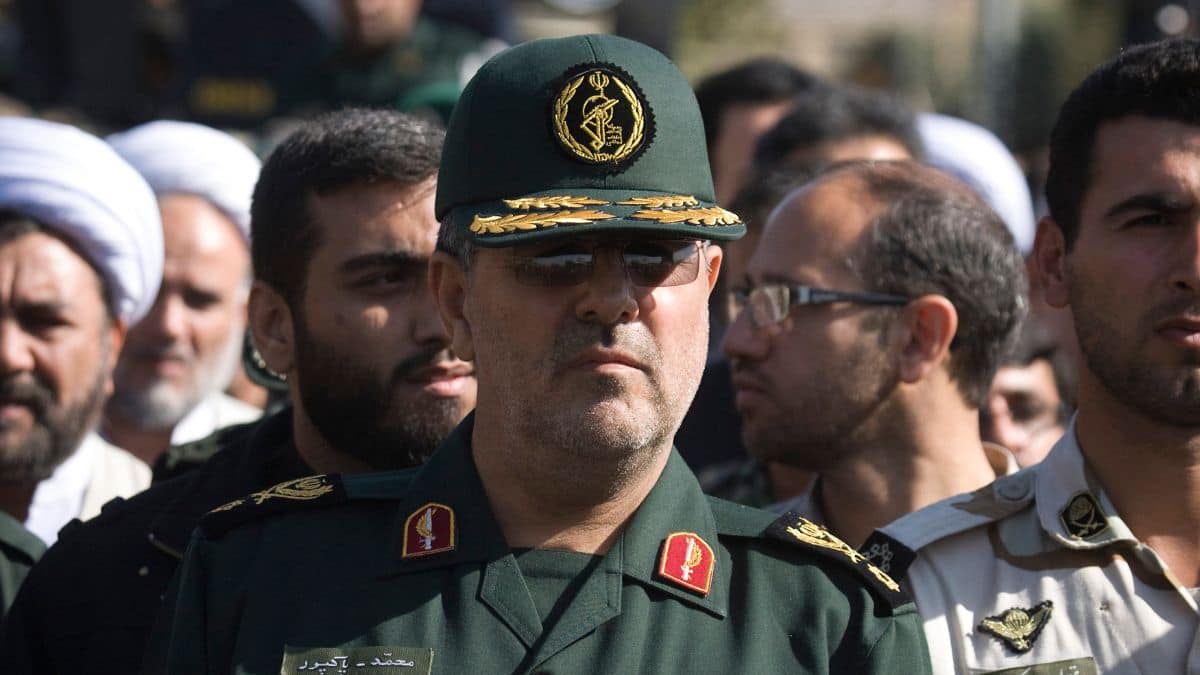
The Western obsession with "High-Value Target" (HVT) lists has become a strategic addiction that masks a fundamental misunderstanding of how power functions in the Middle East. Every time a strike hits a compound in Damascus or a safe house in Tehran, the headlines scream about "crippling blows" and "decapitation strikes." They list names like Mohammad Pakpour or IRGC commanders as if they are pieces on a chessboard that, once removed, end the game.
They aren't. They are cells in a biological organism. You don't kill a hydra by trimming its hair.
The competitor narrative suggests that the deaths of senior Iranian leadership represent a terminal decline for the Islamic Republic’s regional influence. This is a comfort blanket for analysts who prefer tracking individuals over studying institutional inertia. The reality is far more uncomfortable: Western and Israeli kinetic operations are unintentionally stress-testing and refining Iran’s command structure, making it leaner, more decentralized, and harder to kill.
The Cult of the Individual vs. The Machine
The first mistake in the standard analysis is the "Great Man" theory of geopolitics. We are told that men like Qasem Soleimani were irreplaceable. When he was killed in 2020, the consensus was that the "Axis of Resistance" would crumble into chaos.
It didn't. It expanded.
The IRGC (Islamic Revolutionary Guard Corps) and its Quds Force are not built around charismatic authority; they are built on Institutionalized Ideology. When a commander like Mohammad Reza Zahedi is eliminated, the vacancy is filled within hours. The bureaucracy of the IRGC is modeled after a franchise system, not a top-down monarchy.
- Redundancy: Every commander has at least two deputies capable of executing the current five-year plan.
- Doctrine: The strategy is baked into the organization. It doesn't require a genius to oversee it; it requires a manager.
- Martyrdom as Fuel: In this ecosystem, a dead leader is often more useful than a living one. They become a recruitment tool and a justification for escalation.
I have spent years watching intelligence agencies prioritize the "who" while completely ignoring the "how." If you kill the CEO of a company but the supply chain, the customers, and the product remain intact, the company doesn't go bankrupt. It just gets a new CEO.
The Intelligence Trap: Why We Think We’re Winning
We see a spectacular explosion on a grainy drone feed and equate "accuracy" with "effectiveness." This is a category error.
Tactical success is often a strategic failure. Every time a high-ranking official is targeted, the Iranian security apparatus undergoes a "mutation." They identify the leak—whether it’s signals intelligence or a human asset—and they close it. By killing the "top leaders," we are effectively performing an involuntary audit of their security protocols.
The Evolution of the Proxy
Look at the current state of Hezbollah, the Houthis, and the PMF in Iraq. They are less dependent on Tehran’s direct orders than they were a decade ago.
- Local Production: They no longer wait for shipments of finished missiles; they receive schematics and components for local assembly.
- Autonomous Funding: They’ve diversified into illicit trades, real estate, and local taxation.
- Command Autonomy: Commanders on the ground have the authority to initiate strikes without a green light from a general in Tehran.
The "top leaders" mentioned in the news are increasingly ceremonial figureheads of a movement that has already gone open-source.
The Mathematics of Escalation
Let’s look at the friction. $F = \mu N$. In this context, the friction (resistance) is proportional to the normal force (external pressure). The more you press with kinetic strikes, the more heat you generate within the system.
Imagine a scenario where the "Target List" is fully exhausted. Every name mentioned in the competitor's article is gone. What remains? A younger, more radicalized generation of officers who came of age during the "Maximum Pressure" era. Unlike the old guard, who remember a time before the 1979 revolution or the pragmatism of the early 2000s, this new cohort has no interest in back-channel diplomacy. They view the death of their mentors as proof that negotiation is a death sentence.
The Wrong Questions
People always ask: "Who is next on the list?"
They should be asking: "What is the cost of the replacement?"
The replacement is almost always more tech-savvy, more paranoid, and less connected to the global financial system, making them harder to track and harder to sanction.
The Cost of "Success"
- Information Blackouts: As we pick off the "known" leaders, we are forced to deal with "unknown" actors. We lose the "predictable" patterns of the old guard.
- Strategic Drift: Strikes are often reactionary. They are "revenge" operations dressed up as "deterrence." Real deterrence prevents the next move; these strikes merely provoke it.
- Global Optics: While the West cheers a successful hit, the Global South sees a violation of sovereignty that pushes neutral players closer to the China-Russia-Iran tri-polar axis.
The Pivot You Aren't Making
If you want to actually disrupt the "Axis," you stop chasing the men and start chasing the mechanics.
- Target the Connectivity, Not the Node: It’s not about the general; it’s about the encrypted communication relay he uses. It’s about the dual-use technology imports that allow their drone programs to function.
- Degrade the Economic Logic: The IRGC maintains power because it controls the Iranian economy. Kinetic strikes don't hurt their bank accounts; they usually lead to increased "emergency" budgets.
- Accept the Stalemate: The hardest truth to swallow is that there is no military solution to a structural ideological problem. You cannot "kill" your way out of a regional cold war.
The media loves a body count because it’s easy to report. It fits into a three-minute segment. But body counts are a metric of the past. In modern asymmetric warfare, the winner is the one who can sustain the most "decapitations" without losing focus.
Iran has been practicing for forty years.
The current strategy of "Top Leader" elimination is the geopolitical equivalent of clicking "Refresh" on a broken webpage and expecting the content to change. You’re just wearing out your finger while the underlying code remains exactly the same.
Stop cheering for the explosions. Start looking at the architecture that survives them. The machine is humming louder than ever, and it doesn't care who is sitting in the driver's seat.
Success isn't a dead general. Success is a dismantled system. And right now, we aren't even looking at the blueprints.