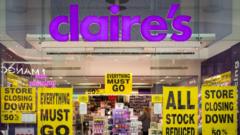
The sudden collapse of Claire’s across the UK and Ireland marks more than just the shuttering of 154 storefronts and the disappearance of 1,300 jobs. It represents the final fracturing of a retail model that relied on a captive audience of pre-teens and the physical necessity of a needle. While the headlines focus on the immediate shock of the closures, the reality is a slow-motion car crash involving debt-heavy private equity, shifting adolescent social habits, and a fundamental failure to adapt to a world where a trip to the mall is no longer a rite of passage.
This is not a story about a lack of demand for glittery earrings. It is a post-mortem on how a dominant market leader found itself suffocated by its own footprint. For decades, Claire’s owned the "ear piercing" category, using the service as a loss leader to drive sales of high-margin plastic accessories. But when the anchors of the high street—the department stores and the massive fashion chains—began to drift away, the foot traffic that Claire’s survived on evaporated. You cannot pierce an ear through a smartphone screen, but you can buy every other item in the store for half the price on TikTok Shop or Amazon.
The Debt Trap Beneath the Glitter
To understand why 1,300 people are suddenly out of work, you have to look past the neon signage and into the balance sheets. Claire’s has spent years wrestling with the ghosts of a leveraged buyout. When private equity firms load a company with debt to fund an acquisition, the business is no longer judged by its ability to serve customers. It is judged by its ability to service that debt.
For a long time, the cash flow from thousands of global locations kept the wolves at bay. However, the UK retail environment has become uniquely hostile. Business rates, rising labor costs, and a plummeting pound turned what were once profitable small-footprint kiosks into liabilities. The company tried to pivot, placing concessions in supermarkets and pharmacies to meet customers where they already were, but it wasn't enough to offset the bleeding from their dedicated boutiques.
Investors often treat retail like a game of musical chairs. They extract value while the music plays, and when the song stops, it’s the floor staff and the local communities that are left without a seat. The UK and Ireland operation became the sacrificial lamb in a broader global restructuring effort. By cutting the cord on these 154 stores, the parent company is attempting to save the brand’s presence in North America and its growing wholesale business. It is a cold, calculated retreat.
A Generation Moving On
There was a time when a Saturday afternoon spent at Claire's was a mandatory social event for a specific demographic. It was the place where you got your first "grown-up" accessory. It was safe, affordable, and ubiquitous. That cultural cachet has vanished. Today’s 12-year-olds are not looking to the high street for style inspiration; they are looking to creators in Los Angeles or Seoul.
The aesthetic of Claire’s—bright, cluttered, and tactile—feels like a relic to a generation raised on the minimalist "clean girl" aesthetic promoted by influencers. When the brand’s core product is perceived as "cheap" rather than "fun," the price point no longer matters. Teenagers are increasingly willing to save their money for a single, higher-quality item from a brand they discovered on an algorithm rather than spending five pounds on a handful of trinkets that will break in a week.
The loss of the physical store also removes the brand's only true competitive advantage: the piercing chair.
The Piercing Problem
Piercing was the gravity that pulled parents and children into the store. Once the child was in the chair, the parent was almost guaranteed to spend an additional twenty pounds on "aftercare" solution and a celebratory set of studs. However, professional piercing studios have become more mainstream and accessible. Older Gen Z and younger Millennials, who value expertise and hygiene standards, have migrated toward specialized boutiques that offer needle piercing over the traditional "gun" method used in malls.
Claire’s found itself squeezed. On one side, high-end professional studios took the serious customers. On the other side, ultra-fast fashion giants like Shein took the impulse buyers who just wanted cheap jewelry. Stuck in the middle, Claire’s was left with expensive leases and declining relevance.
The Logistics of a Liquidation
Closing 154 stores simultaneously is a logistical nightmare that reveals the desperation of the situation. Usually, a retailer will attempt a phased withdrawal, closing underperforming sites while trying to sell the profitable ones as a going concern. A total, immediate shutdown suggests that the cash reserves were bone dry.
When a company enters this stage, the human cost is often buried under talk of "restructuring" and "asset optimization." For the 1,300 employees, many of whom were young people in their first jobs, the exit is unceremonious. They are not just losing a paycheck; they are losing a community hub. In many smaller UK towns, Claire’s was one of the few remaining reasons for young people to visit the town center. Its disappearance hastens the "doughnut effect," where town centers become hollowed out, leaving only service-based businesses like barbers and cafes.
The Ghost of Retail Past
The failure of Claire’s in the UK and Ireland is a warning to every other "category killer" still clinging to the old ways. It is no longer enough to be the biggest name in a niche. If your business model requires physical presence but your product can be replicated digitally or delivered in a cardboard box, you are living on borrowed time.
Retailers are now forced to decide if they are a "place" or a "product." Claire's tried to be both and ended up being neither. They couldn't compete with the experience of a high-end piercing studio, and they couldn't compete with the price and variety of the internet.
We are seeing the end of the "middle" of the market. High-end luxury is thriving because it offers status and an elite experience. Ultra-low-cost e-commerce is thriving because it offers convenience. Brands like Claire's, which sit in the middle—offering modest prices in a physical setting—are being crushed by the overhead of their own existence.
The 154 empty storefronts will eventually be filled, likely by charity shops or discount retailers, further changing the face of the British high street. The glitter has been swept away, leaving behind the stark reality of an industry that failed to respect the speed of cultural change. If you want to survive in modern retail, you have to be more than a shop; you have to be a destination that cannot be replicated by a parcel on a doorstep. Claire’s became a ghost long before the doors were actually locked.
Look at your local high street next week. Count the shutters. Every one of them is a story of a board of directors who thought they were too big to fail until the moment the rent was due and the till was empty.