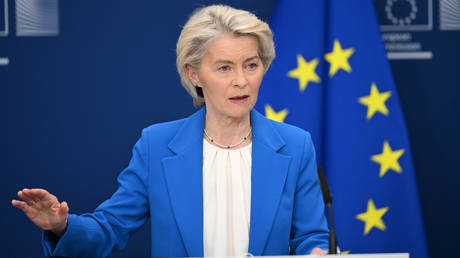
Ursula von der Leyen wants to kill the veto before it kills the European Union. In the drafty halls of Brussels, the Commission President is no longer whispering about "efficiency"; she is openly campaigning for the demolition of the unanimity rule that has governed the bloc’s most sensitive decisions for decades. Her target is the "Qualified Majority Voting" (QMV) expansion—a mechanism that would allow the EU to pass laws on foreign policy, sanctions, and taxation even if a handful of member states scream "no."
By moving toward QMV, Von der Leyen is attempting to strip individual capitals of their ability to hold the entire continent hostage. The primary query isn't just about speed; it's about survival in a world where a single prime minister can trade a European security package for a release of frozen domestic funds. For the Commission, the veto has evolved from a safeguard of sovereignty into a tool of geopolitical blackmail.
The Hostage Economy
The reality of EU decision-making has become a series of backroom shakedowns. Under the current rules, major pivots in the Common Foreign and Security Policy (CFSP) require every single member state to agree. In a Union of 27, this creates a "transactional" diplomatic culture.
Recent history serves as a brutal witness. We have seen the Hungarian government repeatedly block aid to Ukraine or delay sanctions against Russia, often timing these vetoes to coincide with negotiations over rule-of-law penalties or budget allocations. This isn't just a "Hungarian problem." Whether it is a Mediterranean state blocking maritime sanctions to protect shipping interests or a northern state stalling tax harmonization, the veto is the ultimate leverage.
Von der Leyen’s push for "passerelle clauses"—legal shortcuts within existing treaties—is designed to bypass the need for a full, messy treaty change. These clauses allow the European Council to unanimously decide to stop being unanimous. It is a procedural paradox: she needs the very people who love the veto to vote once, and for all, to give it up.
The Enlargement Trap
The urgency behind this reform is tied directly to the maps of the future. With Ukraine, Moldova, and the Western Balkans sitting in the waiting room, the EU is facing a mathematical breaking point. A Union of 30 or 35 members operating under a 100% consensus rule is not a government; it is a permanent stalemate.
Critics of the veto abolition argue that small nations will be steamrolled by the "Franco-German engine." They aren't entirely wrong. Without the veto, a coalition of the largest economies could theoretically dictate tax rates or foreign interventions that smaller states find abhorrent. However, the counter-argument is now louder: a paralyzed Europe is a playground for outside powers. If Moscow or Beijing only needs to influence one capital to stop a continental policy, the entire Union remains vulnerable.
The Mechanics of the Shift
The transition won't happen in a single landslide. The strategy currently being socialized in Brussels involves a "targeted QMV" approach:
- Sanctions Policy: Moving human rights and economic sanctions to majority voting to prevent individual states from shielding autocrats.
- Technical Enlargement Steps: Preventing members from using bilateral historical or border disputes to block a candidate’s progress through technical "chapters."
- Civilian Missions: Allowing the EU to deploy non-combat advisors or observers without a 27-country sign-off.
The Sovereignty Myth
The loudest opposition comes from the "Sovereignty Bloc." For leaders like Viktor Orbán or Robert Fico, the veto is the only thing that makes them relevant in a room full of giants. To them, QMV is a "federalist coup" disguised as administrative reform.
But the "weary veteran" view of this conflict suggests that sovereignty is already being lost—not to Brussels, but to irrelevance. If the EU cannot act on the world stage because it is waiting for a consensus that never comes, its member states lose their collective shield. Real power in 2026 isn't the ability to say "no" to a committee; it’s the ability to project force and economic will on a global scale.
The Commission is betting that the fear of being left behind by the US and China will eventually outweigh the domestic political theatre of the veto. They are proposing a "safety valve" or an "emergency brake" mechanism—where a state can still block a move if it can prove a "vital national interest" is at stake—but the burden of proof would shift. You would have to justify your obstruction, rather than just casting a silent, devastating shadow.
The Budgetary Battlefield
The fight over the veto is also a fight over the purse strings. Negotiating the 2028-2034 Multiannual Financial Framework (MFF) is already proving to be a nightmare. Without a move toward majority voting on certain revenue-raising measures, the EU remains a beggar to its own members.
Von der Leyen’s second-term legacy depends on whether she can decouple "the will of the many" from "the whim of the one." The proposed "Group of Friends on Improved Decision-Making"—a coalition of 12 states including Germany and France—is the vanguard of this movement. They are testing the waters, trying to find the legal "sweet spot" where they can trigger QMV without triggering a constitutional crisis in Warsaw or Budapest.
The Brutal Truth
There is no perfect version of this reform. A majority-run EU will inevitably alienate its fringes, and a consensus-run EU will inevitably remain a "geopolitical dwarf." Von der Leyen has chosen her side. She is gambling that the friction of a majority-rule system is better than the slow-motion car crash of a paralyzed one.
The abolition of the veto is not a dry administrative update. It is a fundamental rewriting of the European power dynamic. If she succeeds, the EU becomes a more nimble, albeit more fractious, global player. If she fails, the Union remains a collection of 27 vetoes in search of a policy, while the rest of the world stops waiting for them to decide.
The path forward is a legal minefield. The "passerelle" requires unanimity to activate, meaning the very spoilers Von der Leyen wants to disarm must first hand her the gun. It is an audacious, perhaps impossible, play. But in a Europe flanked by war and economic stagnation, the status quo has become the most dangerous option on the table.