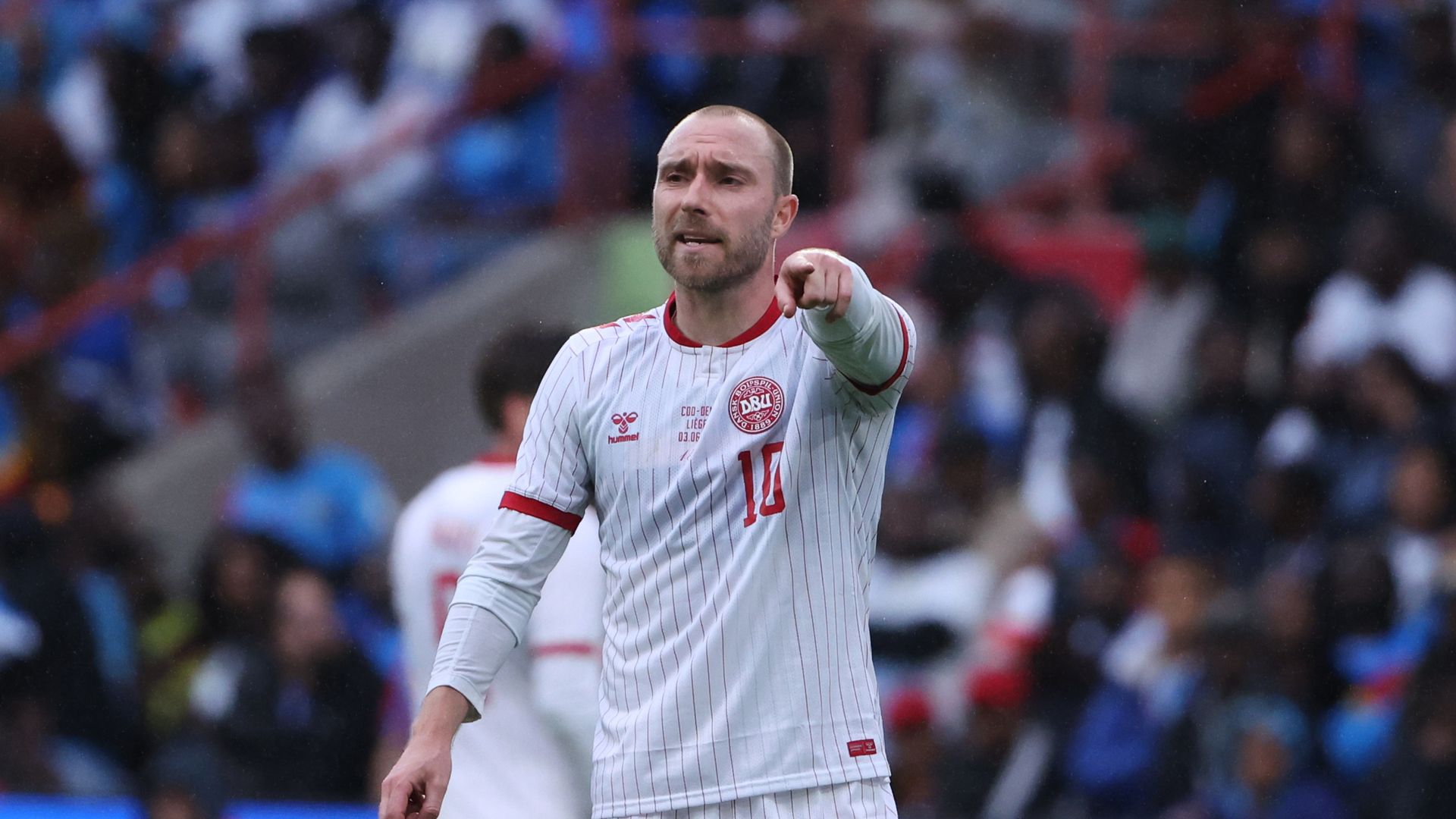
The grass underfoot was pristine, a vibrant summer green beneath the Copenhagen sun. It was June 12, 2021. Parken Stadium hummed with the collective roar of sixteen thousand voices, a wall of sound built from beer, anticipation, and the pure joy of football’s return to the big stage. On the pitch, Christian Eriksen moved with his usual quiet elegance. He was Denmark’s talisman, the architect of their play, a man whose entire career was built on spatial awareness and impeccable timing.
Then, the clock ticked to the forty-second minute.
A routine throw-in drifted toward the left touchline. Eriksen trotted forward to receive it. The ball struck his knee. For a fraction of a second, nothing seemed wrong. But as the ball bounced away, his body stiffened. His knees buckled. He stumbled forward, face-first, into the turf.
Silence did not descend immediately. A few shouts continued from the stands, minds struggling to process an unnatural image. Elite athletes do not simply fall like felled trees. They trip, they slide, they appeal to the referee. They do not drop into the earth as if the ground beneath them has opened up.
Within seconds, the atmosphere curdled.
Denmark captain Simon Kjær reached his teammate first. The urgency in Kjær’s hands as he cleared Eriksen’s airway signaled the shift from a sporting injury to something existential. Anthony Taylor, the referee, waved the medical staff on with a frantic, slashing motion of his arms. The casual Sunday-afternoon energy of a European Championship match evaporated, replaced by a cold, suffocating dread.
The Machinery of Survival
What happens inside a stadium when a heart stops beating is a masterclass in human choreography under extreme duress. Christian Eriksen was experiencing sudden cardiac arrest.
To understand the terrifying gravity of this moment, consider a simple analogy. A heart attack is a plumbing problem; a blockage prevents blood from reaching the muscle. Cardiac arrest, however, is an electrical failure. The power grid goes dark. The heart ceases its rhythmic pumping and begins to quiver uselessly—a state known as ventricular fibrillation. Without immediate intervention, the brain begins to die within minutes.
Mortality statistics for out-of-hospital cardiac arrests are notoriously grim. Survival rates often hover below ten percent. But Eriksen was not on a lonely street corner. He was surrounded by elite professionals trained for the worst-case scenario.
The Danish medical team arrived at his side in under twenty seconds. They were joined moments later by the UEFA stadium medics. The chest compressions began. The rhythm of the CPR was relentless, a desperate, manual attempt to mimic the function of a broken organ.
Time Elapsed | Action Taken
---------------------------------------------
00:00        | Eriksen collapses on the pitch
00:20        | Medical staff arrive, CPR begins
02:10        | Defibrillator (AED) arrives
03:00        | First shock administered
The introduction of the Automated External Defibrillator (AED) was the critical turning point. This device analyzes the heart's rhythm and delivers an electrical shock to reset the system, effectively rebooting the biological generator.
As the medical team worked, a different kind of rescue operation was taking place around them. The Danish players, visibly shattered, weeping, and holding their heads in disbelief, did something extraordinary. Led by Kjær and goalkeeper Kasper Schmeichel, they formed a tight, protective wall around their fallen brother. They turned their backs to the pitch and faced outward, shields of red and white fabric protecting Eriksen’s dignity from the prying lenses of television cameras and smartphone screens.
It was a display of profound empathy. In the age of total digital exposure, where every tragedy is commodified into a viral clip, these men created a sanctuary of privacy on a field watched by millions.
The Boundary of the Screen
For those watching at home, the experience was surreal. Sports broadcasting operates on a predictable script. There are replays, tactical breakdowns, commercial breaks, and energetic commentary. When Eriksen fell, that script was torn to shreds.
The commentators' voices dropped an octave, stripped of their usual theatrical enthusiasm. The cameras panned away, focusing on the weeping faces in the crowd, then on Eriksen’s partner, Sabrina Kvist Jensen, who had rushed down from the stands onto the pitch, comforted by Schmeichel and Kjær.
The invisible boundary between entertainment and raw human tragedy dissolved. Viewers were no longer watching a game; they were witnessing a twenty-nine-year-old man fight for his life in real-time.
This collective trauma united the stadium. Finnish fans, who had traveled to support Denmark’s opponents, began chanting "Christian!" The Danish supporters responded with "Eriksen!" The chant bounced back and forth across the stands, a sonic embrace that transcended sporting rivalry. In that half-hour of uncertainty, the result of the match meant absolutely nothing. The only victory that mattered was a pulse.
The Legacy of a Heartbeat
After a frantic, agonizing period of treatment, Eriksen was carried off the pitch on a stretcher, surrounded by sheets to shield him from view. A photographer captured a fleeting image that offered the first ray of hope: Eriksen was conscious, his hand resting on his forehead.
He had been brought back from the edge.
The subsequent medical investigation revealed that Eriksen would need an Implantable Cardioverter-Defibrillator (ICD) fitted—a tiny device capable of delivering a shock if his heart ever fell out of rhythm again. His club at the time, Inter Milan, was forced to release him due to Italian medical regulations prohibiting athletes from playing with an ICD.
Many assumed his career was finished. The narrative arc seemed complete: a miraculous survival, a quiet retirement, a life preserved.
But the human spirit rarely follows a predictable script. Eriksen wanted to play. He trained alone, proved his fitness, and signed with Brentford in the English Premier League, making his emotional return to professional football just eight months after his collapse. He later earned a move to Manchester United and pulled on the Danish national jersey once again, scoring on his return to international duty.
The true significance of June 12, 2021, extends far beyond Eriksen’s miraculous comeback. His collapse served as a global wake-up call regarding the critical importance of CPR training and accessible AEDs. Grassroots sports clubs around the world re-evaluated their medical protocols. Thousands of ordinary people signed up for resuscitation courses, realizing that the knowledge to save a life is a tool anyone can carry.
The memory of that afternoon in Copenhagen remains etched in the minds of anyone who witnessed it. It stands as a stark reminder of our fragility, a moment when the lights almost went out on a brilliant talent. Yet, it also serves as a testament to human resilience, rapid professional intervention, and the quiet dignity of a team that stood together when the world was watching.
The match eventually resumed that night, but the scoreline has long been forgotten. What remains is the image of a man reclaiming his breath, stepping back onto the grass, and continuing to play the game he loved, his heart beating to its own defiant rhythm.