Silence.
If you have ever stood on the Gran Vía in Madrid at seven in the morning, you know that silence is an unnatural state of affairs, a heavy, suffocating blanket thrown over a city that normally wakes up at a shout. Usually, the air smells of burnt sugar, diesel exhaust, and roasting Arabica beans, punctuated by the metallic clack-clack of shutters rolling up and the hiss of espresso wands clearing steam.
Not today. Today, the shutters stayed down. The buses sat idle in their depots like sleeping whales. For the first time in fourteen years, Spain did not simply pause; it pulled the emergency brake.
A competitor’s headline might tell you that Spain just experienced its largest general strike in over a decade, followed by a tidy parenthetical promising videos of marching crowds and burning tires. That is the skeleton of the story, bleached of blood and nerve. To understand why millions of people walked off the job, forfeited a day’s wages they could barely afford to lose, and flooded the plazas from Bilbao to Seville, you have to look past the drone footage of the rallies. You have to look at the kitchen table of someone like Mateo.
The Arithmetic of Exhaustion
Consider a hypothetical composite of the modern Spanish worker—let’s call him Mateo, a thirty-eight-year-old logistics coordinator living in the working-class Madrid neighborhood of Vallecas. On paper, Mateo is a success story. Macroeconomic charts celebrate Spain’s GDP growth, outpacing much of the Eurozone, buoyed by record tourism numbers and a booming service sector. Analysts in Frankfurt and Brussels point to these graphs with quiet satisfaction.
Mateo cannot eat a graph.
Every month, Mateo sits down with a spiral notebook and performs a magic trick that has stopped working. His rent has climbed forty percent in four years, driven by a housing market squeezed between institutional investors and short-term tourist rentals. His grocery bill—olive oil, eggs, milk, basic staples—has nearly doubled since the early twenties. Meanwhile, his paycheck has crawled upward by fractions of a percent, always arriving a year too late to catch the price hikes.
I remember sitting at a similar table back in 2012, during the last strike of this magnitude, watching my own parents count out coins for the electricity bill while the television murmured about sovereign debt and austerity measures. Back then, the crisis had a face: the banks had collapsed, unemployment sat above twenty-five percent, and everyone knew the ship was sinking. You understood why you were drowning.
What makes today’s eruption so volatile, and so deeply disorienting, is the gaslighting of prosperity. Workers are told the economy is thriving while their purchasing power evaporates. It is like running on a treadmill where someone keeps quietly cranking up the incline while telling you how great your posture looks. Eventually, your legs give out. Or you step off the belt entirely.
Fourteen Years in the Making
To grasp why this particular walkout shattered a fourteen-year streak of relative labor peace, you have to look at the slow pressure cooker of the intervening years.
Between 2012 and today, Spain survived a brutal recession, a global pandemic, an energy shock, and a historic inflation wave. Throughout those emergencies, Spanish workers absorbed the shock. Unions negotiated piecemeal agreements. People took second jobs, delayed having children, moved back in with aging parents in their thirties, and swallowed the bitter pill of mileurismo—the grim reality of scraping by on roughly a thousand euros a month while big-city rents demanded twelve hundred.
Think of a fault line beneath the earth. For fourteen years, the tectonic plates of corporate profit margins and stagnant wages ground against each other without breaking the surface. Small tremors occurred—a transport strike here, a healthcare march there, teachers protesting underfunded classrooms—but the overarching structure held.
Then came the breaking point. When major labor confederations—historically divided on tactics and often accused of growing too comfortable at the negotiating table—finally aligned their calendars and called for a total stoppage, they weren't lighting a fire. They were simply opening the door to a room that was already filled with smoke.
Why did this strike succeed where smaller protests fizzled? Because the grievance crossed every demographic line that usually keeps people divided. It was not just factory workers in the industrial north or dockworkers in Valencia. It was the junior architect in Barcelona sharing a three-bedroom flat with four strangers. It was the nurse in Andalusia working back-to-back shifts on a temporary contract. It was the retiree in Zaragoza watching her pension lose ground against the pharmacy counter.
What Happens When Everything Stops
People often ask what a general strike actually accomplishes beyond traffic jams and dramatic television footage. Does marching down Paseo de la Castellana magically lower the price of olive oil? No. Economics does not bend to slogans alone.
A general strike is not a magic wand; it is a receipt. It is the moment labor forces capital and government to look at the itemized bill of who actually makes the country run.
Watch what happens when the invisible machinery halts. Without the cleaners who arrive at four in the morning, the gleaming corporate towers of Madrid’s financial district become unusable by noon. Without the regional rail operators, the suburban commuters cannot reach the tech hubs. Without the port workers in Algeciras and Barcelona, supply chains freeze across Southern Europe.
During the height of the morning pickets, I walked past a shuttered bakery near Atocha station. Two delivery drivers stood leaning against their parked vans, sharing a thermos of coffee. Neither looked like a radical firebrand. They looked tired. One of them, a man in his fifties with grease permanently etched into the lines of his knuckles, told me he had never missed a day of work in twenty years—not for a cold, not for a broken toe.
"I'm losing eighty euros today," he said, tapping his cigarette ash into an empty soda can. "I need that eighty euros. My daughter needs braces. But if I don't lose eighty today, I'll lose eight hundred next year, and I won't even notice it leaving my pocket."
That is the calculus that changes history. When fear of losing a day’s pay is eclipsed by the certainty of losing your future, the balance of power shifts overnight.
The Anatomy of the Standoff
Of course, the pushback was immediate and predictable. Business associations warned of catastrophic economic losses, tallying up billions of euros in vanished productivity within hours of the first picket lines forming. Government officials urged "dialogue and responsibility," caught in the agonizing bind of trying to project stability to European markets while facing fury from their own voting base.
Critics argue—and they are not entirely wrong—that aggressive wage hikes and sweeping labor mandates risk fueling further inflation or squeezing small business owners who are themselves drowning in taxes and supply costs. Consider Elena, another hypothetical figure representing the tens of thousands of self-employed autónomos who keep Spain’s neighborhood bars and boutiques alive. For Elena, a general strike is a nightmare scenario. She has no corporate cushion. If she closes her doors, she loses revenue; if she opens them, she faces angry pickets outside her glass storefront and an empty street with no customers anyway.
I won't pretend there is an easy answer to Elena’s dilemma. Anyone who claims that macroeconomics can be solved without collateral damage is lying to you. The tension between protecting workers from poverty and keeping small enterprises solvent is real, messy, and frightening.
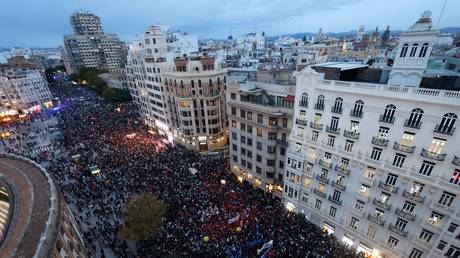
Yet, looking at the sheer scale of the mobilization—hundreds of thousands marching in Madrid alone, tens of thousands more paralyzing Barcelona, Valencia, Bilbao, and Seville—it becomes clear that the old consensus has died. You cannot build a sustainable economy on the backs of a workforce that cannot afford shelter in the cities they clean, build, and serve.
Beyond the Barricades
By late afternoon, the character of the streets changed. The tense, early-morning standoffs at industrial parks and transport hubs gave way to a massive, roaring river of humanity moving toward the central plazas.
Families walked alongside students. Retired metalworkers wore faded union caps from the transitions of the seventies, walking beside twenty-somethings holding cardboard signs painted in their living rooms the night before. The air vibrated with whistles, chants, and the deep, rhythmic thud of drums echoing off limestone facades.
In those moments, the isolation that defines modern economic struggle vanishes. For months or years, when you cannot pay your bills, you feel like a personal failure. You wonder what you did wrong, why you didn't study a different degree, why you couldn't negotiate a better salary. Standing shoulder-to-shoulder with half a million neighbors carrying the exact same burden burns away that shame. You realize the problem isn't your personal math. The system's math is broken.
The videos circulating online capture the spectacle—the sea of flags, the police helicopters hovering like dragonflies against the dusk, the occasional flare painting the sky crimson. Those clips will get millions of views and then vanish from the algorithm within forty-eight hours.
What will not vanish is the memory of that unnatural morning quiet. The powers that be—in boardrooms, in ministries, in the glass towers overlooking the avenues—heard something far more terrifying than chants or sirens. They heard the sound of millions of hands simply letting go of the wheel at the exact same second.
Tomorrow, the shutters will roll back up. The buses will rumble out of their depots, and the espresso machines will hiss back to life across every plaza in Spain. Everyone knows, however, that the silence can return whenever the people decide they have had enough.