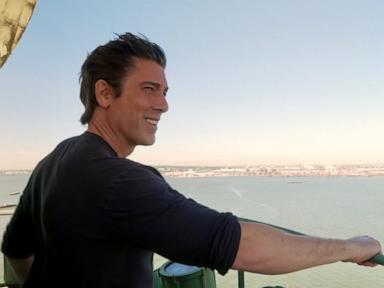
You don't normally see a network news anchor clinging to a 40-foot vertical ladder inside a hollow copper arm, terrified out of his mind. But that's exactly what happened when ABC's David Muir scaled the interior of the Statue of Liberty to reach the forbidden torch platform. The stunt wasn't just for ratings. It kicked off a massive, 24-hour television event called Disney Celebrates America, marking the nation's 250th anniversary.
Seeing someone stand on that tiny balcony 305 feet above New York Harbor triggers a weird mix of vertigo and awe. The public hasn't been allowed up there for over a century. When Muir asked his park ranger guide how many people actually get to make this climb, the answer was simple: nobody.
The footage gives us a rare glimpse of a restricted American symbol. It also forces us to look at what the monument means as the country hits its semiquincentennial milestone.
The Terrifying Climb Through Lady Liberty's Right Arm
Climbing to the torch isn't a casual walk up a spiral staircase. The standard tourist stairs stop at the crown. To get to the torch, you have to go through a tiny door and climb a narrow, industrial ladder built right inside the statue's right arm.
Muir admitted the experience shook him. The wind howls against the thin copper skin, and the structure flexes. During the climb, the audio captured the anchor telling his crew that he wasn't going back down and they weren't doing this twice.
The physics of the statue make the trek intimidating. Frédéric-Auguste Bartholdi designed the copper sheets, but Alexandre-Gustave Eiffel built the iron skeleton inside. The arm supports the heavy torch structure, but it narrows significantly as you ascend.
- The total height from the ground to the tip of the torch is 305 feet.
- The internal ladder stretches roughly 40 feet through the arm itself.
- The structural framework allows the statue to sway up to three inches in high winds, while the torch can sway up to five inches.
Standing on the outdoor platform surrounding the flame provides an unobstructed view of the entire harbor. For Muir, the immediate reaction wasn't about the height. It was about thinking of the millions of immigrants who sailed past that exact point, looking up at the torch as their first glimpse of a new life.
Why the Torch Has Been Closed Since 1916
Most people assume the torch is closed because of modern security concerns or structural wear. The real reason dates back to a forgotten act of German sabotage during World War I.
On July 30, 1916, German agents set fire to a massive munitions depot on Black Tom Island, a small strip of land in New York Harbor right next to Liberty Island. The depot held millions of pounds of ammunition and explosives waiting to be shipped to the Allied forces in Europe.
The resulting explosion was massive. It registered as a magnitude 5.5 earthquake on sensors as far away as Philadelphia. People in Manhattan were shaken out of their beds, and windows shattered across the city.
The blast flew shrapnel straight into the Statue of Liberty. The flying metal damaged the kilt, the dress, and specifically the arm holding the torch. The structural integrity of the arm was compromised enough that officials immediately closed the torch to the public.
The National Park Service never reopened it. The risk of crowding people into a narrow, single-exit ladder inside a hollow metal arm was too high. The 1916 closure became permanent, transforming the torch balcony into an exclusive spot reserved only for maintenance workers and the occasional rare broadcast crew.
The Meaning Behind the America 250 Celebration
Reaching the torch right now carries heavy symbolic weight. The United States is navigating a complicated cultural moment as it hits its 250th year. A milestone like this brings a mix of national pride and deep reflection on where the country has fallen short of its foundational ideals.
The Statue of Liberty wasn't originally intended to be a symbol of immigration. Edouard de Laboulaye and the French abolitionist movement conceived the project to celebrate the Union victory in the Civil War and the abolition of slavery. The broken shackles at Lady Liberty's feet represent the end of bondage, not just the concept of political liberty.
Over the decades, the meaning shifted. Emma Lazarus wrote her famous poem, The New Colossus, to raise funds for the pedestal. Her words about the huddled masses yearning to breathe free permanently tied the statue to the immigrant experience.
Muir's broadcast leans heavily into this layered history. By showcasing the interior framework and the view from the forbidden peak, the special attempts to re-anchor the monument in the public consciousness. It reminds viewers that the ideals symbolized by the light are fragile, much like the thin copper skin holding the structure together.
Behind the Scenes of the Disney Celebrates America Broadcast
The climb was part of a coordinated programming block spanning multiple networks and streaming platforms. The Walt Disney Company leveraged its entire media empire, broadcasting the event across ABC, Disney+, Hulu, ESPN, FX, and National Geographic.
The production required months of coordination with the National Park Service and the Consulate General of France in New York. The French involvement matters because the statue remains a shared piece of heritage. As part of the celebration, the production team debuted a new illumination system called Liberty Lights, designed to highlight the details of the copper drapery.
The special also featured heavy musical programming. Brandi Carlile and SistaStrings performed a rendition of America the Beautiful from the island, while other segments traced the path of American history from colonial times through the modern era. ABC News co-anchor Deborah Roberts even flew with the Patrouille de France, the precision aerobatic demonstration team of the French Air and Space Force, to capture aerial views of the monument.
The scale of the broadcast shows how media companies are treating the 250th anniversary. It's not just a standard holiday weekend. It's a massive cultural event designed to capture eyeballs across streaming and linear television simultaneously.
How to Experience the History Without Climbing the Arm
You won't be allowed to climb the ladder through the right arm. The National Park Service isn't changing that rule anytime soon. You can still experience the history of the torch without risking vertigo.
The Statue of Liberty Museum on Liberty Island houses the original 1886 torch. The original structure was replaced during the massive restoration project in the mid-1980s. The old torch suffered decades of water damage because the glass panels installed in the 1910s leaked constantly.
The current torch features a solid copper flame covered in 24-karat gold leaf. The gold reflects the sun during the day and is lit by external floodlights at night, returning to Bartholdi's original vision of a solid, shining beacon rather than a lantern with internal lights.
Visiting the museum lets you stand inches away from the massive copper and glass structure that sat atop the monument for a century. You can see the weather damage and the structural patches up close, giving you a better understanding of the physical toll the elements take on the monument.
Planning a trip during the 250th anniversary year requires booking months in advance. Pedestal and crown access tickets sell out rapidly. If you want to see the view from the top without the claustrophobia, the National Park Service maintains live torch cams that stream the view from the balcony continuously, giving you the same perspective Muir had without the terrifying vertical ladder climb.

.jpg?width=1200&auto=webp&trim=0%2C100%2C0%2C100)