When the second-place runner in a high-stakes sprint begs the leader to slow down and hold hands, we do not call it sportsmanship. We call it a stall tactic.
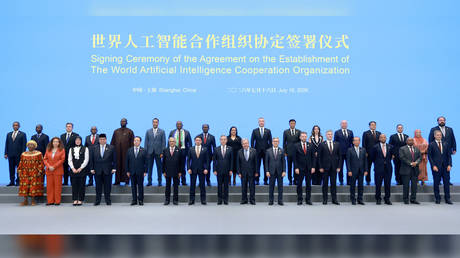
Yet, when Beijing calls for global unity in artificial intelligence, mainstream analysts nod in solemn agreement. The consensus view, parroted across Western media, is that AI is too dangerous for a single nation to lead. They argue we need a global committee, a digital United Nations, a unified rulebook to govern the machines. Don't forget to check out our previous article on this related article.
This is a dangerous delusion.
The recent push from eastern leadership claiming that AI development must not be a "solo performance" by a single country is not an ethical plea. It is a strategic pivot born of compute starvation. Underneath the diplomatic language of shared human destiny lies a simple reality: the current frontrunner has a massive lead in silicon, energy, and algorithmic design, and the lagging powers want to negotiate away that lead before the gap becomes permanent. To read more about the background here, Mashable offers an in-depth summary.
If you are a technology leader, policymaker, or investor building for the next decade, buying into this cooperative fantasy is a recipe for obsolescence. The idea of cooperative global AI governance is structurally impossible, technically illiterate, and geopolitically naive.
The Verification Problem: Software is Not Uranium
The lazy comparison dominating the policy space is the nuclear analogy. Advocates of global AI accords point to the International Atomic Energy Agency (IAEA) as a template. They suggest we can monitor data centers the way we inspect centrifuges.
This comparison collapses under the slightest technical scrutiny.
Nuclear proliferation is bound by physical scarcity. To build a weapon, you need physical infrastructure that is impossible to hide. You need uranium ore, massive enrichment facilities that consume gigawatts of power, and specialized centrifuges. These physical assets leave distinct thermal signatures, chemical traces, and logistical footprints that satellites can track from orbit.
AI models are files.
Once a frontier model is trained, the weights can be compressed, quantized, and stored on a consumer-grade SSD. You can carry the intellectual equivalent of a digital superpower in your pocket on a thumb drive. There is no radiation to detect. There are no centrifuges to count.
How does a global inspector verify compliance with an AI treaty?
To enforce a ban on dangerous training runs, an international governing body would require unfettered, real-time access to every private and state-owned data center on earth. They would need to inspect the code, the datasets, the hyper-parameters, and the execution logs of every cluster of Nvidia H100s, B200s, or Huawei Ascend chips.
No sovereign state—least of all those currently calling for cooperation—will ever grant foreign inspectors deep root access to their state-backed compute infrastructure.
Without absolute, intrusive transparency, any international treaty on AI safety is a piece of paper. The nation that honors the treaty hobbles its own industrial progress, while the nation that cheats gains an insurmountable lead in quiet security. In game theory, this is a classic prisoner's dilemma where defection is the only logical move. Cooperative frameworks do not prevent cheating; they simply penalize the honest.
The Compute Bottleneck and the Stalling Strategy
Let us strip away the diplomatic rhetoric and look at the silicon.
The global distribution of computing power is highly asymmetric. The United States and its allies control the critical choke points of the hardware supply chain:
- Advanced lithography from ASML in the Netherlands.
- High-bandwidth memory (HBM3e) from South Korea and the US.
- Precision fabrication from TSMC in Taiwan.
- Advanced system architectures and software ecosystems from Silicon Valley.
Export controls have severely throttled the flow of these components to eastern competitors. Denied access to the most efficient chips, these competitors are forced to rely on older nodes, multi-die packaging tricks, and domestic hardware that suffers from poor yields and high failure rates.
When a competitor cannot match your hardware, their logical counter-play is to restrict your software.
If you cannot build a cluster of 100,000 next-generation GPUs, your best option is to convince your rival to sign a treaty limiting their own training runs to a lower compute threshold under the guise of "global safety" or "preventing monopolization."
It is a brilliant asymmetric strategy. By framing the American lead as a threat to global stability, lagging powers use Western ethical anxiety to slow down Western labs.
I have seen boards of major tech enterprises freeze development pipelines because they were terrified of violating hypothetical international guidelines that their foreign competitors were actively planning to ignore. This self-imposed paralysis is exactly what the "solo performance" narrative is designed to achieve.
The Open Source Weapon
To understand how the fight for dominance actually works, look at the open-source market.
While Western companies spend billions developing closed-source models protected by guardrails, competitors are flooding the market with open-source alternatives. This is not philanthropy. It is a calculated move to commoditize the proprietary advantages of Western tech firms.
If a Western lab spends $500 million training a state-of-the-art model, and a foreign competitor can download the weights of a similar open-source model, fine-tune it for pennies, and strip away the safety filters, the commercial advantage of the Western lab is gutted.
At the same time, this strategy decentralizes development so rapidly that centralized regulation becomes completely useless. You cannot regulate a model that has been cloned ten thousand times on GitHub and is running locally on decentralized consumer rigs across the globe.
Calling for "shared benefits" and "unified standards" while simultaneously dumping raw, unfiltered model weights into the global ecosystem is a profound contradiction. It proves that the rhetoric of cooperative governance is a public relations shield, used while executing a highly aggressive, decentralized offensive strategy.
The Monoculture Threat to Safety
The most common counterargument to this competitive view is the existential risk argument. We are told that if we do not cooperate, a rogue AI will escape control and destroy us all. Therefore, we must have a single global standard of safety.
This argument gets the basic engineering of safety completely backward.
In complex systems, safety does not come from monoculture. It comes from diversity and redundancy.
If the entire world adopts a single, unified AI architecture governed by a single set of global safety protocols, we create a systemic single point of failure. If that global model has a latent vulnerability, a hidden bias, or a catastrophic failure mode, the entire global infrastructure collapses at once.
Imagine a world where every medical diagnostic tool, every financial trading system, and every electrical grid is managed by systems built on the exact same "cooperative" global standard. A single zero-day exploit or an unforeseen alignment error would cascade globally.
We do not secure the aviation industry by having one global autopilot system built by a single international committee. We secure it through competing manufactures, differing software architectures, redundant sensors, and aggressive, adversarial testing.
True safety comes from competition. We need different labs building different architectures with different alignment philosophies. If one model fails or exhibits dangerous behavior, we need rival models online to detect, isolate, and neutralize the failure. A world with five competing, independent frontier models is infinitely safer than a world governed by one fragile, compromised global compromise.
A Blueprint for Unapologetic Leadership
Stop apologizing for winning.
If your organization is leading the development of advanced computing, the path forward is not to seek permission from international committees that do not understand the underlying technology. The path forward is to widen the gap.
1. Secure the physical layer
The battle is won or lost in the fab and the power grid. Do not focus on regulating software layers that are easily duplicated. Double down on the hardware supply chain. Ensure absolute domestic redundancy in chip fabrication, packaging, and high-density energy generation. The entity that controls the cheapest, most reliable gigawatts of clean energy and the highest yield of advanced silicon wins, regardless of what treaties are signed.
2. Treat weight security as national security
If you are running a frontier lab, your model weights are your crown jewels. The current state of cybersecurity in many commercial AI labs is embarrassingly weak compared to state-sponsored offensive capabilities. If your weights are exfiltrated, your half-billion-dollar investment becomes a free asset for your geopolitical rivals. Implement air-gapped training environments, rigorous internal trust architectures, and zero-trust access controls for model weights.
3. Reject cosmetic alignment
Stop spending half your compute budget training models to write polite, sanitized press releases. Focus on hard alignment: reliability, logical consistency, verifiability, and defense against adversarial prompt injection. A model that is easily manipulated by bad actors because it was trained to prioritize cosmetic politeness over objective truth is a liability, not an asset.
4. Build defensive AI systems
The assumption that we can prevent the creation of malicious AI through international law is a fantasy. Bad actors will build offensive autonomous agents. The only defense against a bad actor with an AI is a good actor with a faster, more capable, highly automated defensive system. We must build the digital equivalent of an active defense shield—autonomous systems capable of detecting, analyzing, and neutralizing cyber threats and disinformation campaigns in real-time.
The call for AI to be a "shared performance" sounds beautiful in a diplomatic hall. But in the cold light of geopolitical reality, it is a request for the pioneer to wait for the laggard.
We cannot afford to wait. The future will not be built on committee consensus. It will be built by those who have the courage to run fastest, build deepest, and defend their lead without apology.
Turn off the diplomatic theater. Turn on the clusters.