The air in the room is thick with panic, smelling faintly of cheap coffee and expensive sweat. It is October 2008. Across the globe, glowing red screens show billions of dollars evaporating into the ether. Red. Everywhere, red. Phones ring off the hook. Traders scream over one another, their voices cracking under the weight of a collapsing financial system. People are throwing their hands up, liquidating everything, desperate to salvage whatever scraps of their life savings remain.
Now, look away from the chaos. Travel to a quiet office in Omaha, Nebraska.
There are no flashing monitors here. No screaming traders. Just an older man sitting at a plain wooden desk, reading a newspaper. He listens to the same news. He sees the same red numbers. Yet, his heart rate doesn't spike. He isn't sweating. In fact, while the rest of the world is frantic to sell, he is quietly writing checks to buy.
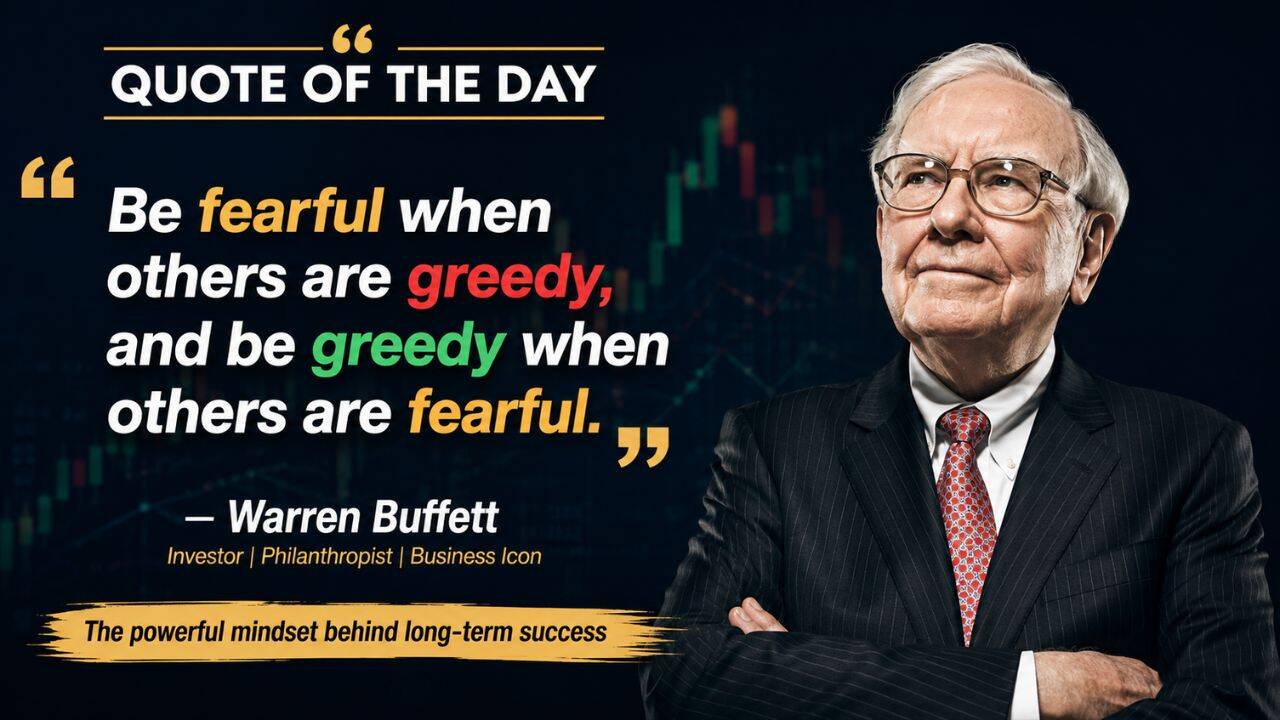
That man is Warren Buffett. During the absolute nadir of the Great Recession, he penned an op-ed for The New York Times containing a phrase that would echo through modern financial history: "Be fearful when others are greedy, and be greedy when others are fearful."
It sounds simple. A tidy little maxim you might find inside a corporate fortune cookie. But practicing it? That requires a form of psychological warfare against your own biology.
The Monster in the Mirror
Human beings are wired for the pack. Thousands of years ago, if the rest of your tribe started running away from a rustling bush, you didn't stand there and analyze the statistical probability of a predator. You ran. The people who stopped to think became lunch.
We carried that evolutionary baggage straight into the modern stock market.
To understand how this plays out, let us look at two hypothetical investors: Sarah and Dave. They are not real people, but they exist in every brokerage account on earth.
Sarah enters the market during a raging bull run. Everywhere she looks, people are getting rich. Her neighbor just bought a Tesla with crypto winnings. Her coworker is bragging about a tech stock that doubled in three months. The financial news anchors are smiling, throwing around phrases like "unstoppable momentum."
Sarah feels a sharp, agonizing pang of envy. The fear of missing out—FOMO—clutches her chest. She can't take it anymore. She logs into her account and buys at the absolute peak of the market. She feels safe because everyone else is doing it. She is part of the herd. This is the definition of greed masked as confidence.
Then, the tide turns.
A sudden economic shock hits. The market drops 10% in a week. Then 20%. The cheerful news anchors are replaced by grim analysts predicting a prolonged depression. Dave, who bought in right alongside Sarah, watches his account balance dwindle. He can't sleep. Every morning he wakes up, checks his phone, and feels a physical sickness in his gut.
"I have to stop the bleeding," Dave whispers to himself.
He sells everything at a massive loss, vowing never to touch stocks again. He feels a sudden wave of relief. The pain stops. But he just locked in his losses, destroying his long-term wealth because he let the collective terror dictate his actions.
The Mathematics of Emotion
What Sarah and Dave failed to realize is that the stock market is the only marketplace in the world where the goods go on sale and everyone runs out of the store in a panic.
Think about it through a simple analogy. If your favorite grocery store suddenly slashes the price of prime rib by 50%, you don't sprint out the front door screaming about a meat crisis. You buy a second freezer. You stock up.
Yet, when the market slashes the price of the world's finest companies by 30%, people treat those companies like toxic waste.
Buffett’s philosophy hinges on a fundamental truth about human nature: price and value are not the same thing. Price is what you pay. Value is what you get. When greed runs rampant, prices skyrocket far above actual value. When fear takes over, prices plunge far below it.
During that terrifying stretch of 2008, Buffett didn't just preach this gospel; he lived it. Berkshire Hathaway pumped billions of dollars into companies like Goldman Sachs, General Electric, and Dow Chemical when no one else would touch them. He wasn't gambling. He knew these institutions were fundamentally sound, but they were being punished by the overwhelming wave of market hysteria.
Years later, those contrarian bets yielded billions in profits. He bought the prime rib when it was on sale.
Standing Naked When the Tide Goes Out
It is easy to nod along with this logic when the markets are steady. It makes sense on paper. But when the ground beneath your feet actually starts shaking, rational thought becomes a luxury.
Buffett famously noted that you only find out who is swimming naked when the tide goes out.
When the money is flowing easily, everyone looks like a genius. Speculators take on massive debts, companies with zero revenue are valued at billions, and caution is thrown to the wind. That is the tide coming in. It covers up all the flaws, the bad decisions, and the sheer recklessness of the crowd.
But the tide always goes out. Always.
When the liquidity dries up and panic sets in, the recklessness is exposed. The people who built their fortunes on the shifting sands of public opinion are washed away. To survive that inevitably recurring cycle, an investor needs something far rarer than intelligence. They need temperament.
You do not need a three-digit IQ to be a successful investor. You do not need to understand complex algorithmic modeling or high-frequency trading patterns. You need the emotional fortitude to stand entirely alone in a room full of screaming people, look at the exit doors everyone is jamming themselves into, and walk calmly in the opposite direction.
The True Cost of Comfort
The crowd offers comfort. There is safety in numbers, even if those numbers are marching off a cliff.
Choosing to be greedy when others are fearful means accepting isolation. It means being called an idiot by the talking heads on television. It means watching your portfolio drop even further after you buy, because timing the exact bottom of a panic is impossible. It requires looking at short-term pain and choosing it willingly for the sake of a long-term future.
Most people cannot do it. They would rather lose money with the crowd than risk looking foolish by themselves.
The quiet office in Omaha remains largely unchanged today. The world outside continues its frantic dance, swinging wildly between the intoxication of easy wealth and the paralysis of sudden ruin. The headlines change, the technologies evolve, but the human heart remains exactly the same—flawed, terrified, and easily led.
The next time the screens turn red and the collective heartbeat of the world begins to race, remember the man at the wooden desk. The greatest victories are not won by outsmarting the competition. They are won by outlasting your own fear.