The pre-dawn air in the agricultural flats just east of Bangkok always smells of damp earth and diesel. At 4:00 AM, the world is muted, cast in a heavy, blue-gray haze that blurs the line between the sky and the endless network of drainage canals slicing through the rice paddies. It is a time when the city is still shaking off sleep, but for the workers heading toward a factory in Samut Prakan, the day is already well underway.
They boarded the old tour bus with the casual familiarity of people who measure their lives in shifts. There were twenty-eight people inside. Some leaned their heads against the vibrating windowpanes, catching a few final moments of rest. Others chatted quietly over the low hum of the engine, sharing early breakfast wrappers. They were neighbors, colleagues, and parents.
Then came the whistle.
A cargo train, heavy with freight and carrying the unstoppable momentum of hundreds of tons of steel, was barreling down the tracks toward the Khlong Khwaeng Klan railway crossing in Chachoengsao province. What followed in the next fraction of a second is a story that repeats itself with tragic frequency across the globe, a stark reminder of what happens when infrastructure fails to keep pace with human life.
The Geography of Risk
To understand how eight people lost their lives on that humid morning, one must look closely at the physical space where the collision occurred. It was not a grand, multi-lane intersection with flashing neon barriers and computerized gates. It was a rural crossing, a place where asphalt simply cuts across iron.
Consider the mechanics of a train crossing. For a driver behind the wheel of a heavy bus, visibility is everything. On this particular morning, the combination of early morning mist, low light, and the angle of the approach created a blind spot. Local residents later noted that the crossing lacked an automatic barrier—a physical gate to drop down and forcefully signal that a train was coming. Instead, the intersection relied entirely on human vigilance and a single, distant siren.
When a cargo train is moving at high speed, it cannot stop for an obstacle. The physics are unyielding. It requires over a kilometer of track for a fully loaded freight train to come to a complete halt even after the emergency brakes are applied. The responsibility for survival sits entirely on the road vehicle.
The driver of the bus, tasked with navigating the dim light and the chatter of twenty-seven passengers, moved forward. The train struck the bus with a force that tore the vehicle apart, twisting metal as if it were foil and scattering the remnants across the gravel banks of the railway line.
The Cost in the Dirt
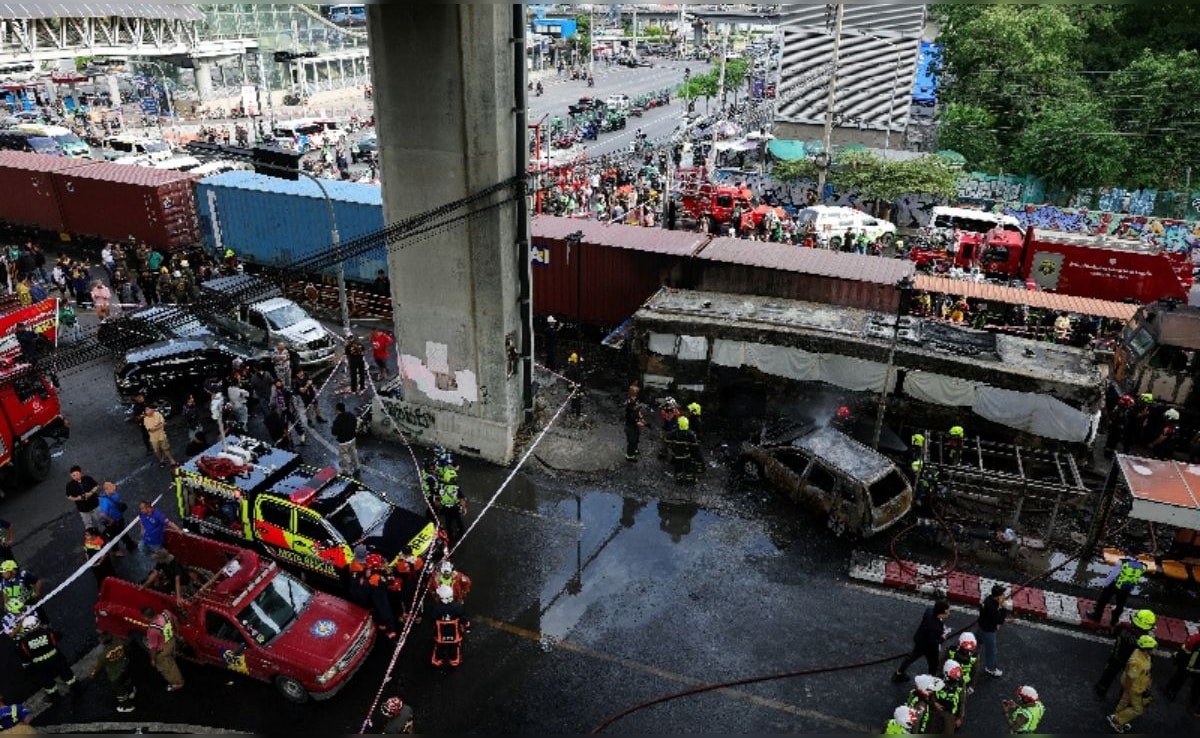
The immediate aftermath of a major transport disaster is defined by an eerie, sudden silence, followed rapidly by chaos. Emergency responders arriving at the Khlong Khwaeng Klan crossing were met with a scene of devastation that numbers alone fail to convey.
Eight individuals died almost instantly. Twenty others were injured, their bodies broken by the sheer kinetic energy of the impact. Rescue workers in bright vests worked under the rising sun, using hydraulic cutters to pry open the crushed frame of the bus.
- Eight fatalities: The immediate loss of life that left families across the district suddenly fractured.
- Twenty injured: Survivors rushed to nearby hospitals, facing long recoveries from trauma, fractures, and internal injuries.
- Zero barriers: The critical infrastructure deficit that allowed two massive machines to occupy the same space at the same time.
Behind each of those statistics sits a specific reality. A pair of shoes left on the floorboards of the bus. A mobile phone ringing continuously on the gravel, displaying the name of a relative who was waiting for updates. These are the details that standard accident reports omit, yet they are the very things that define the event for those who survive it.
The Broken Circuit of Prevention
It is tempting to look at a tragedy like the one in Chachoengsao and blame human error alone. The driver should have looked closer. The train should have sounded its horn louder. But analyzing disasters through the lens of individual blame misses the larger systemic failure.
Safety is not a product of luck; it is a product of design. In transport logistics, there is a concept known as the "Swiss cheese model" of accident causation. Imagine several slices of Swiss cheese stacked together. Each slice represents a layer of defense: a warning sign, a clearing of trees for better visibility, an audible alarm, and finally, a physical barrier. Usually, the holes in the cheese do not line up. But occasionally, every single defense fails simultaneously, and the hazard passes straight through to cause a catastrophe.
At this rural crossing outside Bangkok, the holes lined up perfectly.
The lack of a physical gate meant there was no final, fail-safe barrier to stop the bus. The early morning fog reduced visual acuity. The sound insulation of the bus cabin may have muffled the approaching train's whistle. When these factors converged, the result was mathematically predictable.
The Echo in the Community
The impact of a rail disaster ripples far beyond the tracks. For the families of the eight workers who perished, life changed irrevocably in a single second. The income they brought home is gone, creating immediate financial precarity in households that operate on tight margins. The emotional toll is immeasurable, a sudden void where a living, breathing person sat just hours before.
For the twenty survivors, the physical pain is accompanied by psychological trauma. The sound of a tearing metal frame, the sudden lurch of a vehicle, the realization of vulnerability—these are memories that do not wash away with medical treatment. They linger, altering how these individuals interact with the world, how they commute, and how they view their own safety.
Moreover, the accident cast a long shadow over the local community. Residents had long campaigned for better safety measures at the Khlong Khwaeng Klan crossing, knowing that the intersection was a hazard waiting to be triggered. The tragedy converted their anxieties into grief, sparking a broader conversation across Thailand about the safety of its vast, aging transport network.
The Mandate for Change
The true tragedy of the Chachoengsao collision is that it was entirely preventable. Across the globe, infrastructure upgrades have proven time and again that installing automatic gates and active warning systems dramatically reduces crossing fatalities to near zero.
It is a question of priority and allocation of resources. Rural crossings are frequently neglected in favor of high-profile urban transit projects, leaving working-class commuters to navigate high-risk zones daily. The cost of installing a standard automated barrier is minuscule compared to the economic and human cost of a single mass-casualty event.
As the sun reached its peak over the crash site later that afternoon, the wreckage was cleared away. The twisted metal was hauled to a salvage yard, the debris swept from the tracks, and the rail line reopened for service. Another cargo train passed through the intersection just hours later, its whistle echoing across the fields.
The tracks were clear, but the soil beside them remained forever altered. The passage of time will eventually smooth over the physical scars on the landscape, but for the community left behind, the silence at the crossing will always be deafening.