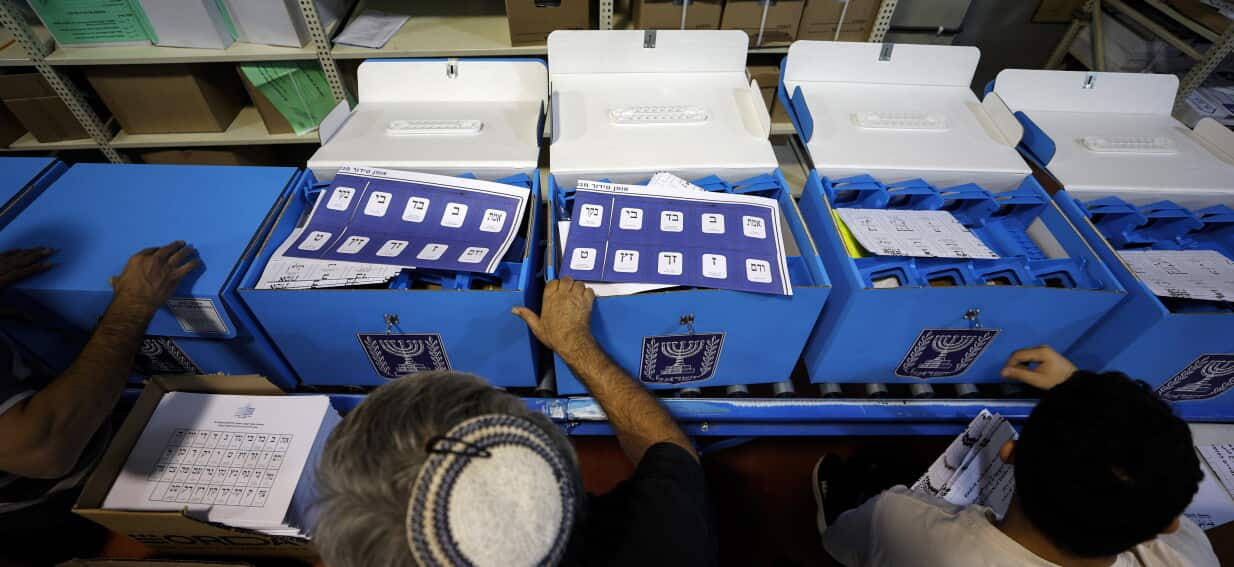
Most international news outlets treat Israeli election day like a standard two-horse race, and that's almost always the wrong way to read the room. You see the live tickers, the breathless exit poll predictions at 10 p.m. local time, and the immediate declarations of victory before a single physical ballot is actually counted.
Honestly, if you're only watching the top two party leaders, you're missing the entire mechanical reality of how power gets built in Jerusalem. Meanwhile, you can explore related stories here: Why Putin Called Elon Musk a Real Genius After Satellite Talks.
Israel doesn't have district-based representation like the United States or the United Kingdom. The entire country acts as one single electoral district. When Israelis walk into polling stations—often set up inside neighborhood elementary schools—they aren't voting for a specific person to represent their street. They're dropping a small paper slip with Hebrew letters on it into a blue cardboard box, casting a ballot for a closed party list.
That single structural detail changes everything about election day. To see the bigger picture, check out the detailed analysis by USA Today.
The 3.25% Cliff That Decides Governments
Here's the number that actually keeps campaign strategists awake at night. It isn't 61, even though 61 seats in the 120-seat Knesset is the magic number needed to form a majority coalition.
The number that breaks campaigns is 3.25%.
Under Israeli election law, a party must win at least 3.25% of the total valid votes nationwide to enter the Knesset at all. Fall just a fraction of a percent short—say, 3.20%—and every single one of those ballots goes straight into the trash. Those votes don't get redistributed to ideologically similar allies. They simply vanish from the seat calculation, artificially inflating the seat counts of the parties that did clear the bar.
Think about what that does on election afternoon.
Around 2 p.m. or 4 p.m., when the Central Elections Committee releases updated voter turnout figures, panic sets in at party headquarters. You'll suddenly see major bloc leaders begging their own supporters not to vote for them, urging voters instead to cast ballots for a smaller allied faction hovering right on the edge of that 3.25% cliff. If a small partner dies at the threshold, the whole ideological bloc can lose its path to 61 seats overnight.
I've watched seasoned political operatives spend the final three hours of voting glued to precinct-level turnout spreadsheets in specific cities— places like Petah Tikva, Beersheba, or Nazareth—trying to calculate whether a minor party is about to survive or wipe out an entire coalition math equation.
Why Exit Polls Regularly Embarrass Broadcasters
If you're following live election updates from abroad, do yourself a favor and treat the 10 p.m. television exit polls with heavy skepticism.
Israeli broadcasters—Channels 11, 12, and 13—spend massive budgets setting up sample ballot boxes outside dozens of polling stations across the country. Voters exit the official booth and cast a mock ballot for the TV networks. At 10 p.m. sharp, when most polls close, the anchors reveal their projections.
They get it wrong with surprising regularity.
Why? Because Israeli elections routinely hinge on one or two seats, and exit polls struggle with specific demographics. Ultra-Orthodox (Haredi) neighborhoods and Arab-Israeli towns historically show different response rates to exit pollsters than secular neighborhoods in Tel Aviv or Haifa. On top of that, Israel uses a complex mathematical formula called the Bader-Ofer method to distribute leftover seats after whole-number quotas are assigned. Two parties can sign a surplus-vote sharing agreement weeks before the election, and a few thousand late-night votes can shift a single seat from one bloc to another at 3 a.m.
The real counting doesn't even start until the cardboard boxes are sealed, signed by local committee observers from rival parties, and transported to regional counting centers. Then comes the "double envelopes."
The Double Envelope Reality Check
Standard neighborhood votes get tallied through the night and into the next morning. By breakfast time in Tel Aviv, you usually have about 90% of the vote counted.
Then the drama stalls for another 24 to 48 hours.
That's when the Central Elections Committee counts the double envelopes—ballots cast by people who couldn't vote at their assigned home precinct. This group includes:
- Active-duty Israel Defense Forces (IDF) soldiers voting on bases
- Diplomats and embassy staff stationed overseas
- Hospital patients and medical staff on shift
- Prisoners and detainees
- Individuals with disabilities using accessible polling stations outside their home districts
Because these voters aren't crossed off a local precinct paper list, they place their ballot inside a blank inner envelope, which then goes inside a second outer envelope bearing their name and ID number. Officials have to manually verify every single outer envelope against the national registry to ensure nobody voted twice before opening the inner envelope to preserve ballot secrecy.
Since young IDF soldiers skew differently demographically than the general population, those hundreds of thousands of double-envelope ballots routinely shift 2 to 4 Knesset seats two days after the pundits have already written their post-mortems.
What Actually Happens After the Votes Are Counted
Winning the most seats doesn't automatically make someone Prime Minister. Not even close.
In Israel's parliamentary system, the party that finishes first has zero legal guarantee of leading the government. Once the official results are certified—usually about a week after election day—the President of Israel holds formal consultations with representatives from every party that cleared the 3.25% threshold.
Each party leader walks into the President's Residence in Jerusalem on live television and names the specific Knesset member they recommend to form a government.
The President then hands the mandate to whichever candidate has the highest realistic chance of assembling a 61-seat coalition—not necessarily the leader of the largest single party. From there, the real horse-trading begins. Under Israeli law, the designated candidate gets 28 days to negotiate coalition agreements, with a possible 14-day extension from the President.
These coalition agreements aren't vague policy statements. They're hyper-specific legal documents detailing cabinet ministries, deputy minister slots, Knesset committee chairmanships, budget allocations for specific constituencies, and legislative commitments down to exact timelines.
How to Read Live Election Updates Without Getting Misled
If you're tracking a high-stakes Israeli election as it unfolds, ignore the loud rhetoric and watch four concrete indicators instead:
- Regional Turnout Disparities by 6 p.m. Compare turnout percentages in Arab-majority cities and Haredi municipalities against the national average. A five-point drop in either sector drastically alters the final seat math before polls even close.
- Parties Polling Between 3.0% and 4.0%. Watch the raw vote totals for small factions near the threshold. Every party that falls just short hands free seats to the surviving parties.
- Surplus-Vote Agreements (Bader-Ofer). Check which pairs of parties signed vote-sharing deals ahead of election day. When the final 120th seat comes down to a few hundred votes, that technical agreement decides who gets it.
- The 61-Seat Bloc Math, Not First Place. Stop looking at who is in first place. Add up the total seats held by parties committed to recommending the same candidate to the President.
Skip the early victory speeches at midnight, wait until the double envelopes are fully processed by the Central Elections Committee, and keep your eyes strictly on whether either ideological bloc actually holds 61 firm recommendations before the presidential consultations begin.


