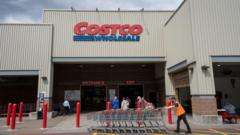
The class-action litigation against Costco Wholesale Corp. regarding the non-refund of tariffs on returned merchandise exposes a structural friction point between retail accounting systems and federal customs regulations. At its core, the dispute is not merely about consumer dissatisfaction; it is a breakdown in the Duty Drawback mechanism and the downstream "pass-through" of tax liabilities to the end-user. When a consumer returns a product, the reversal of the sale usually triggers a reversal of sales tax, but the underlying tariff—paid by the importer to U.S. Customs and Border Protection (CBP)—remains embedded in the cost of goods sold (COGS) unless specifically reclaimed through a complex administrative process.
The Calculus of Embedded Tariffs
Retailers operate under a pricing model where the "landed cost" of an item includes the manufacturer’s price, freight, insurance, and duties. In the current trade environment, specifically regarding Section 301 duties on Chinese-origin goods, these tariffs can range from 7.5% to 25%. Unlike sales tax, which is an ad valorem tax added at the point of sale (POS) and remitted to state authorities, a tariff is a "hidden" cost factored into the shelf price.
The legal tension arises from the Asymmetry of Tax Visibility.
- Explicit Taxes: Sales taxes are transparent. When a return occurs, the retailer acts as a conduit, returning the tax collected to the consumer and claiming a credit from the state.
- Implicit Taxes: Tariffs are opaque. They are paid by Costco (the importer of record) months before the item reaches the shelf. When the consumer pays $100 for an item, $15 might represent the tariff cost. If the consumer returns the item, they expect the full $100. If the retailer only refunds the pre-tariff amount or fails to adjust for a price increase driven by the tariff, the consumer effectively absorbs a tax for a product they no longer possess.
The Statutory Bottleneck of Duty Drawback
The primary mechanism for recovering paid duties is Duty Drawback (19 U.S.C. § 1313). This allows importers to claim a 99% refund of duties paid if the imported merchandise is subsequently exported or destroyed.
In a standard retail return loop, the returned item usually goes back into inventory or is liquidated. If the item stays within the commerce of the United States, the retailer (Costco) cannot legally claim a drawback from the federal government. This creates a stranded cost. If the retailer refunds the tariff portion to the consumer but cannot recover it from the government, the retailer takes a direct hit to its gross margin. Conversely, if the retailer refuses to refund the tariff portion—or fails to adjust the refund to match the tariff-inclusive price paid—the consumer is penalized.
The litigation suggests that Costco failed to maintain parity between the price paid (which included the tariff burden) and the price refunded. This is often a result of Legacy ERP Limitations. Most retail Enterprise Resource Planning systems are designed to handle SKU-level pricing and sales tax logic, but they are not dynamically linked to the "entry summary" data of the Customs Bureau. Therefore, the POS system may not "know" which specific tariff rate was applied to a specific unit at the time of its import, leading to "blended" refund amounts that under-compensate the buyer.
The Three Pillars of Retailer Liability
To evaluate the strength of the claim against Costco, we must deconstruct the retailer’s obligations through three distinct lenses:
1. Contractual Transparency
Costco operates on a membership model, which is a contract between the entity and the individual. This contract typically promises a refund of the "purchase price." The definition of "purchase price" is the primary battleground. If the price on the receipt is $100, and that $100 was reached because of a 25% tariff surcharge, any refund less than $100 constitutes a breach of the membership agreement. The retailer’s internal difficulty in recovering the duty from the government is legally irrelevant to the consumer's contractual right to a full refund of the consideration paid.
2. Unjust Enrichment
The "Unjust Enrichment" framework posits that the retailer is retaining a portion of the consumer’s money for which they provided no value (since the product was returned). If Costco increases prices to cover Section 301 tariffs and then retains the "tariff delta" upon return, they are effectively using the consumer as a micro-lender to cover their regulatory costs.
3. Systematic Precision in "Net-of-Tax" Calculations
The complexity increases when retailers use Weighted Average Cost (WAC) accounting. Because tariffs fluctuate based on trade policy shifts, two identical items on the shelf might have been imported under different duty regimes.
- Unit A: Imported at 0% duty.
- Unit B: Imported at 25% duty.
If the POS system uses a rolling average to calculate refunds rather than specific identification (linking the return to the exact import entry), the consumer who bought Unit B but is refunded based on the average price of Units A and B is being systematically underpaid.
The Operational Breakdown of Customs Compliance
Costco’s defense likely rests on the administrative impossibility of tracing specific tariffs to individual retail returns. The "Import-to-Shelf" pipeline involves several points of data degradation:
- The Entry Summary (CBP Form 7501): Filed at the port of entry for thousands of units.
- The Distribution Center (DC) Allocation: Units are de-consolidated and shipped to various warehouses.
- The Point of Sale (POS): The transaction is recorded, but rarely is the specific "Entry Number" from the 7501 form attached to the individual barcode (UPC/GTIN).
Without this digital thread, a retailer cannot prove to the CBP that a specific unit was returned and destroyed (to claim a drawback) nor can they easily automate the refund of the exact tariff amount to the customer. This lack of granular data creates a Compliance Debt.
Macroeconomic Implications of the "Tariff-Refund Gap"
This litigation is a lagging indicator of the volatility in U.S. trade policy. When tariffs are stable (e.g., the 0-3% range typical of the pre-2018 era), the "leakage" from un-refunded tariffs is negligible—often absorbed as a rounding error in "shrinkage" or "returns processing" costs. However, with Section 301 duties and subsequent "Trade War" escalations, the leakage has moved from the periphery to the center of the P&L statement.
For a high-volume, low-margin operator like Costco, a 1% error in refund calculations across a multi-billion dollar return volume represents tens of millions of dollars in misallocated capital. This creates a Negative Externality for the consumer: they are paying for the retailer's inability to modernize its customs-to-POS data integration.
Strategic Defense and Mitigation
Retailers facing this specific litigation risk must transition from a reactive "Customer Service" posture to a proactive "Tax Technology" posture.
- Specific Identification Logic: Upgrade ERP systems to associate "Land Cost Components" with individual serial numbers or batch codes at the POS. This allows the system to recognize the exact tariff burden of the item being returned.
- Dynamic Membership Disclosures: Explicitly define "Purchase Price" in membership agreements to clarify whether it includes or excludes non-recoverable federal duties—though this may face challenges under state consumer protection laws.
- Automated Drawback Filing: Utilize "Substitution Drawback" rules, which allow importers to claim refunds on "commercially interchangeable" goods. If Costco exports or destroys any inventory, they can use those exports to "match" against consumer returns, effectively recouping the duty they refund to the customer.
The Costco case serves as a warning that the "hidden" nature of tariffs is no longer a shield. As trade policy remains a primary tool of economic statecraft, the costs of those policies will continue to be litigated at the cash register. The winners in this space will be the firms that treat tariffs not as a fixed cost of doing business, but as a variable tax that must be managed with the same rigor as sales tax or VAT.
The immediate move for large-scale importers is a Customs Audit of Return Logs. Companies must quantify the delta between "Tariffs Paid on Imported Units" and "Tariffs Implicitly Refunded on Returned Units." If the delta is positive, the retailer is carrying a latent legal liability. If the delta is negative, they are hemorrhaging margin. The only sustainable path is a 1:1 data integration between the Customs Entry and the Register Receipt.