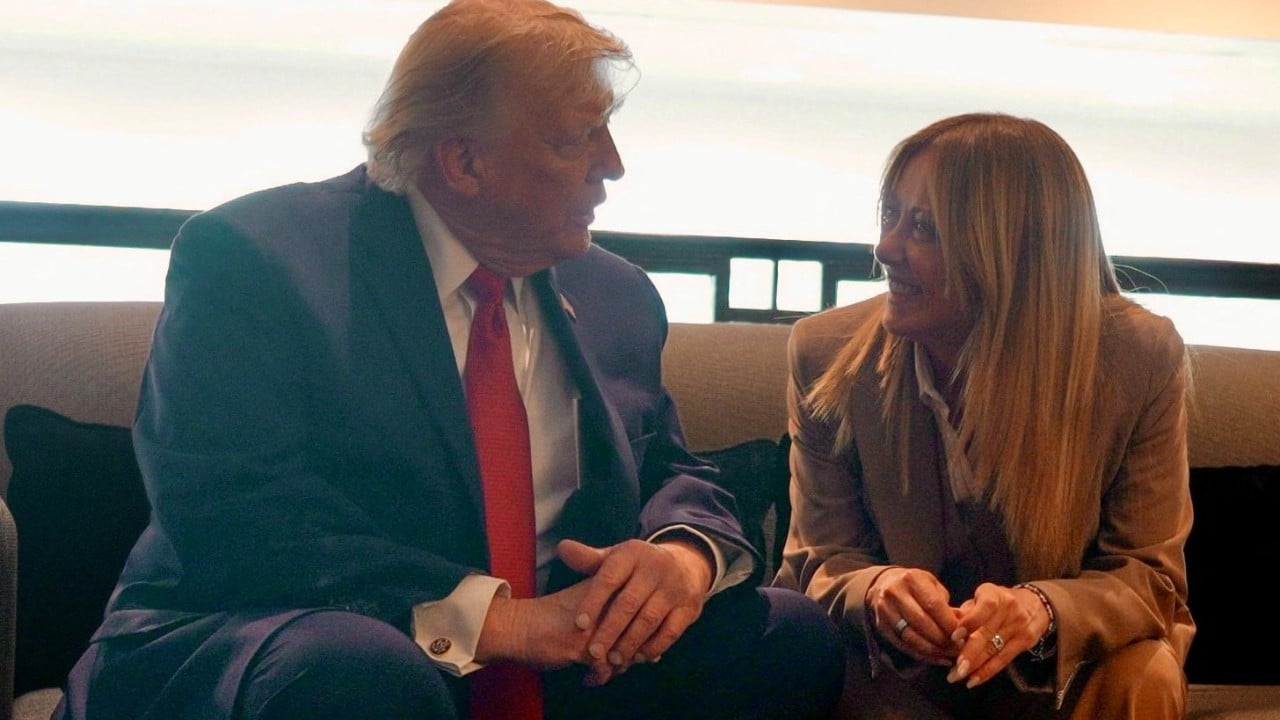
The air inside the G7 summit in Evian-les-Bains, France, carried the sharp, clean scent of alpine rain and expensive espresso. On a small velvet sofa tucked away from the main plenary hall, two people sat deep in conversation. To a casual observer, the scene looked exactly like what the world expected: a quiet huddle between the American president and his most reliable bridge to the European continent.
Giorgia Meloni sat forward, her posture rigid, her face carefully schooled into an expression of polite engagement. Across from her, Donald Trump gestured broadly, the cadence of his voice carrying that familiar, unyielding confidence. For months, this was the posture Meloni had chosen. Smile. Absorb the friction. Keep the channels open.
But behind the polite smiles of international diplomacy lies a brutal calculus of human endurance. Every politician has a ledger. You balance the public slights against the national interest. You swallow a personal insult if it secures a trade route, protects a military alliance, or keeps a superpower from upending the global order. For over a year, Italy’s first female prime minister kept her ledger firmly in the black by paying with her own silence.
Then came the broadcast on Italy’s La7 network.
The American president, speaking with a journalist, casually tossed a match into the dry kindling of their alliance. He claimed that during their quiet moment in France, Meloni had "begged" him for a photograph. He recounted the story with the breezy condescension of a monarch bestowing a favor on a desperate subject, claiming he only agreed because he felt sorry for her.
The response from Rome did not come via a dry, third-person press release from a ministry spokesperson. It came directly from Meloni, captured on video, her eyes locked onto the camera lens with cold, unmistakable clarity.
"Donald Trump's statements are completely fabricated," she said, her voice dropping to a register that signaled an absolute end to the patience she had carefully cultivated since January 2025. "I am frankly stunned. But there is one thing he must remember: Italy and I do not beg."
To understand how a casual piece of bravado over a photo-op managed to derail a crucial transatlantic alliance, you have to look past the headlines and into the fragile mechanics of political identity. Pride is not just an emotion in high-stakes geopolitics; it is currency. When a leader allows their country to be framed as a supplicant, they lose the ability to govern at home.
Consider the trajectory that brought them to this velvet sofa. When Trump began his second mandate in early 2025, Meloni was the lone European Union head of state to fly to Washington for his inauguration. She had positioned herself as the ideological translator between a skeptical, nervous Europe and a disruptive American administration. They shared common ground on border control and traditional values. Trump publicly called her "fantastic" and "incredible."
But a relationship built entirely on transactional alignment is highly volatile. The first hairline fractures appeared in April 2025, when the conflict between the United States and Iran escalated into open warfare. When Pope Leo XIV condemned the American military action, Trump took to Truth Social to label the pontiff "WEAK on Crime."
For Meloni, a leader whose political foundation is deeply intertwined with Catholic tradition and Italian sovereignty, that attack was a profound miscalculation. She called the criticism unacceptable. Trump fired back through the pages of Corriere della Sera, declaring, "I thought she had courage, but I was wrong."
Still, Meloni held her tongue. She chose to absorb the blow because the alternative—an open, raging feud with the commander-in-chief of the world's most powerful military—seemed too costly for Italy. She chose the path of the pragmatist.
But pragmatism has a breaking point.
The real problem with enduring constant, low-level humiliation is that it creates an illusion of permanent submission. When you let the small jibes slide, the bully assumes the boundaries have been permanently erased. By transforming a policy disagreement over airspace into a personal narrative of a woman begging for his attention, Trump crossed from the realm of political theater into personal degradation.
The fallout was immediate and concrete. Italian Foreign Minister Antonio Tajani abruptly canceled a high-profile, long-planned diplomatic visit to the United States. "The serious and offensive words of President Trump offend all of Italy," Tajani wrote, drawing a defensive perimeter around his prime minister.
Trump did not deescalate. He doubled down on his social media platform, misspelling her name as "Gigiorgia" and mocking her domestic poll numbers, suggesting she was only trying to use his star power to lift her political fortunes. He criticized Italy for refusing to allow American bombers to use Italian airfields for strikes in the Middle East.
Meloni’s counterstrike on Instagram was surgical. She published a screenshot of his attack and addressed him directly in English, stripping away the traditional insulation of diplomatic decorum.
"As for my popularity, being your friend certainly has not helped it," she wrote. Then, she delivered the structural blow, defending her refusal to open Italy’s runways for the Iran war: "Their use is governed by agreements that we have always respected, and that cannot be violated as long as I am Prime Minister. Italy remains a sovereign nation."
It is a chilling reminder of how quickly the architecture of global stability can fracture under the weight of personal vanity. Human ego is the invisible variable in every treaty, every mutual defense pact, and every trade agreement. We like to imagine that international relations are governed by grand theories of realism, economics, and institutional frameworks. We build massive bureaucracies to maintain the illusion that the system is rational.
But the system is only as stable as the people sitting on the velvet sofas. When the human element curdles into disrespect, the treaties begin to look like very thin pieces of paper.
Meloni’s domestic approval ratings currently hover around 35 percent, while Trump’s sit near 36 percent. Both are fighting intense domestic battles against inflation and political exhaustion. Yet, instead of finding common cause, they are locked in an escalating war of words because neither can afford to look weak to the audiences back home.
The tragedy of the modern political landscape is that accommodation is so often mistaken for capitulation. Meloni spent a year trying to be the adult in the transatlantic room, holding open a door that others wanted to slam shut. Her reward was a public narrative that painted her as an entitlement seeker waiting for a scrap of American validation.
The image that lingers now is not the photograph Trump claimed she begged for. It is the video of Meloni standing before the microphones in Rome, her expression devoid of the warmth she once brought to Mar-a-Lago. She looked like someone who had calculated the exact cost of her silence and decided, finally, that the price was simply too high to pay.