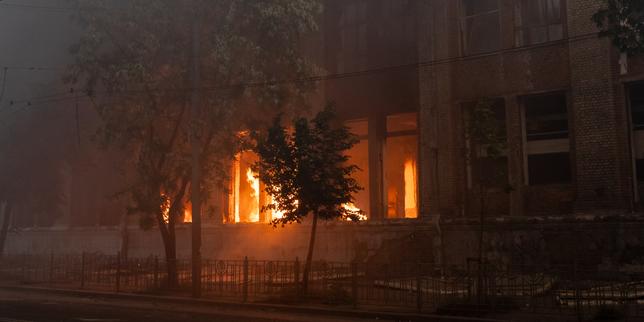
The immediate consequence of delayed Western military support is measured in fractured infrastructure and strained air defense networks across Ukraine. Following a massive wave of Russian missile and drone strikes targeting critical energy grids, Ukrainian President Volodymyr Zelensky has issued another urgent appeal to international allies for enhanced defensive capabilities and the authorization to strike launch sites deep within Russian territory. While diplomatic rhetoric often centers on funding approvals, the actual bottleneck is a mix of depleted Western stockpiles, bureaucratic red tape, and a lingering fear of escalation among NATO members. Ukraine requires interceptors and long-range strike capabilities now, not promises for next year.
To understand why Ukraine remains vulnerable despite billions of dollars in pledged aid, one must look beyond the political announcements and examine the cold realities of industrial warfare.
The Air Defense Math That Favors the Aggressor
Air defense is fundamentally an asymmetrical economic battle. Russia manufactures and deploys low-cost kamikaze drones alongside sophisticated ballistic and cruise missiles. A single drone can cost a fraction of the price of the interceptor missile used to bring it down. When dozens of these targets are launched simultaneously, they overwhelm radar systems and deplete finite stockpiles of ammunition.
Western allies have supplied advanced platforms like the Patriot, NASAMS, and IRIS-T systems. These systems are highly effective. However, the production rate of the interceptor missiles they fire is severely lagging behind the consumption rate on the front lines. A Patriot missile battery cannot protect a city if its launchers are empty.
This scarcity forces Ukrainian commanders into a brutal daily triage. They must choose between protecting major civilian population centers, safeguarding thermal power plants, or shielding military maneuvers on the front lines. Every choice to defend one asset leaves another exposed to devastation.
The Industrial Production Gap
For decades, Western defense procurement operated on a peacetime footing. Factories produced high-tech equipment at a leisurely pace, optimized for low-intensity conflicts rather than prolonged, high-attrition artillery and missile duels.
- Lead Times: Ordering a new batch of advanced air defense missiles can take anywhere from 12 to 24 months from contract signing to delivery.
- Supply Chain Chokepoints: Shortages of specialized components, from solid-rocket motor fuel to advanced microchips, limit how quickly factories can scale production.
- Stockpile Depletion: Many European nations have already dipped into their strategic reserves to a degree that defense officials warn compromises their own national security frameworks.
The Strategy of Forced Neutralization
The current Western strategy emphasizes defensive containment over decisive neutralization. By restricting Ukraine from using supplied long-range weapons—such as ATACMS or Storm Shadow missiles—to strike military airfields and logistics hubs inside Russia, allies are forcing Ukraine to fight with one hand tied behind its back.
It is the military equivalent of trying to swat mosquitoes instead of draining the swamp.
intercepting a missile in mid-air is vastly more difficult than destroying the bomber or the launcher on the ground before it ever fires. The restriction on cross-border strikes creates a sanctuary zone for Russian forces. They can mass troops, store ammunition, and launch sorties with near-impunity just miles inside their own border, knowing Western weapons will not touch them.
The Escalation Argument Under Scrutiny
The primary justification for these restrictions has been the desire to avoid direct conflict between NATO and Russia. Policy circles frequently debate red lines that must not be crossed.
However, this calculation overlooks a critical historical precedent. Throughout the Cold War, proxy conflicts regularly involved the supply of advanced weaponry to combatants without triggering a global conflagration. By treating defensive restrictions as a moving goalpost, Western policymakers inadvertently signal hesitation. In geopolitical competition, hesitation is often interpreted as weakness, which invites further aggression rather than deterring it.
The Infrastructure Crises and Economic Collapse
The targeting of Ukraine's energy infrastructure is not a random act of terror; it is a calculated economic strategy. By knocking out power grids, heating plants, and water distribution networks, Russia aims to render Ukrainian cities uninhabitable, forcing further waves of refugees into Europe and crippling the domestic economy.
An economy without reliable power cannot sustain war production. Steel mills, drone assembly workshops, and logistics hubs all rely on a stable grid. When the lights go out, the cost of running the state skyrockets as reliance shifts to expensive, imported diesel generators.
+------------------------------------+----------------------------------------+
| Asset Type                         | Economic/Strategic Impact of Loss      |
+------------------------------------+----------------------------------------+
| Thermal Power Plants               | Destroys baseline grid stability      |
| Substations and Transformers       | Isolates regional economies            |
| Hydroelectric Facilities           | Risks systemic downstream flooding     |
+------------------------------------+----------------------------------------+
Repairing these facilities during an ongoing conflict is an exercise in futility if they cannot be protected from the next raid. Kyiv is forced to spend valuable resources rebuilding infrastructure that remains completely vulnerable to the next missile wave.
The Logistics of Weapon Deliveries
Even when political consensus is achieved and funding packages are signed into law, the physical journey of a weapon from a Western depot to the Ukrainian front lines is fraught with logistical friction.
Weapons must be transported across international borders, often via rail and road networks through Poland, Romania, or Slovakia. These routes are well-known bottlenecks. Labor strikes, political disputes, and border congestion can delay critical shipments by weeks. Furthermore, once inside Ukraine, transferring heavy equipment across a country under constant aerial surveillance requires meticulous planning to avoid destruction in transit.
Maintenance and training present additional hurdles. Providing a military with five different types of Western air defense systems creates a logistical nightmare. Each system requires its own specific spare parts, its own specialized mechanics, and its own unique training pipeline. Instead of a streamlined force, the Ukrainian military must manage a fragmented patchwork of technology.
True strategic support requires moving past sporadic emergency packages toward a predictable, industrialized pipeline of supply. Without a massive expansion of Western defense manufacturing capacity and the political will to lift restrictions on cross-border operations, Ukraine will remain trapped in a cycle of reactive defense. The air defense umbrella will continue to fray, and the true cost of this political caution will be paid in Ukrainian territory and human lives.