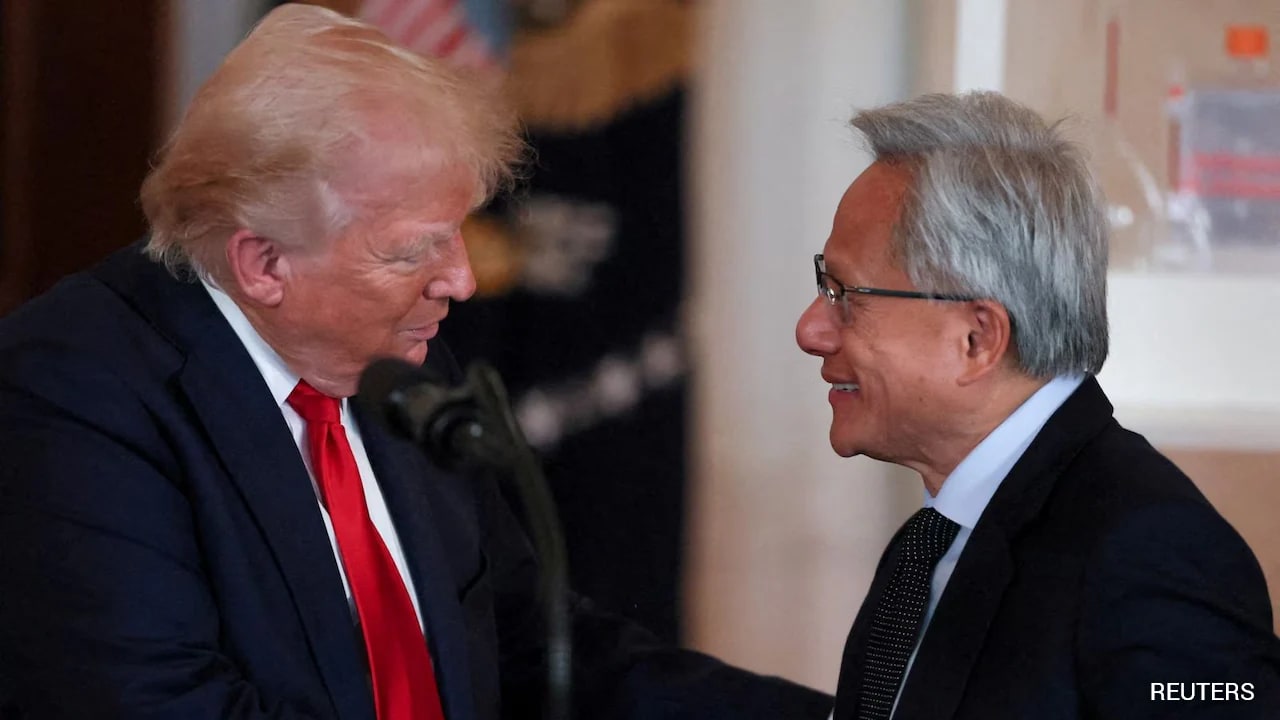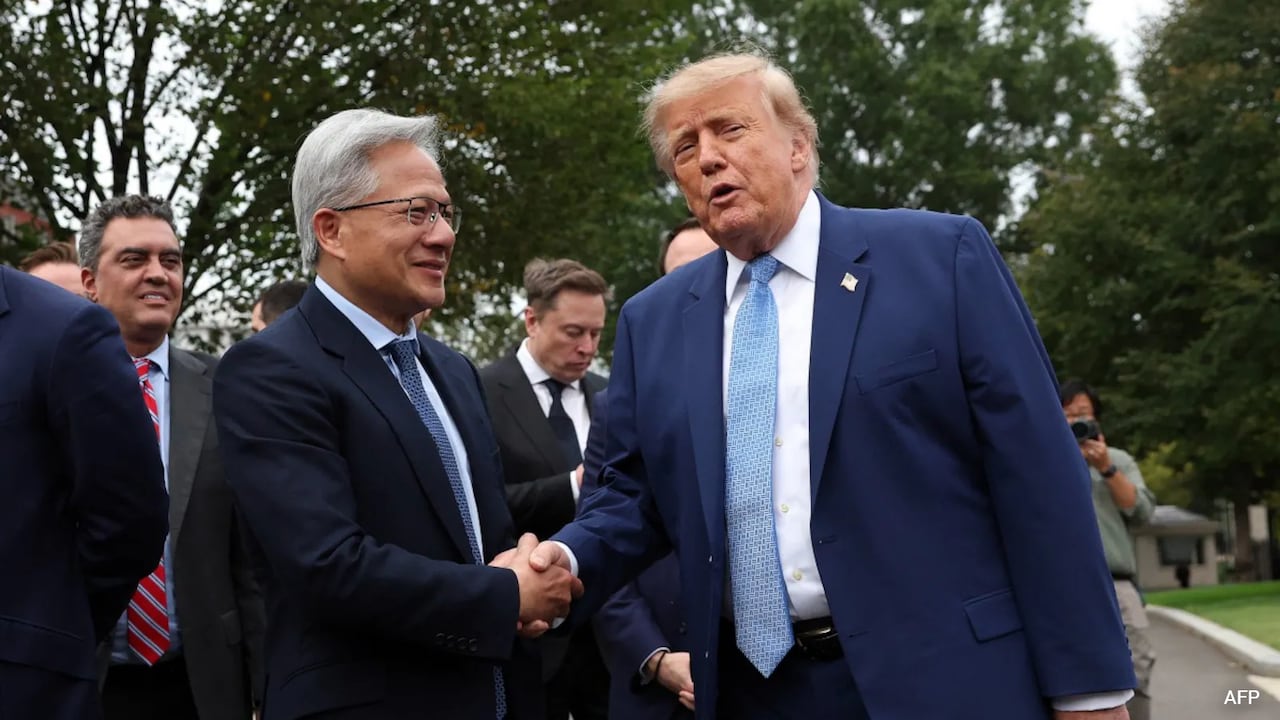
The intersection of executive branch advocacy and legislative oversight in the semiconductor sector represents a structural collision between industrial policy and national security governance. When former or departing administration officials publicly endorse specific hardware leaders—such as the political alignment between Donald Trump and Nvidia CEO Jensen Huang—that endorsement creates an immediate regulatory target for congressional committees tasked with enforcing export controls and supply chain security. To understand why legislative scrutiny intensifies around these executive relationships, analysts must examine the mechanics of dual-use technology governance, the incentive structures of hyperscale compute suppliers, and the institutional friction between executive discretion and statutory oversight.
The Structural Friction Between Executive Advocacy and Legislative Oversight
In United States technology policy, the executive branch and Congress operate under distinct constitutional and statutory mandates that frequently generate friction during periods of rapid technological transition. The executive branch, particularly through the White House, the Department of Commerce, and the National Economic Council, prioritizes domestic industrial competitiveness, capital formation, and macroeconomic growth. Publicly backing a market leader like Jensen Huang serves a clear political and economic signaling function: it validates domestic corporate dominance in artificial intelligence infrastructure and reassures capital markets of regulatory stability.
Congressional committees—specifically the House Select Committee on the Strategic Competition Between the United States and the Chinese Communist Party, the Senate Committee on Banking, Housing, and Urban Affairs, and the House Foreign Affairs Committee—operate under a different risk calculus. Their primary mandate in this sector is preventing the diffusion of advanced compute capabilities to strategic adversaries. Under the Export Control Reform Act of 2018 (ECRA), Congress delegated broad authority to the Department of Commerce's Bureau of Industry and Security (BIS) to regulate dual-use technologies. When lawmakers perceive that high-level political affinity between the executive branch and a dominant hardware vendor could soften enforcement or create tailored regulatory carve-outs, legislative oversight mechanisms activate to reassert statutory intent.
This dynamic is governed by principal-agent theory. Congress (the principal) delegates regulatory execution to executive agencies (the agents). When the executive leadership signals strong alignment with a regulated entity, legislators suspect agency drift—a scenario where enforcement priorities shift away from strict national security containment toward commercial facilitation. Congressional inquiries into the ties between political leadership and semiconductor executives are therefore not merely partisan exercises; they are institutional corrective mechanisms designed to audit whether commercial diplomacy is compromising export control integrity.
The Three Pillars of Semiconductor Regulatory Scrutiny
When congressional investigators examine the relationship between political figures and leading semiconductor executives, their inquiry systematically targets three operational vulnerabilities.
1. Export Control Threshold Calibration and Product Redesign Loops
The primary locus of legislative scrutiny involves how hardware specifications are modified to comply with—or circumvent—BIS restrictions. Following the October 2022 and October 2023 export control updates, which established strict ceilings on total processing performance (TPP) and interconnect bandwidth for chips destined for China, Nvidia engineered compliant variants (such as the A800, H800, and subsequently the H20).
From a corporate engineering perspective, modifying silicon architectures to fall just below statutory thresholds is standard compliance optimization. From a congressional oversight perspective, this iterative redesign loop demonstrates that static performance metrics fail to contain compute accumulation. Lawmakers scrutinize executive-level interactions to determine whether chipmakers receive advance visibility into regulatory thresholds or informal assurances regarding the permissibility of downgraded variants. If political backing translates into permissive licensing or delayed rule updates, the containment architecture degrades.
2. Supply Chain Concentration and Single-Vendor Dependency
Nvidia’s command over the data center GPU market and its proprietary CUDA software ecosystem creates a structural monopoly in AI training infrastructure. In economic terms, the company captures immense producer surplus while dictating the pace of global compute deployment. For policymakers, this concentration creates a single point of failure and a concentrated lobbying vector.
Congressional scrutiny intensifies when executive endorsements appear to validate a single-vendor industrial strategy. Lawmakers evaluate whether political favoritism distorts federal procurement, CHIPS and Science Act grant allocations, or sovereign AI partnerships abroad. Specifically, oversight committees examine whether executive support facilitates large-scale GPU shipments to intermediary jurisdictions—such as data center hubs in the Middle East or Southeast Asia—that could serve as transshipment or cloud-access proxies for restricted entities.
3. Lobbying Architecture and Regulatory Capture Risk
As a company transitions from a specialized graphics hardware vendor to a multi-trillion-dollar infrastructure pillar, its engagement with Washington scales proportionally. Congressional investigators map campaign contributions, executive meetings, trade association influence, and revolving-door hires between regulatory agencies and corporate government affairs teams.
The analytical distinction here lies between legitimate technical consultation and regulatory capture. Because modern semiconductor fabrication and AI cluster networking involve extreme technical complexity, regulators rely heavily on industry engineers to define feasible control parameters. However, when this technical advisory role coincides with high-profile political endorsements from top executive officials, lawmakers investigate whether the regulated firm is effectively writing its own compliance boundaries.
The Cost Function of Political Alignment for Hardware Monopolies
For a chief executive leading a critical infrastructure firm, securing the public backing of a president or incoming administration carries asymmetric payoffs. A clear cost-benefit analysis reveals why executives pursue this alignment despite the certainty of triggering legislative blowback.
The immediate benefits of executive alignment include:
- Tariff and Trade Exemption Leverage: Direct access to executive decision-makers increases the probability of securing exemptions from broad-based import tariffs on servers, printed circuit boards, and sub-components assembled across Asian supply chains.
- Sovereign Deal Facilitation: Executive backing acts as a force multiplier when negotiating state-backed compute infrastructure contracts with foreign governments, where diplomatic clearance is a prerequisite for export licenses.
- Antitrust Buffer: A favorable posture from the executive branch can moderate the aggressiveness of the Department of Justice or the Federal Trade Commission regarding market dominance and software bundling practices.
Conversely, the cost function imposes severe long-term liabilities:
- Bipartisan Legislative Alienation: In a polarized legislature, overt alignment with one political faction alienates opposing committee chairs, turning routine regulatory reviews into adversarial subpoenas and public hearings.
- Accelerated Statutory Tightening: When lawmakers suspect executive leniency, they bypass the regulatory rulemaking process entirely by embedding rigid, non-waivable hardware restrictions directly into must-pass legislation such as the annual National Defense Authorization Act (NDAA).
- Reputational Securitization: Excessive political visibility frames the company not as a neutral commercial supplier, but as an instrument of statecraft, complicating its relationships with international enterprise customers and foreign regulators.
Cause-and-Effect Mechanics in Export Control Enforcement
Superficial political reporting often treats congressional investigations as isolated reactions to specific headlines or meetings. In reality, legislative scrutiny follows a predictable causal chain driven by market data and intelligence assessments.
First, commercial export data or gray-market hardware teardowns reveal that restricted entities continue to acquire high-end compute capacity, either through third-party shell companies, cloud compute rentals, or newly engineered compliant chips. Second, intelligence briefings to congressional committees attribute this capability retention to lags in executive branch enforcement or loopholes in BIS licensing criteria. Third, lawmakers cross-reference those regulatory delays against the timeline of executive-level meetings, public endorsements, and corporate lobbying disclosures.
This causal sequence explains why scrutiny persists even after a political transition or an official's departure from office. Congressional oversight is retrospective by design; committees audit past executive decisions to establish legal precedents and constrain the discretionary authority of the incoming administration. When a departing leader publicly champions a chief executive, that endorsement serves as an evidentiary marker for legislators seeking to prove that commercial considerations previously outweighed national security protocols.
Distinguishing Known Mechanisms from Speculative Narratives
Rigorous analysis requires separating documented institutional processes from unverified political speculation.
It is an established fact that Nvidia operates at the center of US-China technological competition, that its executives regularly engage with senior policymakers across administrations to advocate against overly broad export restrictions, and that congressional committees actively monitor export license approvals and chip performance thresholds. It is also documented that executive branch leaders frequently highlight domestic corporate champions to project economic strength.
What remains speculative—and requires empirical verification through formal oversight—is whether personal rapport or public political backing directly alters specific BIS licensing determinations or delays specific regulatory tranches. Regulatory rulemaking at the Department of Commerce involves interagency review across the Departments of Defense, State, and Energy. While White House directives establish broad policy posture, altering specific technical parameters requires navigating complex bureaucratic sign-offs that leave extensive paper trails. Congressional investigators focus precisely on those interagency communications to determine whether political signals overrode technical national security objections.
Limitations of Legislative Oversight in Fast-Moving Tech Markets
While congressional scrutiny imposes significant reputational and compliance costs on hardware executives, legislative oversight suffers from structural limitations that prevent it from fully controlling technology diffusion.
- The Latency Gap: Legislative inquiries and statutory revisions operate on multi-month or multi-year cycles, whereas semiconductor design iterations and AI model training runs evolve on quarterly cycles. By the time a committee concludes an investigation into a specific chip variant, the manufacturer has already transitioned production to a next-generation architecture.
- Information Asymmetry: Congressional staffers rarely possess the deep microarchitectural expertise required to evaluate how software optimizations—such as model quantization, sparsity techniques, or distributed training protocols—can compensate for hardware interconnect limits. Vendors retain a permanent technical advantage in defining what constitutes a "frontier" capability.
- Global Substitution Effects: Overly aggressive unilateral restrictions risk eroding US market share without halting adversary progress, as foreign buyers accelerate investment in domestic silicon alternatives and open-source software stacks that bypass proprietary US ecosystems entirely.
Strategic Execution for Semiconductor Leadership Under Dual-Branch Scrutiny
To navigate the structural tension between executive branch advocacy and congressional oversight without suffering punitive statutory blowback, hardware leadership must abandon reactive political alignment in favor of institutionalized regulatory insulation:
- Decouple Corporate Strategy from Partisan Endorsements: Maintain strict operational neutrality in public political communications. Frame all executive branch engagements strictly around objective national metrics—domestic supply chain resilience, onshore manufacturing job creation, and standard-setting leadership—rather than personal political rapport.
- Implement Proactive Compliance Telemetry: Voluntarily deploy hardware-level verification and telemetry frameworks (such as cryptographic attestation and location verification protocols for high-density data center deployments) before Congress mandates invasive statutory backdoors. Demonstrating auditable end-use control neutralizes the primary argument for blanket export bans.
- Institutionalize Bipartisan Technical Briefings: Establish continuous, staff-level technical education channels with key oversight committees in both chambers. By serving as an objective source of architectural data rather than a defensive lobbying target, leadership can shape feasible regulatory metrics before adversarial narratives solidify into rigid legislative mandates.