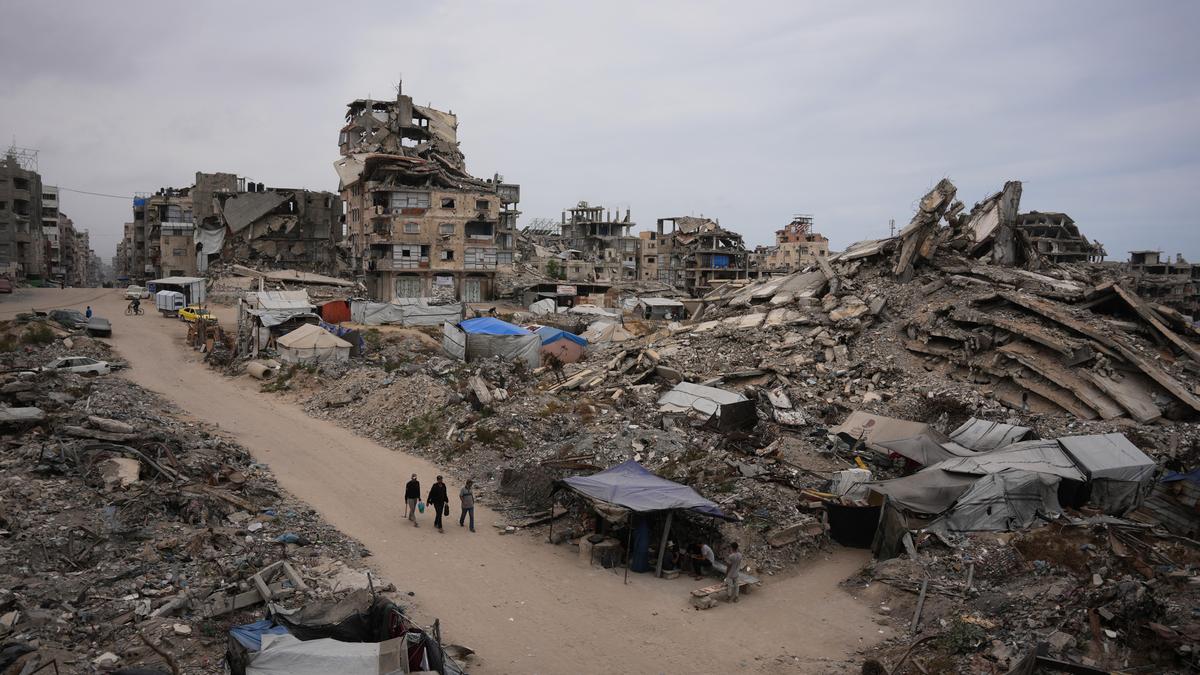
The air in Gaza does not circulate; it waits. It hangs heavy with the scent of pulverized limestone, exhaust fumes, and the sweet, sharp tang of overripe citrus from trees that somehow survive between concrete partitions. When the sky tears open, it does not sound like thunder. Thunder has a rolling, majestic cadence. A missile strike is a sudden, absolute erasure of sound, followed by a pressure wave that slaps the air out of your lungs before your brain registers the detonation.
For thirty-eight minutes after the blast, the only sound in the neighborhood was the rhythmic hiss of a ruptured water main.
We tend to consume geopolitics as a series of chess moves described in the passive voice. A target was neutralized. A strike was executed. Retaliation was delivered. But geopolitical chess is played with human pieces on a board made of living rooms, markets, and narrow alleyways where children kick deflated soccer balls against pockmarked walls. To understand the reality of a targeted strike against a senior militant commander, you have to look away from the military briefings and look instead at the architecture of a crisis. You have to look at the dust.
The Geography of the Crosshairs
Every targeted assassination begins as an exercise in intimacy.
To kill a high-value target in one of the most densely populated strips of land on earth requires knowing them better than they know themselves. It requires an invisible web of surveillance that tracks the specific cadence of a man’s gait, the exact time he prefers his morning tea, and the structural integrity of the ceiling above his head. For months, perhaps years, intelligence analysts thousands of miles away or buried in underground bunkers have mapped his life. They know his children’s names. They know which window he looks out of when he cannot sleep.
Consider the physics of the targeted building. In a standard military operation, artillery flattens a grid. In a precision strike, the goal is a surgical extraction using explosive force. Engineers calculate the payload required to collapse a specific floor while attempting—often with agonizingly imperfect results—to leave the adjacent structures standing. They use concrete-piercing munitions designed to delay detonation until the missile has traveled through three feet of reinforced materials.
The math is precise. The reality is chaotic.
When the missile struck the apartment complex, the target was reportedly inside, deep within a labyrinth of security protocols that had kept him alive through three previous wars. He was a man who moved like a ghost, changing locations every few hours, never using a cellular phone, communicating only through handwritten notes carried by a trusted chain of couriers. He understood the sky was hostile. He knew that to be seen was to die.
But secrecy is a exhausting currency. It requires absolute perfection, every second of every day. The adversary only needs to get lucky once. A single leaked word, an unusual pattern of movement by a courier, or a heat signature captured by a drone idling high above the cloud layer—and the geometry of survival collapses.
The Collateral Anatomy
The blast radius of a standard precision ordinance does not respect the boundaries of a map.
A hundred meters away from the impact site, a woman named Amina—a hypothetical composite of the thousands who inhabit these targeted sectors—was washing mint leaves in a plastic basin. She did not hear the jet. The modern machinery of war operates beyond the speed of sound. What she experienced was the sudden, violent shattering of her kitchen window, the glass transforming into a thousand tiny needles that peppered her forearms.
The blast wave from a high-explosive warhead moves at thousands of meters per second. It creates a vacuum in its wake, pulling air outward and then slamming it back with the force of a physical wall. Walls buckle. Internal organs vibrate at frequencies that cause deep, unseen trauma.
This is the hidden ledger of targeted warfare. The headlines focus on the name of the commander, his rank, his past operations, and his ideological significance. The spreadsheets of history record his elimination as a strategic victory. But the neighborhood records it in the sudden absence of a bakery, the cracked foundation of a school, and the permanent tremor in a child's hands.
The strategy behind these strikes relies on a theory of deterrence and decapitation. The logic dictates that by removing the ideological and tactical architects of a militant movement, you disrupt the operational capacity of the entire organization. You create a power vacuum. You sow paranoia within the ranks, forcing them to look inward for informants rather than outward at their enemy.
Yet, history suggests a more complicated calculus. Ideologies are not biological organisms; they do not die when you remove the head. Often, the elimination of a senior leader simply clears the path for a younger, more radicalized generation—individuals who grew up under the shadow of the very drones that took their predecessors' lives. The vacuum fills quickly. The cycle resets.
The Weight of the Aftermath
By nightfall, the dust had settled into a fine, gray shroud over the block.
Rescue workers dug with their bare hands, their fingers bleeding against the jagged edges of rebar and broken cinderblocks. A crowd gathered, silent and watchful, illuminated only by the headlights of a few idling ambulances and the occasional flare of a lighter. Every time a piece of concrete was lifted, a collective breath was held.
This is where the political rhetoric of both sides dissolves into the stark reality of human endurance. To the military planners, the operation was a success, a demonstration of technological superiority and intelligence penetration. To the militant faction, the fallen commander becomes a symbol, a martyr whose face will be plastered on posters across the territory within forty-eight hours, fueling the next recruitment drive.
But to the people who have to live in the ruins, the strike is neither a victory nor a political statement. It is a chore. It is the task of sweeping up the glass, of finding clean water, of explaining to a six-year-old why the ceiling fell down while they were sleeping.
The true cost of conflict is not measured only in the immediate body count, but in the slow, grinding erosion of the future. It is found in the psychological toll of living under a sky that can turn lethal without warning. It is the understanding that in this small corner of the world, peace is not an objective reality, but merely the fragile space between detonations.
A single shoe, bright blue and belonging to a child, lay undisturbed on the sidewalk three houses down from the epicenter of the strike. It was covered in a layer of ash so thick it looked like a relic from an ancient excavation, a silent witness to a modern war that shows no signs of ending.