The blueprint does not care about nostalgia. It sits flat on a drafting table, smelling of fresh ink and sharp chemical binders, waiting for the first heavy machinery to break the morning frost.
We talk about architecture as if it were a static monument to the past. Stone columns, marble steps, the silent weight of history resting on mortar. But sometimes, a structure is born with an entirely different mandate. Sometimes, concrete and rebar are poured not to honor what came before, but to anchor what is coming next.
Consider the quiet hum of a morning shift change at a modern logistics hub. Shift supervisors check clipboards. Forklifts beep in reverse. The air tastes faintly of diesel and damp earth. Now, shift that scale upward. Imagine a scale so vast that civilian life and logistical command structures begin to brush against one another in unexpected ways.
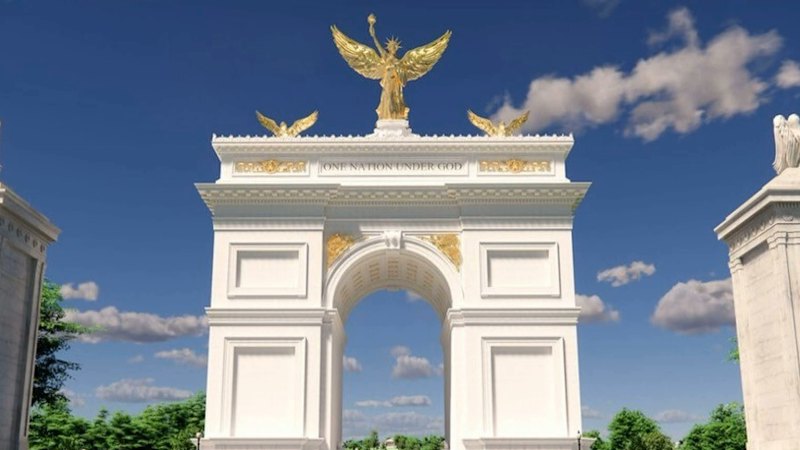
The proposal arrives quietly. A massive archway, monumental in proportion, engineered to double as a fully integrated military complex.
At first glance, the concept sounds like science fiction. A monument that functions as a fortress. A landmark that houses command centers behind its sweeping curves. But peel back the cinematic veneer, and you find a stark engineering reality. Modern defense strategy increasingly demands dual-use infrastructure. When budgets tighten and urban footprints expand, the luxury of single-purpose fortifications begins to vanish.
Ask any urban planner who has navigated zoning laws near a major defense installation. Space is finite. Public tolerance for sprawling military bases within municipal borders is low. Yet, the strategic necessity for secure, hardened nodes remains absolute. The solution, forged in boardrooms and engineering offices, is integration.
The arch stands tall. From the outside, tourists might snap photographs, marveling at the sheer tonnage of steel and stone rising toward the clouds. They see art. They see civic ambition. They see a skyline being redefined.
Beneath the surface, the narrative shifts entirely.
Sub-levels stretch deep into the bedrock. Climate-controlled server bays hum with the steady heartbeat of encrypted communications. Reinforced bulkheads, designed to withstand immense concussive forces, divide administrative zones from high-security operational wings. The transition from public viewing gallery to restricted defense sector happens behind unmarked doors equipped with biometric scanners.
This is the hidden architecture of the twenty-first century. It is pragmatic, defensive, and entirely unapologetic about its dual nature.
Critics argue that blending civic landmarks with military capabilities blurs the line between public life and national security. They worry about targets painted onto cultural touchstones. It is a fair anxiety. When a monument can launch a logistical response just as easily as it frames a sunset, the definition of a safe public space shifts underneath our feet.
Proponents, however, point to efficiency. In a rapidly changing geopolitical climate, redundancy is a luxury nations can ill afford. Why build two separate footprints when one engineered colossus can serve the public eye and protect national interests simultaneously?
The debate is fierce. It touches on how we want our cities to look, and more importantly, how we want them to function when peace gives way to tension.
As the ground is cleared and the first foundations are poured, the debate matters less than the physical reality taking shape. Steel beams do not wait for consensus. They rise because they are told to rise.
Walk past the perimeter fence today, and you will hear only the rhythmic pounding of pile drivers sinking deep into the earth. The air vibrates with it. It is the sound of a new era being anchored into the ground, layer by heavy layer, changing the horizon forever.