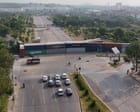
The shipping containers arrived under the cover of a suffocating autumn night. Towering stacks of rusted steel, hauled by groaning flatbed trucks, dropped into place with deafening metallic thuds along the arterial highways of Pakistan’s federal capital. Overnight, Islamabad—a city meticulously planned in the 1960s with wide, open boulevards and leafy green sector dividers—was chopped into jagged, isolated islands.
Barricades of barbed wire unspooled across major intersections. Trenches were carved into thoroughfares. Thousands of steel and concrete blocks transformed the seat of government into a medieval garrison awaiting a siege.
To understand why a metropolis of two million people was placed under absolute lockdown, you have to look beyond the cold bureaucratic terminology of state security and into the visceral rhythm of political fracture. Imran Khan, the ousted former prime minister and leader of Pakistan Tehreek-e-Insaf (PTI), sat behind the thick stone walls of Adiala Jail in Rawalpindi, yet his shadow loomed over every barricade. His party had issued a singular, uncompromising directive to its supporters: march on Islamabad.
The objective was the high-security Red Zone, home to Parliament, the Supreme Court, and diplomatic missions. The demand was the release of Khan and a direct challenge to the ruling coalition government.
For ordinary residents caught in the crosshairs, the lockdown meant an immediate, grinding halt to daily existence. Cellular networks blinked out in key districts, choking off communication as easily as a severed telephone line. Public transport ground to zero. Schools locked their doors. Grocery shelves emptied as panic-buying set in, fueled by the terrifying uncertainty of how long the concrete curtains would stay up.
Consider the human cost in the quiet neighborhoods far away from the television cameras. A mother needing emergency medical care found her route blocked not by traffic, but by a towering wall of shipping containers guarded by paramilitary rangers in riot gear. A daily wage earner watched his weekly income vanish because the streets were simply declared non-existent by decree. Fear became the ambient noise of the city, humming quietly beneath the blare of sirens and the distant, echoing thuds of tear gas canisters.
The government, led by Prime Minister Shehbaz Sharif, faced an existential calculation. In their view, allowing a massive, galvanized opposition crowd to breach the administrative heart of the country was not a peaceful protest; it was an existential threat to constitutional order. Interior Minister Mohsin Naqvi and federal ministers drew a hard line, invoking Section 144 bans on public gatherings, deploying the army under Article 245 of the Constitution, and throwing an iron net around the federal capital.
Yet, locking down a capital city carries a profound irony. In trying to protect the state, the state ends up paralyzing itself. Commerce stops. Governance freezes. The message sent to the international community is one of volatile fragility rather than stability. When a government must barricade itself behind mountains of imported steel against its own citizenry, the optics speak louder than any press conference.
Across the sprawling expanse of Punjab and Khyber Pakhtunkhwa, the columns of PTI supporters began to stir. They were not monolithic. Some were hardened political activists willing to face batons; others were ordinary citizens gripped by a deep sense of economic grievance and political disenfranchisement. They moved in convoys, clearing roadblocks with tractors, facing heavy tear gas barrages on motorways, and pushing forward with a stubborn momentum born of intense loyalty to their imprisoned leader.
This clash is part of a much deeper, recurring cycle in Pakistan's political history—a perpetual friction between civilian authority, judicial frameworks, political populism, and powerful institutional actors. Every few years, the script repeats with terrifying familiarity: an opposition leader gains mass mobilization, the state responds with preemptive mass arrests and lockdowns, the streets fill with tear gas, and the fundamental question of democratic legitimacy remains stubbornly unresolved.
As the confrontation reached its boiling point on the outskirts of Islamabad, the air grew thick with acrid smoke and the heavy tension of an impending collision. The containers stood like stoic giants, indifferent to the political drama unfolding around them.
The sun set over the Margalla Hills, casting long, bruised shadows across a city held hostage by its own internal contradictions. No press release or administrative decree could hide the central truth of the moment. Bricks and mortar can temporarily block a march, but they cannot pave over the underlying grievances that brought thousands of people to the gates in the first place. When the smoke finally clears and the shipping containers are hauled away, the city will remain, but the fractures in its foundation will run deeper than ever before.