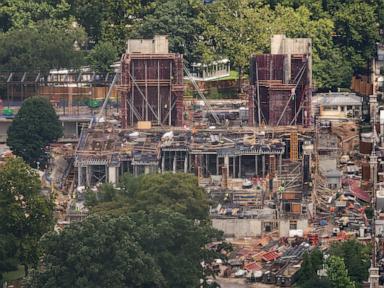
Stone dust settles differently in Washington than it does anywhere else. Here, it carries the weight of centuries, settling into the crevices of sandstone and the quiet memories of state dinners, secret treaties, and midnight decisions that shaped the globe. When the bulldozers finally tore into the historic East Wing, they weren't just clearing room for steel beams and poured concrete. They were tearing open a raw nerve at the center of American governance.
Imagine walking the gravel paths of Lafayette Square on a crisp autumn morning, watching the heavy machinery loom against the gray horizon. The air hums with the metallic whine of construction, a constant reminder that the physical boundaries of the presidency are shifting in real-time. For months, the $400 million project has transformed a national symbol into an active industrial zone. You might also find this connected story interesting: The Heavy Silence of an Internal Matter.
The vision driving this disruption is grand in scale. The administration champions a 90,000-square-foot ballroom designed to host global leaders and massive formal functions, backed by private donations and paired with subterranean security upgrades. Proponents argue that the executive mansion has long lacked the sheer square footage required for modern diplomacy, pointing to security vulnerabilities that left the old layout exposed. To them, this is a practical modernization of a dated estate.
Stop. As highlighted in latest coverage by USA Today, the results are notable.
Consider what happens when architectural ambition outpaces constitutional mechanics.
In a decisive 2-1 ruling, the U.S. Court of Appeals for the District of Columbia Circuit drew a sharp, unyielding line in the dust. The court upheld a preliminary injunction secured by the National Trust for Historic Preservation, halting above-ground construction immediately. The majority opinion cut straight to the core of the democratic experiment with a stark reminder: each president is a temporary tenant, not an owner.
The legal battle cuts deeper than floor plans and masonry. Justice Department lawyers defended the effort as an exercise of executive authority shielded from judicial interference, emphasizing national security and private funding structures. Yet, attorneys for the preservationists countered with a foundational principle of the republic: executive self-help cannot override the explicit budgeting and oversight powers constitutionally reserved for Congress.
The courts agreed. No statute grants the executive branch carte blanche to permanently reshape the People House without legislative sign-off.
Now, the legal machinery shifts toward a final, high-stakes showdown. The federal appeals court granted a temporary 14-day administrative hold, giving the administration a narrow window to petition the Supreme Court. Cranes stand frozen against the Washington sky. Below the surface, authorized subterranean security work may hum onward, but the grand above-ground vision hangs in total suspension.
A blueprint is never just a drawing on paper. It is a declaration of who holds power, who pays the cost, and who gets to decide how the nation looks to the future. As the Supreme Court prepares to weigh in on the limits of presidential reach, the empty cavity where the East Wing once stood remains a monument to an unresolved question: how much can a single leader alter the house that belongs to everyone before the foundations finally give way.