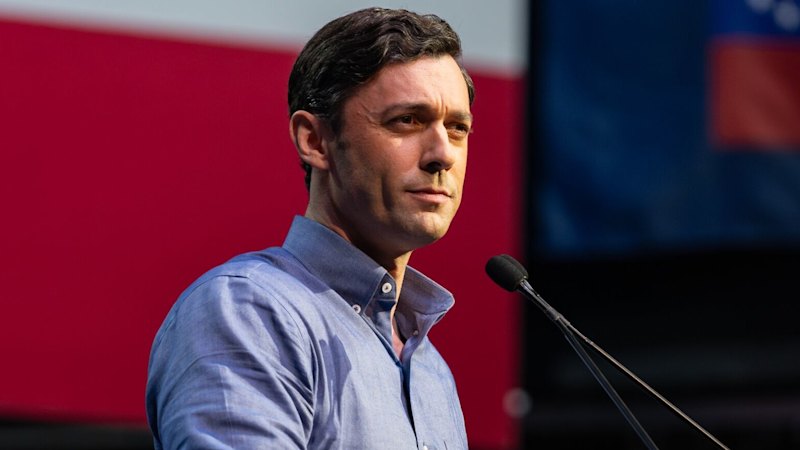
Stop looking for the next Barack Obama in every young Democrat who knows how to deliver a speech without tripping over the microphone cord.
Ever since Jon Ossoff shook up Georgia politics by winning a brutal Senate runoff in 2021, national commentators haven't been able to stop making the comparison. He's young. He's telegenic. He speaks in measured, rhythmic cadences. Naturally, the political machine slapped the "Obama 2.0" label on him before he even picked out his Washington office space.
But it's a lazy comparison. It misreads the reality of modern American politics, and honestly, it misunderstands who Ossoff actually is as a legislator.
As Ossoff gears up for a high-stakes reelection fight in Georgia, the political landscape looks entirely different than it did during the hopeful days of 2008. The playbook has changed. If you look past the tailored suits and the smooth media presence, you'll see a political identity built on a completely different foundation.
The Aesthetic Trap
It's easy to see why pundits get lazy. The surface-level similarities are definitely there. Ossoff entered the Senate at just 33 years old, making him the youngest Democratic senator since Joe Biden in 1972. Like Obama, he possesses a calm, almost unflappable demeanor under the camera lights. He knows how to speak to a crowd without sounding like an angry partisan warrior.
But aesthetics aren't strategy.
Barack Obama burst onto the national scene at the 2004 Democratic National Convention with a message of grand, sweeping national unity. He spoke of a country that wasn't divided into red states and blue states. It was a poetic, idealistic vision that captured the imagination of a nation weary of the post-9/11 partisan divide.
Ossoff didn't rise to power on poetry. He rose to power on grueling, hyper-local organization in a deeply divided state. His 2021 victory alongside Reverend Raphael Warnock wasn't a sudden cultural phenomenon driven by national euphoria. It was the result of a decade of grinding voter registration work led by local organizers like Stacey Abrams. Ossoff didn't win by convincing Georgians that red and blue didn't exist. He won by turning out a diverse, coalition-driven base in metro Atlanta and peeling off just enough moderate suburbanites who were tired of chaotic politics.
From Hope and Change to Deep-Dive Investigations
The biggest difference between the two politicians shows up in how they actually use power. Obama was a constitutional law professor who viewed politics through the lens of big ideas, structural debates, and massive legislative lifts like the Affordable Care Act.
Ossoff approaches his job like an investigative journalist. Because that's exactly what he was before entering public office.
As the former CEO of Insight: The World Investigates, a London-based documentary company, Ossoff spent years tracking down international corruption, human trafficking, and war crimes. When he got to the Senate, he took that specific skillset and applied it directly to government oversight.
Look at his record on the Permanent Subcommittee on Investigations. He didn't spend his first term giving grand speeches on the Senate floor to build a national brand. Instead, he quietly led intense, bipartisan investigations into horrific conditions within the federal prison system, the corruption plaguing military housing, and the systemic abuse of children inside Georgia's foster care system.
This isn't the behavior of a politician trying to replicate the soaring, inspirational arc of 2008. This is a tactical, grind-it-out approach focused on executive oversight and concrete accountability.
Bipartisanship in a Fractured Era
When Obama talked about bipartisanship, it was an ideological goal. He genuinely believed he could bridge the gap between the two parties through rational debate and consensus-building. The bitter gridlock of his presidency proved just how difficult that dream was to achieve in modern Washington.
For Ossoff, bipartisanship isn't a grand philosophical dream. It's a survival mechanism in a purple state. Georgia is a state where elections are decided by razor-thin margins. You don't hold a seat here by playing the role of a national ideological progressive savior.
Instead of chasing national headlines, Ossoff has focused heavily on pragmatic, local wins. He has partnered across the aisle with Republicans to secure funding for Georgia’s ports, expand mental health access for veterans, and protect local agricultural interests. He pushed hard alongside Republicans to pass legislation capping insulin costs for seniors and cracked down on online child exploitation.
He also isn't afraid to break from the national party script when it serves his state's economic interests. He has aggressively championed Georgia’s booming clean energy and advanced manufacturing sectors, landing massive investments for electric vehicle and solar manufacturing plants. He protects his home turf first, second, and third.
The Challenge of Reelection
The true test of Ossoff's distinct political identity is unfolding right now. Winning a special election runoff during a moment of peak national political mobilization is one thing. Defending a Senate seat in a high-pressure midterm or general election cycle is a completely different beast.
The Republican strategy against him is predictable. They will try to tie him directly to national Democratic leadership and paint him as a radical Washington elite. But that attack is a lot harder to pull off against a guy who spent his term exposing corruption in federal agencies and passing local infrastructure bills.
Ossoff's political future doesn't depend on whether he can recreate the magic of the 2008 Obama campaign. That magic belonged to a specific moment in time that no longer exists. Today’s voters are far more cynical, highly polarized, and deeply skeptical of soaring rhetoric.
Instead, his success depends on proving that a disciplined, detail-oriented focus on local results and aggressive accountability can still win in a deeply divided state. He doesn't need to be the next Obama. Being the first Jon Ossoff might actually be exactly what Georgia wants.
If you want to understand where American politics is heading, stop looking backward at the ghosts of campaigns past. Watch how Ossoff navigates the ground-level realities of Georgia over the coming months. That is where the real playbook for the next decade of leadership is being written.