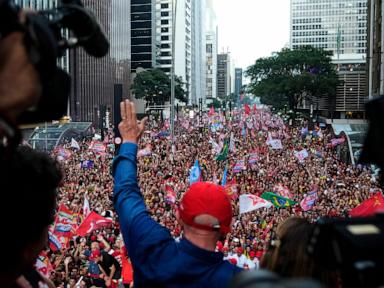
Tens of thousands of flags waving on Copacabana Beach or Paulista Avenue make great television. They make terrible electoral models.
Every time a major election cycle hits its final weekend, wire dispatches rush to frame the race around "closing arguments" and street rallies aimed at swaying "undecided voters". That framing is lazy consensus. In Brazil's 2026 presidential runoff between incumbent Luiz Inácio Lula da Silva and Sen. Flávio Bolsonaro, the contest was never about convincing a pool of open-minded fence-sitters with a last-minute speech. It was about negative partisanship, turnout mechanics among absentees, and who could make the other side's brand feel more intolerable.
Wire reporting treats closing arguments like a courtroom summation where a persuasive orator flips the jury on Friday night. Political science and hard Brazilian ballot math tell a far colder story. By the time a runoff arrives after a high-salience first round—where Flávio Bolsonaro took 47.03% of valid votes to Lula's 45.16% on October 4—almost every regular voter already has a strong preference or a visceral aversion. Calling millions of deeply polarized citizens "undecided" because they dislike both options is a category error. Reluctant voters do not wake up on Saturday morning needing a policy speech; they wake up asking which candidate poses the smaller threat to their wallet, their family, or their sanity.
The Myth of the Persuasion Finale
Watch how mainstream coverage describes the final hours of a Brazilian runoff. Rallies are cast as persuasion engines. In reality, massive street demonstrations in São Paulo, Rio de Janeiro, or even deep-right strongholds like Santa Catarina—where Bolsonaro won 66.65% in the first round—function primarily as morale and mobilization theater. A rally proves your core base is loud and willing to stand in the sun. It rarely converts someone who spent the last six months arguing against you at the dinner table.
I have watched political teams and corporate communications shops blow millions of dollars in the final ten days of high-stakes campaigns trying to "win the news cycle" with clever slogans and viral stunts while ignoring basic ground logistics. Campaigns love talking about persuasion because persuasion feels heroic. You get to write soaring lines and point to crowd sizes. Getting voters who skipped the first round to actually show up for the second round—or convincing a skeptical moderates' bloc to hold their nose—is unglamorous, repetitive work. Yet in tight runoffs, marginal turnout shifts and rejection math decide outcomes far more often than late-breaking rhetorical brilliance.
Political analysts who study Brazilian runoff dynamics, including observers like political scientist Sérgio Abranches and Latin America strategists tracking voter polarization, have long emphasized that Brazil's two-round system forces coalition-building and ceiling-testing rather than simple base-cheering. When roughly half the electorate disapproves of the Bolsonaro camp and roughly half disapproves of Lula's Workers' Party, a candidate does not win by making hardcore fans love them more. A candidate wins by lowering resistance among people who are lukewarm or hostile.
Imagine a scenario where a campaign spends its final week mocking undecided or cautious voters online to entertain its own followers. That clip might rack up millions of views and make activists feel invincible. Meanwhile, an older or more moderate voter who already disliked the candidate's family or party feels alienated and stays home—or votes for the rival purely out of spite. Dominance inside your own echo chamber is not a majority in a runoff.
Why Voters Are Asking the Wrong Question
Most coverage of the runoff asks a deceptively simple question: Whose closing argument is stronger? That question assumes voters are grading essays on vision and competence. They aren't. Voters in a hyper-polarized runoff are running a risk-avoidance calculation.
Look at what actually dominated the closing stretch rather than polite policy debates:
- Corruption and legal warfare: Bolsonaro's camp hammered the history of Operation Car Wash and Lula's past conviction before the Supreme Court annulled it, while Lula's side pointed to pandemic-era controversies, money-laundering allegations, and ties to Rio de Janeiro militias—claims Bolsonaro rejected as baseless.
- Institutional fear: Voters weighed whether a Bolsonaro presidency would reshape the Supreme Court, alter constitutional rules, or seek amnesty for former President Jair Bolsonaro, or whether a Lula continuation meant entrenched state power and judicial friction.
- Geopolitical and economic signaling: Traders and citizens alike watched how alignment with Washington under Donald Trump versus closer ties with Beijing and the Global South would affect trade, tariffs, and long-term investment.
When polling shows large shares of the electorate fearing either outcome—with fear of a Bolsonaro return and fear of a Lula re-election running neck and neck—the contest turns into a referendum on which nightmare feels more immediate. Framing that tug-of-war as "closing arguments to voters" sanitizes a raw battle over fear, memory, and institutional survival.
Common Misconceptions People Also Ask About
"Do last-minute rallies actually flip undecided voters?"
Rarely in a two-round system where both finalists are household names with decades of baggage. A rally is a mirror for the faithful, not a magnet for the hesitant. If a voter is still undecided on the eve of the second round, they are usually torn between two bad options or tuning out politics altogether. A speech on a stage does less to move them than a trusted family member, local leader, or concrete worry about grocery prices and public safety.
"Does social media dominance win a Brazilian runoff?"
No. Digital strategists love boasting about impressions, memes, and algorithmic reach, and Flávio Bolsonaro's camp leaned heavily into social media savvy. Yet online engagement is heavily skewed toward hyper-engaged partisans. In a country of over 214 million people voting on electronic machines, viral outrage can backfire just as easily as it mobilizes. Aggressive online mocking can energize your base while hardening opposition among swing or reluctant voters. Social media amplifies existing momentum; it rarely manufactures a runoff majority out of thin air.
"Is Brazil's election mainly a proxy fight between the U.S. and China?"
That is a convenient lens for foreign correspondents, and external alignment certainly matters at the margins for tariffs, diplomacy, and capital flows. Still, treating Brazilian voters as pawns on a Washington-versus-Beijing chessboard misses what drives ballots on the ground. Most Brazilians vote on domestic pocketbook issues, crime and security, corruption narratives, and institutional trust. Foreign policy is a multiplier and a symbol, not the primary engine of mass turnout.
What Actually Moves Votes When the Dust Settles
If you want to understand—or compete in—a razor-thin runoff without falling for punditry clichés, stop staring at stage lights and start tracking mechanics.
First, audit your ceiling, not your floor. Any campaign can pack a square with loyalists. The decisive metric in a close runoff is how many people who voted against you in the first round—or stayed home—can be nudged from "never" to "maybe" or "acceptable." That requires toning down gratuitous hostility toward non-aligned voters and addressing their specific anxieties directly.
Second, treat abstention and first-round non-voters as a distinct target. Under Brazilian rules, citizens who missed the first round can vote in the second. Those voters are not a monolithic bloc; they include people who were traveling, overwhelmed, or disgusted by the options. Practical mobilization—reminders, logistics, local persuasion—beats abstract ideological lecturing every single time.
Third, separate short-term noise from structural power. Even after the presidential runoff is decided, governance happens inside a broader institutional map. Legislative balances in Congress, state governorships, and judicial appointments shape what the winner can actually pass or block. A president with a narrow runoff margin and heavy institutional constraints faces a very different reality than a headline about a "decisive mandate" implies.
The Blind Spot in This Contrarian View
To be fair, dismissing closing arguments entirely goes a step too far in the other direction. In an election separated by narrow margins, even tiny shifts matter. A single sharp line in a final television appearance, a well-timed apology or misstep, or a visible show of strength in a rival's backyard can tip a few percentage points in a tight race. When two candidates are locked in a dead heat, a 1% or 2% nudge is the difference between inauguration and defeat. Closing moments do not rewrite the whole book, but they can decide the final chapter.
Electronic voting machines in Brazil count ballots fast, usually delivering clear results within hours after polls close. The real verdict is never written by the last speech on Saturday night; it is written by who actually walks into the voting booth on Sunday.