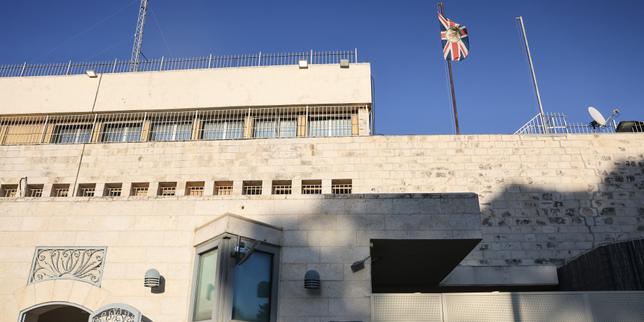
Diplomacy rarely dies in a hail of gunfire. More often, it slips away in the quiet redaction of a bureaucratic status report, buried beneath neutral language about essential services and operational continuity.
London is scaling back its physical footprint in East Jerusalem, maintaining the bare minimum of consular operations while wrapping the decision in the polite fiction of administrative streamlining. For anyone who has tracked the slow erosion of Western diplomatic leverage in the contested city, the shift is hardly surprising. Yet the quiet retreat tells a story that Foreign Office press releases refuse to articulate. When a major European power begins quietly pulling down its physical shutters in one of the most politically volatile postal codes on earth, the ripples extend far beyond a change in office hours. In other updates, we also covered: The Myth of the Martyr: How Che Guevara Was Stripped of History and Sold as a Commodity.
The Anatomy of a Quiet Retrenchment
The official line from Whitehall remains steadfastly routine. Essential services will continue. Visa applications, emergency travel documents for British nationals, and basic consular protection are purportedly safe. But an office open only for emergencies is not an embassy or a fully functioning consulate in any traditional sense. It is a lifeboat.
For decades, foreign missions in East Jerusalem occupied a unique legal and political gray zone. They operated under complex historical precedents, maintaining ties with the local Palestinian population while navigating the sweeping, de facto sovereignty asserted by Israeli authorities. Maintaining a physical presence in East Jerusalem was never just about stamping passports. It was a tangible expression of a diplomatic stance regarding the city's contested status under international frameworks. BBC News has also covered this critical issue in extensive detail.
When those missions begin to downscale, the symbolic weight is immediate. A skeleton crew processing paperwork from a secure hotel conference room or a consolidated regional hub is a physical manifestation of diplomatic fatigue. It signals that the juice is no longer worth the squeeze, or worse, that the physical and political risks of maintaining an open door have begun to outweigh the diplomatic utility of staying put.
The Cost of the Status Quo
To understand why London is quietly consolidating its presence, one must look at the grim reality of operating on the ground. Diplomatic security in East Jerusalem has transformed into an exhaustive, high-stakes logistical puzzle. Threat assessments fluctuate wildly based on neighborhood tensions, municipal clashes, and broader regional escalations.
Every vehicle movement requires risk mitigation. Every public interface carries the potential for political friction or direct security exposure. When budgets face tightening pressures at home and embassies worldwide are forced to justify every square foot of real estate, high-risk consular posts with diminishing direct access become prime targets for rationalization.
Yet, reducing consular exposure carries a heavy hidden cost. Diplomacy is a sensory art. It relies on being in the room, smelling the tear gas in the streets, hearing the frustrations of localfixers, and witnessing the day-to-day friction of occupation or municipal neglect firsthand. When diplomats retreat behind reinforced glass miles away or shrink their daily interactions to scheduled, low-risk meetings, they suffer from a dangerous loss of granularity. They begin to govern their policy decisions based on sanitized cables rather than direct observation.
The Wider European Retreat
London is not acting in a vacuum. Across the continent, European capitals have been quietly trimming their diplomatic sails across the Middle East. The grand ambitions of the post-Oslo era—where European capitals fancied themselves as active mediators, heavy investors in civil society, and counterweights to shifting American policies—have collided with the hard rock of political stalemate.
Consider the trajectory of European aid and diplomatic engagement over the past fifteen years. Billions have flowed into institution-building projects, legal defense funds, and municipal initiatives in East Jerusalem and the West Bank, only for donors to watch those very projects face demolition, restriction, or administrative strangulation. At a certain point, pragmatic career diplomats ask themselves a blunt question. Why pour resources into a crumbling structure when you can shore up your perimeter and minimize your exposure?
This retreat into minimalism feeds a vicious cycle. As European nations pull back their physical presence, their capacity to shape events on the ground diminishes proportionally. Local actors notice who is still standing in the storm and who has retreated to the bunker. When the UK or any other European power scales back its physical footprint, it surrenders initiative to actors who have no intention of leaving, whether local municipal authorities or harder-line regional players.
The Illusion of Continuity
The phrase "essential services will be maintained" has become the standard boilerplate for diplomatic withdrawal. It is designed to soothe markets, reassure expatriates, and prevent opposition lawmakers from asking uncomfortable questions in parliament.
However, essential consular services are merely the plumbing of international relations. They keep the water running, but they do not power the lights. A consulate is supposed to be an antenna, picking up the subtle frequencies of social unrest, economic shifts, and political realignments before they burst into open crisis. By reducing the operation to a transactional passport mill, London is cutting its own wires.
The decision to scale back in East Jerusalem reflects a broader, more melancholy truth about contemporary foreign policy. Western powers are increasingly hunkering down, prioritizing risk management over active engagement. They are managing decline rather than seizing opportunity.
When the last British diplomat finally locks the heavy oak doors of the downscaled East Jerusalem office, the paperwork will still be processed. Citizens in distress will still get their emergency flights home. But the city itself will have lost another quiet witness, and London will have taken one more step away from the messy reality of a conflict it no longer has the stomach to influence.


