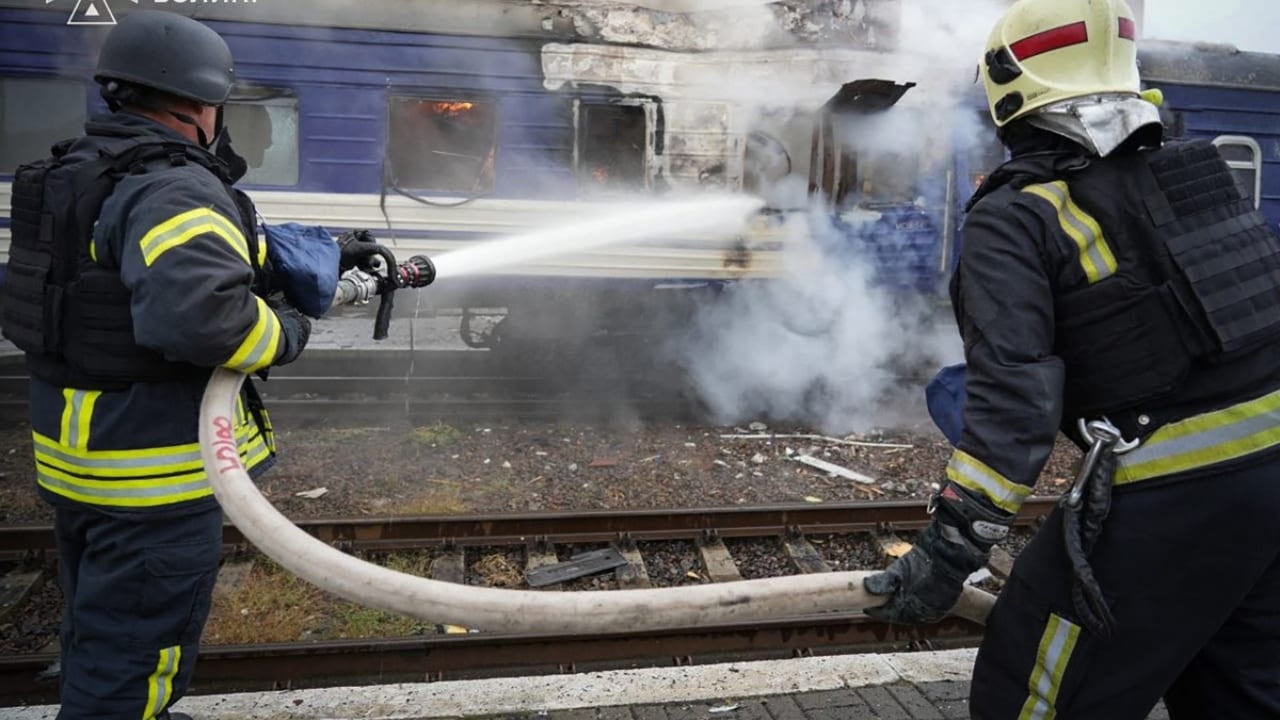
When a Russian drone slams into a railway station just minutes after a train carrying former British Prime Minister Boris Johnson rolls past, headlines write themselves. But let's be honest. The near miss at the Ukraine-Poland border isn't a shocking new departure for Moscow. It's just another Tuesday in a war where civilian infrastructure has been fair game from day one.
Johnson and other high-profile figures, including former Swedish Prime Minister Carl Bildt and former CIA Director David Petraeus, were returning from the Yalta European Strategy conference in Kyiv when the strike hit near Yahodyn. The train immediately behind the diplomatic party took the hit. Thankfully, rapid detection systems allowed for a quick evacuation, and nobody died.
Yet, the international media circus treating this as a personalized near-death experience misses the broader, grimmer reality. Vladimir Putin isn't hunting specific Western politicians with kamikaze drones. He doesn't need to. The entire Ukrainian railway network is already a target, and has been for years.
The Logistics of Terror on the Rails
Train tracks, locomotives, and switching stations don't carry just diplomats. They carry grain, humanitarian aid, everyday commuters, and regular soldiers rotating off the front lines. When Russian state media claims they struck "railway infrastructure used to transport military cargo," they use it as a blanket excuse to hammer civilian transit hubs right up against the NATO border.
Think about what happened at Yahodyn. The diplomatic train left slightly ahead of schedule because Ukrzaliznytsia—Ukraine’s state railway operator—caught the incoming threat on monitoring systems and adjusted the timetable. That's not luck. That's a battle-hardened rail system operating on pure survival instinct. Ukrainian railway workers are dodging air raids daily, keeping trains running on time while overhead skies buzz with Shahed drones.
When Boris Johnson stepped off that train into Poland and blasted Putin's "warped logic," he wasn't wrong. But calling these attacks "random and senseless" risks misunderstanding the method behind the madness. It is systematic exhaustion. By pushing strikes closer and closer to the Polish border, Moscow wants to signal two things: nowhere in Ukraine is safe, and the ripple effects of this war can bleed into European territory at any second.
Why the Border Location Matters
The proximity to Poland—just a couple of kilometers away—turns a standard transit strike into a geopolitical stress test. Polish authorities immediately raised readiness levels, and Prime Minister Donald Tusk convened emergency evaluations. Poland knows that air defense capabilities stopping missiles over western Ukraine are essentially defending Warsaw's airspace by proxy.
Every time a drone or missile arcs toward the border zone, it tests NATO's nerves. Foreign Minister Andrii Sybiha didn't mince words, calling it Putin's terror knocking directly on the door of the EU and NATO.
Yet, rhetoric from Western capitals rarely matches the velocity of the threat. Condemnations roll out on social media within minutes of an explosion, followed by the usual debates over air defense packages and interceptor delivery timelines. Meanwhile, Ukrainians live under the constant hum of jet-powered drones regardless of whether a VIP is sitting in a carriage three cars down.
What Actually Needs to Happen Now
If this close call serves any useful purpose, it should shatter any remaining illusions of containment. You can't quarantine a war of attrition to the eastern half of a country. As long as Russia retains the capacity to launch long-range aerial assaults, western transit hubs and border crossings remain vulnerable.
The fix isn't tighter security protocols for visiting politicians. Boris Johnson can fly out or take armored cars next time. The millions of ordinary people relying on those trains don't have that luxury. They need robust, layered air defense systems deployed heavily across western regions, not just around Kyiv.
Until allied nations supply the interceptors necessary to close the skies over vital civilian logistics lines, these near misses will keep happening. Only next time, the train behind the VIP might not be empty when the drone strikes.