There is a specific kind of silence that settles over Washington when the calendar turns toward an election year autumn. It is not a peaceful silence. It is the tense, metallic quiet of a loaded spring. Telephones ring with muted urgency in subterranean offices. Analysts stare at flickering Bloomberg terminals and classified intelligence summaries, watching the numbers shift by tenths of a percent, calculating outcomes that will echo from the Strait of Hormuz to the floor of the New York Stock Exchange.
Far away from the marble corridors, in a modest kitchen in Ohio, a mother pours coffee while the morning news drone softly in the background. Her son is twenty-two, stationed on a carrier group cutting through the restless waters of the Middle East. She does not know the exact coordinates of his ship, and she has learned that asking too many questions only breeds a deeper, more corrosive anxiety. She only knows the season. She knows that autumn in an election cycle carries its own unpredictable weather, where political survival and geopolitical strategy become dangerously entangled. For a different look, consider: this related article.
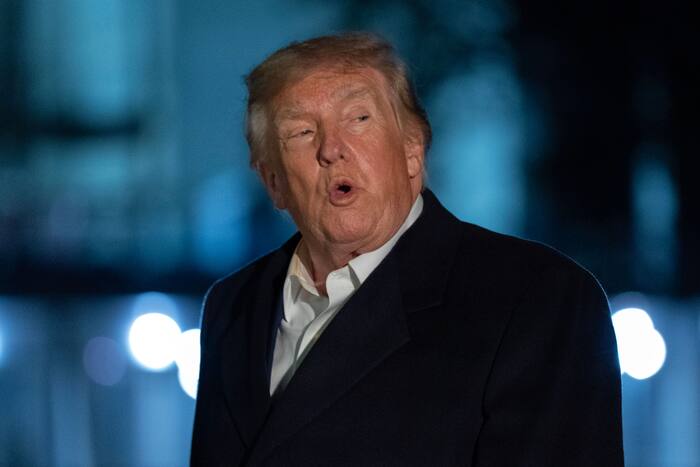
When Donald Trump stated publicly that the United States would not launch new military strikes on Iran before the November midterms, the announcement landed with a strange duality. To the Washington press corps, it was read as a calculated tactical maneuver—a temporal boundary drawn in the sand to protect domestic majorities at the ballot box. But to the families watching from kitchen tables across the country, it was something else entirely. It was a temporary pause. A tether holding back the storm until the votes were cast.
Politics has always danced a dangerous waltz with statecraft, but the choreography changes when the ballot boxes are open. Further reporting on this trend has been shared by TIME.
Consider the mechanics of modern deterrence. For decades, foreign policy experts have operated under the assumption that grand strategy moves on a grand timeline—measured in decades, doctrines, and long-term containment. Yet, reality intrudes. The American electoral calendar is a relentless metronome. Every two years, the entire architecture of the House of Representatives and a third of the Senate face a harsh reckoning. Politicians live in terror of the October surprise, that unpredictable flash of violence halfway across the globe that can instantly rewrite campaign narratives, shift suburban swing voters, and sweep a congressional majority out of power overnight.
When a leader draws a hard line based on a domestic date rather than a strategic milestone, it reveals the raw underbelly of democratic power. It forces us to confront an uncomfortable truth. Even the most powerful nation on earth is tethered to the shifting moods of voters deciding local tax issues and school board seats.
The standoff with Iran is not a new theater. It is a decades-long chess match played across shifting boards of proxy wars, nuclear enrichment centrifuges, cyber warfare, and tanker security. Every move carries the risk of escalation, a miscalculation that could spiral from a localized skirmish into a regional conflagration.
Imagine sitting in the West Wing at midnight. The red phones are quiet, but the air is thick with tension. On the desk sits a thick dossier outlining potential retaliatory options following a drone attack on an American outpost. The military commanders are ready. The blueprints for strikes are drawn, vetted, and waiting for a single signature. The justification is legally sound. The deterrence argument is compelling.
Then, someone points to the calendar on the wall. November looms.
The calculation shifts instantly. The question is no longer just whether an action is strategically necessary to restore deterrence. The question becomes: What does this do to the suburban vote in Pennsylvania? How does a spike in oil prices at the local gas pump, triggered by retaliatory turmoil in the Persian Gulf, play out in congressional districts where inflation is already the primary grievance?
This is the invisible friction of statecraft.
To understand why a pre-midterm pause matters, you have to look past the talking points and examine the human cost of timing. War and peace are rarely dictated solely by the noble pursuit of geopolitical stability. They are buffeted by the chaotic winds of domestic political survival. When an administration explicitly takes military strikes off the table until a specific electoral milestone passes, it sends a profound signal to adversaries and allies alike.
To Tehran, the message is parsed line by line in the high-security chambers of the Supreme National Security Council. They see a window. They calculate that a superpower distracted by internal democratic contestation is less likely to absorb the political cost of a prolonged escalation. It opens a brief, fraught season for asymmetric maneuvering, knowing that the heavy hand of American military retribution is artificially restrained by the ballot box.
To traditional allies in the region, particularly Israel and the Gulf states, that same announcement triggers a quiet panic. They live within striking distance of the ballistic missile arsenals and proxy networks managed by the Islamic Revolutionary Guard Corps. For them, security is not an abstract debate on a cable news panel; it is an existential daily reality. When American military responses are calibrated to domestic election cycles, allies are forced to hedge their bets, wondering if the shield holding back the darkness is temporarily being lowered for domestic political convenience.
We like to pretend that our institutions operate above the fray, that foreign policy is an immaculate science conducted by dispassionate experts in sterile rooms. But it is run by mortals. Mortals who want to win elections. Mortals who know that a sudden war can turn a wave election into a wipeout.
The danger lies in the gap between the political pause and reality. Adversaries do not always wait for our elections to conclude. History is littered with crises that refused to respect a democracy's domestic schedule. A miscalculated drone strike by a proxy militia, a seized oil tanker, or a cyberattack on critical infrastructure can shatter a carefully crafted political timeline in a single afternoon. When you announce that your hands are tied until November, you inadvertently invite tests of that very boundary.
As the leaves turn and the political ads flood the airwaves, the tension in the intelligence briefings does not dissipate; it merely changes shape. The analysts keep watching the monitors. The carrier groups keep cutting through the dark water. And somewhere in Ohio, a mother keeps her phone close, waiting for a text message that tells her another day has passed safely.
The election will come and go. The ballots will be counted, the pundits will dissect the winners and losers, and a new Congress will take its oath. But the shadow cast by the intersection of foreign crisis and domestic politics will remain, stretching long across the desk of whoever sits in the Oval Office, reminding us all how fragile the peace is when the clock is ticking toward November.