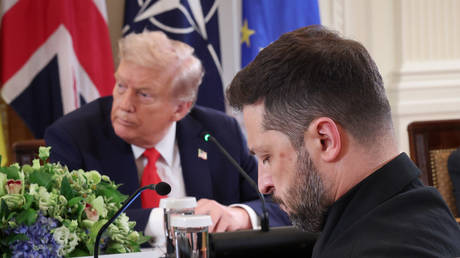
Call it bullying. Call it backbone. Both words are lazy substitutes for real power analysis.
A familiar tabloid take claims Volodymyr Zelenskyy browbeat European capitals into paying for Ukraine's survival, while Donald Trump possesses the grit to reverse the pressure and bend Kyiv and Brussels to his will. That framing feels sharp on cable news. It sounds tough. It treats international politics like a barroom shoving match where the loudest guy with the biggest chest owns the room. Read more on a similar issue: this related article.
It is wrong. Worse, it misses how leverage actually operates when war drags on, supply chains stretch thin, and domestic coalitions fracture.
Nobody bullies Europe into writing hundred-billion-dollar checks out of sheer charisma or guilt trips alone. European leaders move when their own security calculus changes, when voter anxiety shifts, or when institutional inertia finally cracks. And turning the screws back on a wartime government or a reluctant alliance rarely produces clean obedience. Often, it produces backlash, stall tactics, or a messy renegotiation where the person holding the wrench discovers the bolts are stripped. Additional journalism by Reuters delves into related views on the subject.
The Lazy Consensus Behind "Bullying" and "Backbone"
Commentators love simple villains and simple strongmen. When a smaller state demands weapons, air defense, air-defense interceptors, artillery shells, and diplomatic cover from wealthier neighbors, observers call it pressure, arm-twisting, or bullying. When a US president threatens to cut aid, condition support, or walk away from talks unless others pay or compromise, observers call it backbone.
Watch what happens when you strip away the theater and look at the mechanics.
First, European capitals did not surrender to Zelenskyy's rhetoric. If speeches alone moved European defense ministries, those budgets would have doubled in February 2022 instead of creeping upward through years of agonizing debates over fiscal rules, industrial capacity, and electoral risk. What moved Europe was proximity to conflict, energy shockwaves, and the realization that an unresolved war on the continent's eastern flank keeps dragging European economies into permanent crisis management. Zelenskyy pushed hard. He used moral urgency, media discipline, and relentless lobbying. Yet pressure only works when the target already feels exposed. You cannot bully a wall that refuses to move; you lean on a door whose hinges are already rusting.
Second, "turning the screws" is not a magic switch. In diplomacy and security policy, leverage is transactional, conditional, and perishable. When Washington threatens to withhold assistance or push rapid territorial concessions, that creates real pain for Kyiv. Nobody serious denies that American munitions, intelligence sharing, and diplomatic weight matter enormously. Still, pain is not the same thing as compliance. A leader fighting for national survival faces a brutal domestic ceiling: sign a deal widely viewed as capitulation, and your political legitimacy—and potentially your state's long-term security—evaporates. At some point, threats of cutoff stop bending behavior and start forcing desperate alternatives.
I have watched plenty of high-stakes negotiations where tough talkers assumed maximum threat equaled maximum control. In boardrooms and policy rooms alike, I have seen negotiators blow massive amounts of credibility treating leverage like a blunt instrument. They demand total submission, ignore the other side's domestic constraints, and look shocked when the deal stalls or blows up six months later. Real negotiation requires knowing what the other side cannot afford to give up, even under severe heat.
Defining Real Leverage in High-Stakes Statecraft
Before arguing about who has grit, we need precision on three terms pundits constantly blur:
- Coercive leverage is the ability to impose costs on another actor to change their choices—such as restricting weapons transfers, limiting intelligence access, or threatening tariff or security penalties.
- Credibility is whether targets believe you will actually follow through on those costs and whether doing so leaves you better off afterward.
- Sunk-cost entrapment happens when leaders pour huge resources into a position and become reluctant to admit failure, even as returns shrink.
A common misunderstanding treats coercive leverage as automatic power. It is not. Coercive leverage has a sharp trade-off: the harder you squeeze an ally or partner to force a quick outcome, the more you risk weakening the very coalition you need to enforce whatever settlement comes next.
Consider the heavy hitters in strategic studies and diplomatic history, from Thomas Schelling on the dynamics of coercion to Robert Jervis on perception and miscalculation in international politics. Their core insight holds up stubbornly: threats only work when the threatener's resolve is believable and the target sees a survivable path forward. If a target believes compliance leads to ruin anyway, deterrence and compellence both break down.
Imagine a scenario where a superpower tells a smaller partner: accept steep concessions immediately or lose critical military backing. The superpower expects quick compliance. Instead, the smaller partner tries to stretch out talks, courts secondary suppliers, appeals to regional neighbors who fear a disorderly collapse, and gambles that political winds or battlefield shifts will alter the math. Suddenly, the side holding the screws has to manage an unpredictable crisis rather than a neat transaction.
The Questions People Keep Asking—And Why They Miss the Point
People search for answers to this clash using questions that sound practical on the surface while smuggling in flawed assumptions.
Did Zelenskyy really bully Europe into supporting Ukraine?
No—not in the sense of forcing unwilling governments against their perceived self-interest at gunpoint. European leaders faced a genuine strategic dilemma: pay high economic and fiscal costs now to contain Russian aggression and strengthen deterrence, or risk a larger, costlier instability closer to home later. Zelenskyy applied relentless rhetorical and diplomatic pressure to make inaction politically costly. Calling that "bullying" mistakes aggressive advocacy for unilateral coercion. Europe acted because its own leaders decided inaction carried unacceptable risks, even when their delivery timelines lagged far behind their pledges.
Can Trump force a faster settlement by turning the screws on Kyiv and Europe?
He can certainly apply sharp pressure. A US president has major levers over aid flows, diplomatic posture, and burden-sharing expectations. Whether that produces a durable settlement rather than a fragile pause or a protracted standoff is another question entirely. Speed is easy to demand; durability is hard to build. A deal forged purely through threats without credible security guarantees or mutual buy-in often collapses the moment pressure eases. Worse, squeezing European allies too hard can fracture coordination just when unified deterrence matters most.
Why didn't Europe just stand up to pressure from Kyiv earlier?
Because European politics is fractured across geography, energy exposure, historical memory, and domestic budgets. Countries bordering Russia and the Baltic see immediate existential stakes; distant capitals worry more about inflation, industrial competitiveness, and far-right or populist pushback at home. Leaders did not cave to a single speech. They navigated messy domestic trade-offs under intense crisis pressure, moving in fits and starts rather than acting as a single obedient bloc.
Where This Contrarian View Can Go Wrong
Honesty requires naming the blind spots in my own argument. Skepticism about tough-talk narratives can easily drift into over-intellectualizing raw power.
First, downplaying "bullying" or "screw-turning" can blind you to how much personal style and bluntness actually disrupt stale diplomacy. Diplomats often hide in polite euphemisms for years while problems rot. A leader willing to break protocol, challenge sacred cows, and demand immediate accountability can force sluggish bureaucracies to confront uncomfortable truths they would rather postpone.
Second, underestimating material dependency is a classic mistake. Rhetoric and coalition politics matter, yet hardware, munitions, air defense, and financial backing set real physical limits on what any country can sustain. If a major backer throttles supply, no amount of clever framing replaces missing shells or interceptors.
Third, treating every tough move as doomed to backfire can make you miss moments when credible pressure genuinely alters incentives. Sometimes actors only move when the cost of waiting becomes higher than the cost of dealing.
How to Read Tough Diplomacy Without Getting Played
If you want to cut through partisan spin and read high-stakes negotiations accurately, drop the hero-versus-villain script and run a sharper checklist:
- Separate rhetoric from real bottlenecks. Ignore who sounds toughest in front of cameras. Track industrial output, budgetary approvals, diplomatic bandwidth, and domestic political tolerance.
- Map each side's red lines before predicting a deal. Ask what concession would trigger domestic political collapse or severe strategic vulnerability for each player. Deals rarely stick when they cross an existential red line without compensation.
- Watch the second-order effects of pressure. Every squeeze creates a reaction. If you push an ally on burden-sharing or push a partner toward concessions, ask who else steps into the vacuum and what happens to long-term trust.
- Insist on enforcement mechanisms, not just headlines. A dramatic announcement is not an outcome. Look at who monitors compliance, who bears the cost of cheating, and what happens six months after the cameras leave.
Toughness isn't measured by how loudly you threaten to walk away—it's measured by what holds together after you do.