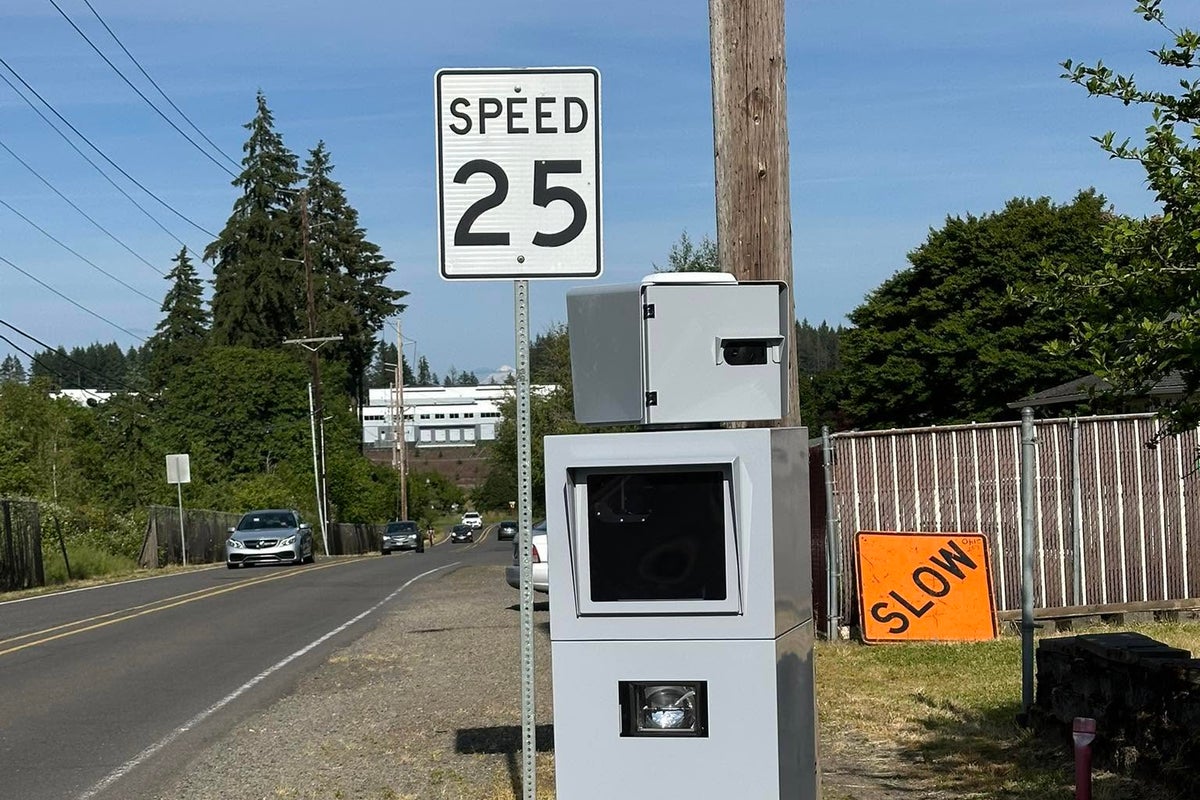
A thousand drivers caught in fourteen days.
Local news outlets are salivating over those numbers from a single stretch of road in Oregon. The media runs the predictable playbook: frame it as a shocking tale of lawlessness, praise the new automated enforcement tech, and imply that the street is finally being saved from the clutches of reckless commuters.
It is a comforting narrative for bureaucrats. It is also completely wrong.
When a single speed camera flags over one thousand drivers in a two-week span, you are not looking at a crisis of individual criminality. You are looking at a massive, systemic engineering failure. The drivers are not the problem. The road itself is telling them to speed, and the city is simply cashing the checks.
The Illusion of Safety vs. The Reality of Revenue
Municipalities love to wrap automated enforcement in the language of public safety. They quote statistics on impact velocities and pedestrian survival rates. But as someone who has analyzed urban transit networks and traffic flow data for over a decade, I can tell you exactly what those high-volume camera stats actually mean: the posted speed limit is artificially low for the design of the road.
Traffic engineers have known a fundamental truth for generations: drivers adapt their speed to the physical environment, not to the number printed on a metal sign.
Imagine a scenario where a road is built eighty feet wide, with multiple wide lanes, sweeping curves, clear sightlines, and zero physical obstructions. Every visual cue signals to the human brain that it is safe to travel at 45 mph. If a city arbitrarily slaps a 30 mph speed limit on that stretch and installs a camera, it is not engineering safety. It is running a regulatory speed trap.
The 85th Percentile Rule
For decades, the gold standard in traffic engineering has been the 85th percentile rule. This principle dictates that the speed limit should be set at the speed at or below which 85% of people travel under free-flowing conditions.
Why? Because the vast majority of drivers are rational actors who want to arrive alive. They naturally select a speed that feels safe for the environment.
When a camera catches a thousand people in two weeks, it proves that the speed limit deviates wildly from the 85th percentile. The city has created a mismatch between infrastructure and law. Instead of fixing the infrastructure, they are penalizing the rational behavior of their own citizens.
The Dark Side of Automated Enforcement
Let's look at what actually happens when you introduce automated enforcement into a poorly designed corridor. The data does not support the utopian vision of calm, orderly streets.
- The Brake-and-Surg Effect: Drivers quickly learn where cameras are located. They slam on their brakes right before the radar sensor, creating dangerous velocity differentials, and then accelerate immediately after passing the zone. This erratic flow increases rear-end collisions.
- Regression to the Mean: Many cities boast about an initial drop in crashes after installing cameras. What they hide is that traffic accidents naturally fluctuate. If you place a camera at a high-injury location during a peak year, numbers will almost always drop the following year due to statistical randomness, not the camera.
- The Equity Tax: Automated cameras cannot issue warnings. They cannot assess context. They disproportionately penalize low-income drivers who cannot afford to contest the tickets or pay the fines, often leading to suspended licenses over non-safety issues.
| Enforcement Method | Primary Outcome | Systemic Impact |
|---|---|---|
| Speed Cameras | Short-term compliance, high revenue generation | Increases rear-end spikes, masks poor engineering |
| Physical Redesign | Permanent speed reduction, self-enforcing | Eliminates the need for policing, protects pedestrians |
Dismantling the "People Also Ask" Mythos
Go look at any public forum regarding traffic enforcement, and you will see the same flawed questions repeated ad nauseam. The answers provided by municipal PR departments are designed to shield them from accountability. Let's correct the record brutally.
"Don't speed cameras save lives by forcing people to slow down?"
Only in the most localized, temporary sense. A camera changes behavior for about a hundred yards. It does absolutely nothing to alter the fundamental mechanics of the road. If a street is designed like a highway, people will drive like they are on a highway the second they pass the camera's line of sight. True safety comes from geometry, not surveillance.
"If you aren't doing anything wrong, why do you care about cameras?"
This is the classic authoritarian defense, and it ignores how human perception works. Even law-abiding drivers experience a spike in cognitive load when approaching a known camera zone. They look at their speedometer instead of looking at the crosswalk. They panic when the light turns yellow because they fear an automated ticket, leading to dangerous intersection decisions. Surveillance infrastructure degrades the driving environment for everyone.
"How else can cities control speeding without police officers?"
This question assumes that enforcement is the only tool available. It completely ignores the entire field of traffic calming. If you want people to drive 25 mph, you do not build a 45 mph road and hire a robot to hand out fines. You build a 25 mph road.
The Solution Nobody Wants to Pay For
The reason cities opt for cameras over real solutions is simple: cameras generate cash, while infrastructure costs cash.
If a street has a chronic speeding problem, the fix requires physical intervention. This is called Self-Enforcing Road Design. It uses human psychology and environmental feedback to naturally dictate safe speeds.
Narrow the Lanes
Standard American travel lanes are often eleven or twelve feet wide—the same width used on interstate highways. When lanes are that wide, drivers feel comfortable traveling at high speeds. By narrowing lanes to nine or ten feet, you create visual restriction. Drivers naturally slow down because the margins for error are smaller.
Implement Chicanes and Curb Extensions
Slowing traffic down requires disrupting straight lines. Curb extensions at intersections shorten pedestrian crossing distances and force drivers to take turns with precision rather than speed. Chicanes create artificial S-curves that require deliberate, lower-speed maneuvering.
Plant Street Trees
Open, barren roadside environments encourage acceleration. Planting a dense canopy of street trees close to the curb creates a "tunnel effect." This alters the driver’s peripheral vision, making them feel like they are moving faster than they actually are, prompting them to lift their foot off the gas pedal.
Admitting the Counter-Argument
To be fair, there is one scenario where speed cameras make sense: ultra-dense, highly volatile construction zones where workers are physically exposed and traffic patterns change daily. In those temporary environments, physical redesign is impossible, and immediate compliance is mandatory.
But using that edge case to justify permanent, revenue-generating surveillance networks on standard municipal arterials is a bait-and-switch. It allows city councils to check the "safety" box without ever doing the hard, expensive work of rebuilding broken streets.
Stop celebrating the one thousand tickets. Start questioning the engineers who built a racetrack and expected people to drive like they were in a school zone.
Demand that your city fix the asphalt. Turn off the cameras.



:max_bytes(150000):strip_icc():focal(665x0:667x2)/gettyimages-50733149-2000-8b129a2475974982a915418ce92a73d8.jpg)