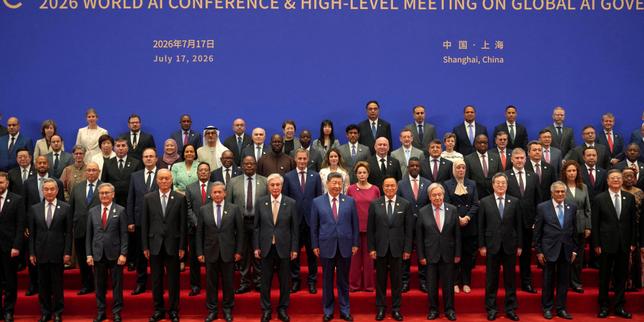
Don't let the polite diplomat-speak fool you. When Chinese President Xi Jinping stepped onto the stage at the World Artificial Intelligence Conference (WAIC) in Shanghai, he wasn't just offering a friendly hand to the international community. He was executing a calculated, highly strategic move to rewrite the rules of global tech dominance.
For the first time, Xi personally attended the event to deliver a keynote address. He laid out a vision for a "people-centered" and "human-centered" approach to artificial intelligence, arguing that AI should be a "symphony of international cooperation" rather than a "solo performance by a single country".
But behind the poetic phrasing lies a massive geopolitical shift. By championing the Global South, launching an international body with nearly 30 founding nations, and positioning Chinese open-source AI as a cheaper, unrestricted alternative to Western models, Beijing is building a parallel tech ecosystem.
If you're still viewing the AI race as a simple two-way street between Silicon Valley and Beijing, you're missing the bigger picture.
The World Artificial Intelligence Cooperation Organization (WAICO)
While the US focuses on restrictive licensing, export bans, and tight control over proprietary models, Beijing is taking the opposite approach. They are packaging their AI technology as a global public good.
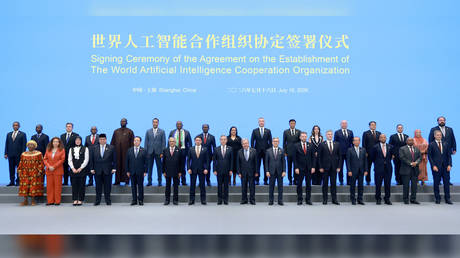
A day before Xi’s speech, representatives from 29 nations officially signed an agreement in Shanghai to establish the World Artificial Intelligence Cooperation Organization (WAICO). Headquartered in Shanghai, the body includes signatories like Brazil, Russia, Indonesia, Serbia, and dozens of other Asian and African nations.
WAICO Core Signatories & Partners:
├── Latin America: Brazil, Venezuela, Cuba
├── Eastern Europe: Russia, Belarus, Serbia
└── Emerging Markets: Indonesia, 12 Asian nations, 10 African nations
This isn't just a talking shop. WAICO stands to hand Beijing massive influence over international standard-setting. Why does this matter? Because whoever sets the technical standards for interoperability, data privacy, and ethical guidelines controls the global market. By bringing emerging economies into its orbit early, China is ensuring that the foundational infrastructure of tomorrow's global economy runs on Chinese protocols.
Xi Jinping’s Playbook for the Global South
If you look at the strategy closely, it's clear China is filling a void left by Western tech companies. Most US AI labs build expensive, resource-heavy models that require massive computing power and English-dominated datasets. They also face heavy regulatory restrictions on where they can export their technologies.
Beijing is capitalizing on this friction by offering a comprehensive digital package. Here is what Xi explicitly promised to the developing world during his WAIC address:
- 5,000 Training Opportunities: China will host 5,000 AI training and seminar programs for researchers and officials from developing countries over the next five years.
- International Application Centers: New joint centers will be established in partnership with ASEAN, the Arab League, and African nations.
- MAZU Early Warning System: China plans to deploy its AI-driven MAZU meteorological system to help 30 developing countries better predict extreme weather events.
- Open-Source Alternatives: China’s powerful state planner, the National Development and Reform Commission (NDRC), announced a plan to aggressively promote open-source Chinese models globally.
This isn't charity. It is classic diplomatic soft power. By giving these nations the tools to build their own systems using Chinese open-source architecture, Beijing makes them fundamentally dependent on Chinese hardware, cloud infrastructure, and technical expertise.
The Irony of Human-Centered AI Control
Xi’s speech heavily emphasized a "human-centered" approach, calling for robust laws, technological monitoring, and emergency response systems to keep AI under human control. On paper, it sounds almost identical to the safety-first language coming out of Washington and Brussels.
But "human control" means very different things depending on which capital city you're standing in.
In China, a human-centered approach naturally aligns with social stability and state oversight. Beijing is already incredibly efficient at regulating its domestic AI sector, requiring companies to register their algorithms and ensure their outputs align with core socialist values.
When Xi warns against "loss of control" or "new historical injustices" in AI, he's targeting two things at once: the potential for autonomous systems to disrupt social order, and the current US monopoly on the global AI narrative.
Why Western Businesses are Turning to Chinese Models
It's easy to assume that Western sanctions have crippled Chinese tech progress. That’s a massive mistake. Chinese startups are rapidly narrowing the gap with Silicon Valley, and they're doing it at a fraction of the cost.
Just as Xi was speaking, Chinese AI startup Moonshot debuted a brand-new large language model with capabilities that rival top-tier US labs. Even more telling is how Western enterprises are reacting. Companies like Siemens, DoorDash, and Airbnb are quietly integrating Chinese AI models into their workflows.
Why Chinese Models are Gaining Global Market Share:
1. Pricing: Significantly cheaper API calls compared to Western equivalents.
2. Deployment: Models are optimized to run on local, on-premise infrastructure.
3. Supply Chain Security: No risk of sudden US export bans cutting off access.
The risk of relying solely on US-based technology became painfully clear when Washington briefly threatened to impose export controls on specific models, sparking massive anxiety in Europe. Though the administration backtracked after a fierce Silicon Valley backlash, the damage was done. Global enterprises realized that relying entirely on a single nation's tech stack is a massive business risk.
Navigating the Two-Track AI Future
We aren't heading toward a unified global AI standard. We are heading toward a polarized, two-track digital world. On one side is a US-led ecosystem built on proprietary, highly guarded, and expensive commercial models. On the other side is a China-led block powered by WAICO, open-source technology, and heavily subsidized infrastructure designed for the Global South.
For tech leaders, developers, and policymakers, ignoring this shift is dangerous. You need to start auditing your dependencies now.
Evaluate your exposure to US regulatory swings. Look closely at how open-source frameworks are evolving outside of Western hubs. If your organization operates globally, particularly in emerging markets across Latin America, Southeast Asia, or Africa, you must prepare for a reality where your users, partners, and local governments are running on Chinese-backed, WAICO-compliant AI infrastructures. The split is already happening, and it's time to build your strategy accordingly.