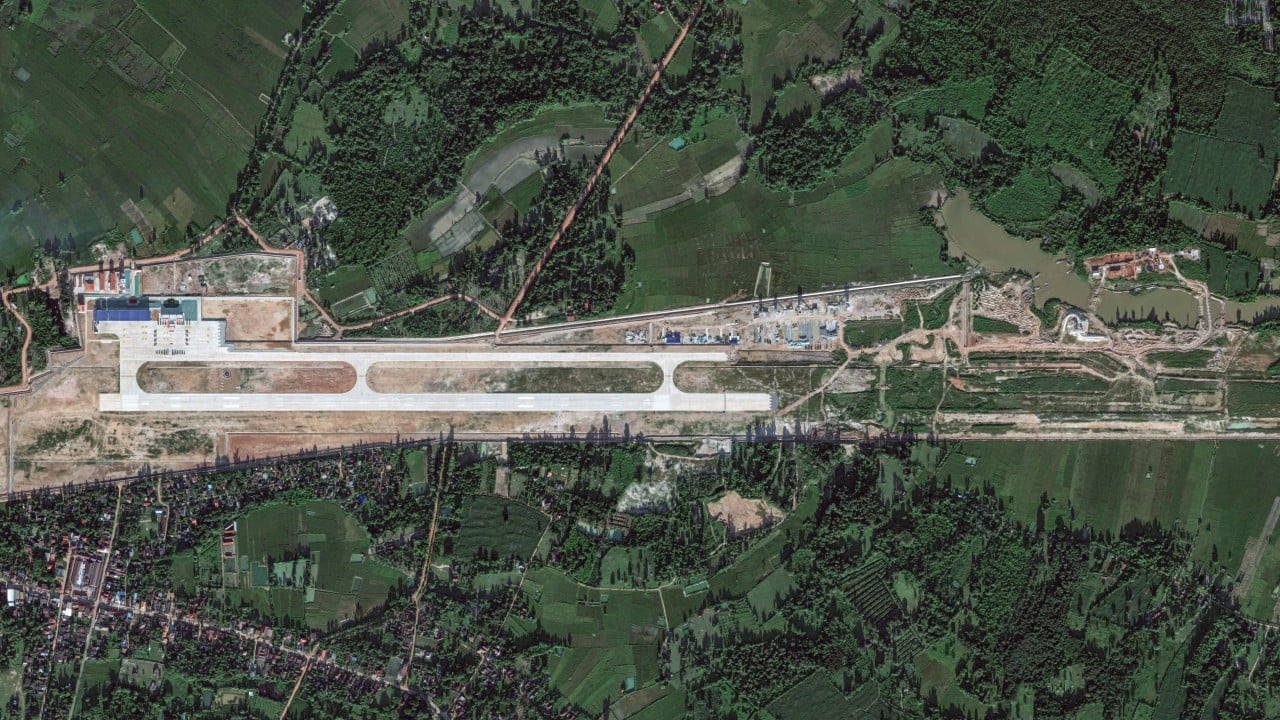
Every defense analyst in the Indo-Pacific is currently having an identical, highly predictable panic attack.
The headlines write themselves. China builds an airstrip in northern Laos. Western think tanks dust off their Cold War maps, redraw red lines, and warn that Hanoi is about to be flanked. The lazy consensus is that Beijing is planting a permanent iron boot on mainland Southeast Asia, turning its southern neighbor into a staging ground for regional dominance and leaving Vietnam isolated in a tightening geopolitical vise. For a different perspective, read: this related article.
It is a neat, tidy narrative. And it is entirely wrong.
If you evaluate this situation through the lens of traditional territorial conquest, you miss the entire point of modern projection. Beijing does not need to occupy Laos or turn it into an unsinkable aircraft carrier to achieve its objectives. In fact, parking permanent fighter squadrons and stationing heavy tactical air assets in the Laotian highlands would be a strategic blunder of staggering proportions. Similar reporting regarding this has been published by USA Today.
Let us dismantle the fear-mongering and look at what is actually happening on the ground.
The Geography of Friction
To understand why the alarmists are missing the mark, you have to look at actual military topography, not just a flat map colored in red and blue.
Laos is landlocked, mountainous, and heavily constrained by infrastructure bottlenecks. The terrain in the north is a logistical nightmare. I have spent enough time tracking regional infrastructure investments to know that pouring concrete in the Annamite Range is expensive, maintenance-heavy, and notoriously vulnerable to monsoon disruptions.
When people hyperventilate about a new Chinese-built dual-use airfield near the border, they assume it functions like an American base in Japan or a major facility in Hainan. It does not. An isolated airstrip tucked into a mountainous basin does not alter the strategic balance of power simply because it has a longer runway or reinforced hangars. Without deep, redundant supply chains, massive underground fuel storage, and local air defense bubbles that overlap with domestic airspace, a forward-deployed base is nothing more than a high-value target sitting in a shooting gallery.
Vietnam knows this better than anyone. Hanoi does not view a Laotian airfield through the hysterical lens of a Western pundit. Vietnam fought a bitter, bloody border war with China in 1979 and spent decades mastering asymmetric defense. Their military planners do not panic over concrete pours; they measure risk in terms of tactical depth, missile trajectories, and radar coverage. And by those metrics, a runway in northern Laos does not give Beijing the ability to roll over Vietnamese defenses. It gives Beijing a headache of exposure.
The Real Game is Economics, Not Dogfights
Why build an airfield if it is a mediocre military platform? Because the premise of the question is flawed. You are looking for a dagger when you should be looking for a tollbooth.
China’s strategy in mainland Southeast Asia is not about establishing forward operating bases for a blitzkrieg. It is about economic gravity. The Laos-China railway, the network of highways cutting through the northern provinces, and these dual-use transportation hubs are designed to pull landlocked economies irrevocably into the gravitational pull of the southern Chinese industrial base.
Beijing is spending capital to secure resource corridors, lock in supply chains, and bypass the maritime bottlenecks of the Malacca Strait. If an airfield happens to be built along those corridors, its primary utility is logistics, regional integration, and rapid transport for commercial and dual-use contractors. It projects influence through dependency, not through air superiority fighters sitting on tarmac waiting for a dogfight that will never come.
When you judge infrastructure through a purely military prism, you fall straight into the trap that Beijing's grand strategists set for you. You spend billions countering a phantom threat while your economic leverage quietly evaporates.
The Downside of the Contrarian View
I will be entirely candid about the blind spot in this argument. Dismissing the military utility of these facilities too quickly runs its own risk.
Airfields are scalable. A simple transport hub today can become a staging area for drones, electronic intelligence-gathering outposts, and helicopter refueling stations tomorrow. Even if a full fighter wing would be strategically vulnerable in a hot conflict, peacetime coercion operates on a different frequency. Just having the infrastructure present alters the psychological calculus of smaller neighbors. It whispers a constant reminder of who holds the economic and geopolitical cards in the subregion.
Hanoi understands this psychological pressure acutely. That is why Vietnam's response has not been panic or public posturing, but quiet, methodical counter-balancing. They are modernizing their naval capabilities, upgrading their coastal defenses, diversifying their diplomatic partnerships with Tokyo, New Delhi, and Washington, and ensuring their economic sovereignty remains uncompromised.
Vietnam is not trembling in the shadow of a Laotian runway. They are playing a long, cold game of strategic hedging.
Stop Fighting the Last War
The obsession with Chinese military bases in mainland Southeast Asia is a symptom of intellectual laziness among defense watchers who cannot conceive of power projection without aircraft carriers and bomber wings.
Beijing is playing a multi-dimensional game of economic integration, infrastructure diplomacy, and regional connectivity. Treating every piece of graded earth in Laos as the opening salvo of a regional invasion misses the forest for the runway lights.
If you want to understand how the Indo-Pacific order is actually shifting, stop staring at the skies over northern Laos. Look at the balance sheets, the trade routes, and the quiet, unsexy calculus of supply chain dominance.
The next time a headline tells you a new concrete strip is about to upend regional stability, remember that the most effective walls are built with currency, not steel.