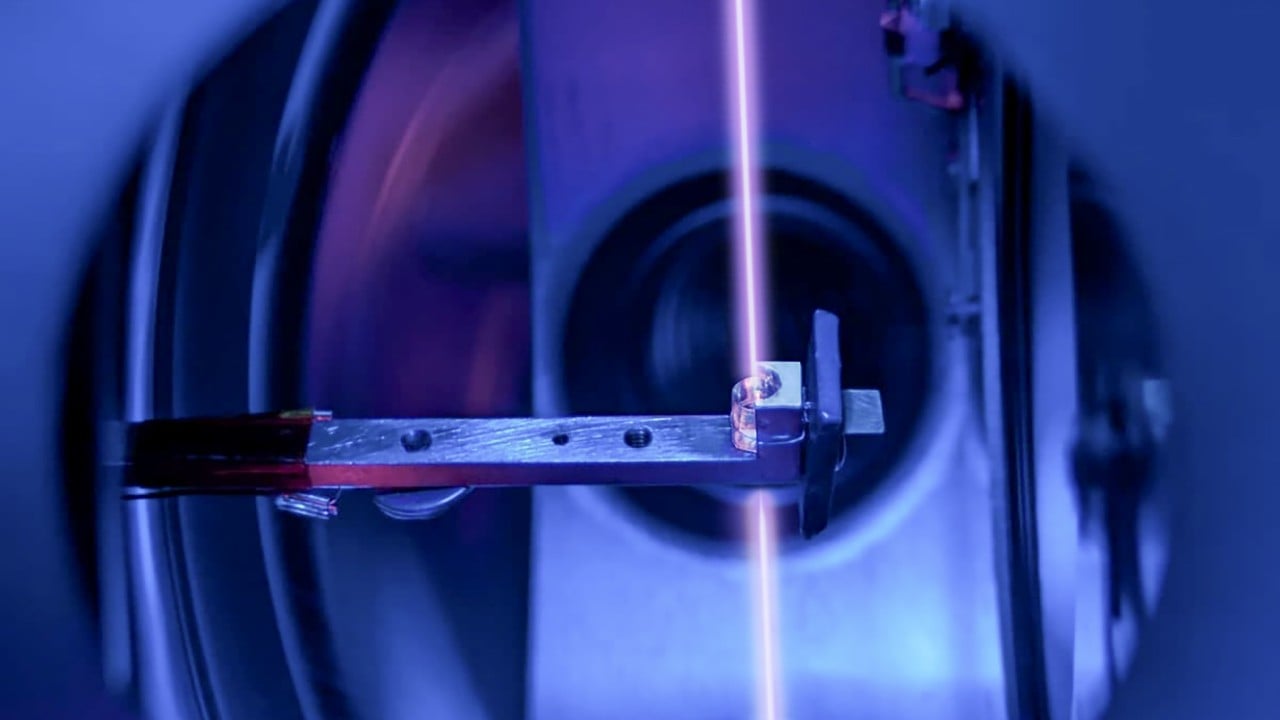
For decades, we have trusted atomic clocks to keep global time, manage internet traffic, and guide satellites through space. But atomic clocks have a glaring flaw. They rely on the electronic shells of atoms, which are easily disturbed by stray magnetic fields, temperature fluctuations, and external laser drift. Physics needed a harder standard. Enter the thorium-229 nuclear clock.
Instead of messing with electrons on the outside, a nuclear clock looks deep inside the atom's nucleus. Because a nucleus is roughly ten thousand times smaller than the full atom, it is practically immune to outside environmental noise. Recent studies out of Vienna University of Technology (TU Wien) and a Tsinghua-led team in Beijing have turned this theoretical dream into working hardware. They published breakthrough results showing fully functioning thorium-229 optical nuclear clocks. But beneath the shared excitement, a quiet rivalry has emerged over stability, crystal growth, and who gets to define the future of time itself.
The Battle of Stability Between Beijing and Vienna
When two elite research groups hit the exact same milestone around the same time, comparisons are inevitable. Researchers at TU Wien in Austria managed to run their self-stabilizing thorium nuclear clock unattended for a full day, showing incredible resilience and proving that the concept actually works outside of a purely theoretical paper.
Meanwhile, a team led by Tsinghua University in Beijing pushed the numbers further on frequency instability, hitting an impressive 5e-13 instability metric in their specific setup. According to the data, the Chinese team pulled ahead on raw short-term stability metrics, while the Vienna group boasted superior crystal doping homogeneity and optical properties.
What makes this race fascinating isn't just national bragging rights. It's the fact that these two independent teams used completely separate solid-state crystals to arrive at the same operational timeframe. When two distinct crystals grown miles apart keep the exact same nuclear time, you are looking at true reproducibility. That's the moment a lab experiment transforms into an engineering reality.
Why Ordinary Atomic Clocks Are Suddenly on Borrowed Time
You might wonder why we need an upgrade when standard cesium atomic clocks already lose less than a second over millions of years. The answer comes down to fundamental physics limits.
Cesium clocks use microwave frequencies. Optical atomic clocks use visible light lasers, which tick much faster and offer higher precision. Even the best optical atomic clocks require massive, room-sized laser setups and constant environmental shielding. A thorium-229 nuclear clock changes the equation entirely by utilizing the nuclear transition of the thorium isotope.
The energy required to excite a thorium-229 nucleus sits at an anomalously low level—around 8 electron-volts—making it accessible with vacuum ultraviolet (VUV) lasers. This unique quirk of nuclear physics bridges the gap between atomic precision and solid-state practicality. You get a robust, compact package that doesn't need to be housed in a pristine, vibration-isolated basement lab to remain accurate.
Real-World Applications Beyond Telling Time
If you think this is just about making a better watch, you are missing the bigger picture. Ultra-precise timekeeping drives modern infrastructure.
- GNSS-Denied Navigation: Current GPS systems rely entirely on satellite signals that can be jammed, spoofed, or blocked underground and underwater. A portable, hyper-stable nuclear clock on a vehicle or submarine could maintain accurate positioning for weeks without external signals.
- Dark Matter Detection: The Vienna team used their nuclear clock setup to hunt for invisible dark matter signatures. While they didn't catch any dark matter on this run, these clocks provide extreme sensitivity to tiny shifts in fundamental constants like the fine-structure constant and quark masses.
- Telecom Synchronization: High-frequency financial trading and 6G network rollouts demand timing accuracy down to the attosecond. Nuclear clocks eliminate the tiny drifts that plague current fiber-optic and satellite networks.
The Engineering Hurdles Left to Clear
Despite the recent headlines, we aren't replacing every clock on Earth tomorrow. Both the Beijing and Vienna prototypes sit firmly at Technology Readiness Level 4 (TRL 4). They are complex laboratory assemblies resting on optical benches, far from being field-ready devices.
Researchers still have to solve several brutal engineering problems. First, generating stable vacuum ultraviolet laser power at scale requires bulky equipment that drains too much power. Second, local structural strain inside the calcium fluoride crystals can distort the optical path, limiting long-term reproducibility. Until scientists can manufacture identical thorium-doped crystals with zero internal stress, mass production remains out of reach.
The race between European and Chinese physicists isn't slowing down. As funding pours into quantum sensing and robust timing networks, expect these lab benches to shrink into field units over the next decade. The second hand of the nuclear age has finally started ticking, and the old atomic standard's days are numbered.
Time to change to nuclear clocks, say researchers in China and Austria
This video provides a helpful overview of the collaborative yet competitive efforts between researchers in Vienna and China as they build the world's first working nuclear clocks.