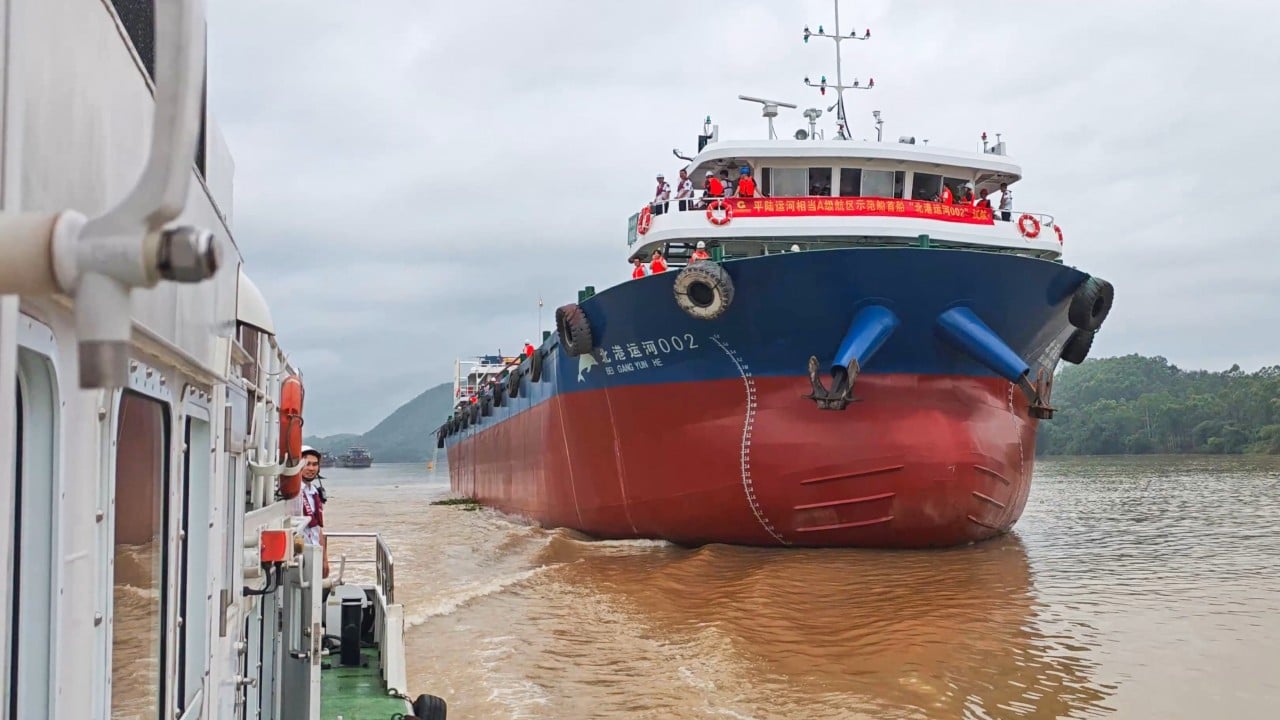
China is currently constructing the Pinglu Canal, a $10.3 billion megaproject in the southwestern Guangxi region designed to connect the Xijiang River system directly to the Gulf of Tonkin. The primary goal is to bypass the traditional, congested shipping routes that flow eastward through Guangdong province toward Guangzhou and Hong Kong, shaving off over 5,600 kilometers of travel distance for inland goods heading to sea. While state media frames the 134-kilometer waterway as a triumph of modern engineering and regional integration, a closer look at the region’s economic realities suggests the project serves a far more complex geopolitical agenda rather than a purely commercial one.
The canal requires moving massive amounts of earth—dwarfing the scale of the Three Gorges Dam excavation—to allow 5,000-ton cargo vessels to cut through mountainous terrain. Yet, the economic justification rests on shaky foundations. Industrial output in Guangxi and neighboring Yunnan or Guizhou provinces does not currently match the staggering capacity this canal provides, raising immediate questions about who will actually use this corridor.
The Bottleneck Illusion and the True Flow of Trade
Proponents of the Pinglu Canal argue that the Xijiang River, a major tributary of the Pearl River, has reached its physical limits. Freight barges frequently face massive delays at the Changzhou shipping lock, sometimes waiting days for passage. On paper, creating a new southern outlet to the sea solves this problem.
The argument falls apart when you look at where the cargo is actually going. Guangdong is not just a transit point; it is the industrial heartland of southern China. Most raw materials moving down the Xijiang are destined for the factories, construction sites, and mega-ports of Shenzhen, Guangzhou, and Hong Kong, not for immediate export to international markets. Forcing trade southward toward the Gulf of Tonkin disconnects it from these established supply chains.
Furthermore, the ports at the end of the new canal—primarily Qinzhou and Beihai—lack the deep-water infrastructure and global liner connectivity of the Pearl River Delta networks. A shipping container arriving at Qinzhou cannot simply jump onto a direct vessel to Rotterdam or Los Angeles with the same frequency or cost-efficiency as it would from Yantian or Nansha. Western buyers expect consolidated, high-frequency shipping options that smaller southwestern ports cannot provide without massive, taxpayer-funded subsidies.
Geopolitical Insurance and the Malacca Dilemma
If the domestic commercial case is weak, the international strategic case is ironclad. Beijing has long been obsessed with the "Malacca Dilemma," the reality that the vast majority of its energy imports and container trade must pass through the narrow Strait of Malacca, a choke point easily blockaded by the United States military in a conflict scenario.
The Pinglu Canal is the domestic anchor for a much larger project: the New International Land-Sea Trade Corridor. By linking inland rail and river networks directly to the Gulf of Tonkin, China creates a shorter, heavily protected supply line that feeds directly into Southeast Asia.
Squeezing Into ASEAN Markets
Vietnam, Laos, Cambodia, and Thailand are becoming China's most critical trading partners as Western markets erect higher tariff walls. The canal accelerates this shift.
- Raw materials from western China can flow down to Vietnamese manufacturing hubs faster.
- Agricultural imports from Southeast Asia can move north into China's interior without clogging eastern ports.
- Military logistics gain a highly secure, inland waterway capable of moving heavy equipment and supplies away from vulnerable coastal shipping lanes.
This is infrastructure built for a fragmented world. It is an expensive insurance policy against Western sanctions and maritime blockades, paid for upfront by state-backed banks.
The Ecological Toll on the Pearl River System
Engineering a mountain range to swallow a river system comes with severe environmental costs that economic models routinely downplay. The canal relies on complex water-diversion schemes from the reservoir system of the upper Xijiang. This diversion threatens to alter the hydrological balance of the entire region.
During the dry season, the Xijiang already struggles with low water levels, halting barge traffic and causing salt-water intrusion in the Pearl River Delta downstream. Siphoning off billions of cubic meters of water to flush the Pinglu Canal will inevitably worsen these shortages. Cities like Macau and Zhuhai, which rely on the Pearl River for fresh water, could face increased salinization issues.
The construction also disrupts delicate freshwater ecosystems. The mixing of river water with marine water at the canal's southern terminus creates an artificial estuary environment that threatens local fisheries and shrimp farming industries in the Gulf of Tonkin. Environmental impact assessments approved by local authorities assert that mitigation strategies will protect the environment, but independent hydrologists remain skeptical that such a massive disruption can be cleanly managed.
Who Bears the Financial Burden
Local governments in China are currently drowning in debt, largely due to years of over-reliance on land sales and massive infrastructure spending. Guangxi is no exception. While the central government provides a portion of the funding for national-level projects, a significant financial burden falls on regional state-owned enterprises and local banks.
To pay off the $10.3 billion price tag, the canal must generate substantial revenue through toll fees and industrial zone development along its banks. This creates a classic chicken-and-egg dilemma. If toll fees are set too high to recoup construction costs, shipping companies will stick to their existing, cheaper rail or eastern river routes. If tolls are set low to attract traffic, the project will never break even, turning into a massive fiscal drain on an already strained regional economy.
The financial risk is compounded by the demographic realities of western China. Population decline and shifting industrial priorities mean that the projected boom in inland manufacturing may never materialize. Automation and high-value tech manufacturing favor coastal clusters, leaving heavy, low-margin bulk commodities as the canal's primary cargo—goods that cannot afford high transit tariffs.
Shifting the Map of Global Logistics
The construction of the Pinglu Canal demonstrates that China is no longer building infrastructure simply to meet existing demand. It is building to force a structural shift in how goods move across Asia.
[Inland China Factories] ---> (Pinglu Canal) ---> [Gulf of Tonkin Ports] ---> [Southeast Asian Markets]
                                                                         (Bypassing Eastern Ports)
Global shipping firms and supply chain managers cannot afford to ignore this realignment. Even if the canal operates at a loss for its first two decades, the state's ability to subsidize container rates means that routes will change. Companies sourcing components from Southeast Asia will find themselves increasingly integrated into this southern corridor, regardless of whether the initial $10 billion investment made financial sense on a corporate balance sheet.
The true metric of success for the Pinglu Canal will not be found in its annual financial statements or its return on investment percentages. It will be measured by how effectively it tethers the economies of mainland Southeast Asia to Beijing, creating a contiguous economic zone that functions entirely outside the influence of Western maritime power.