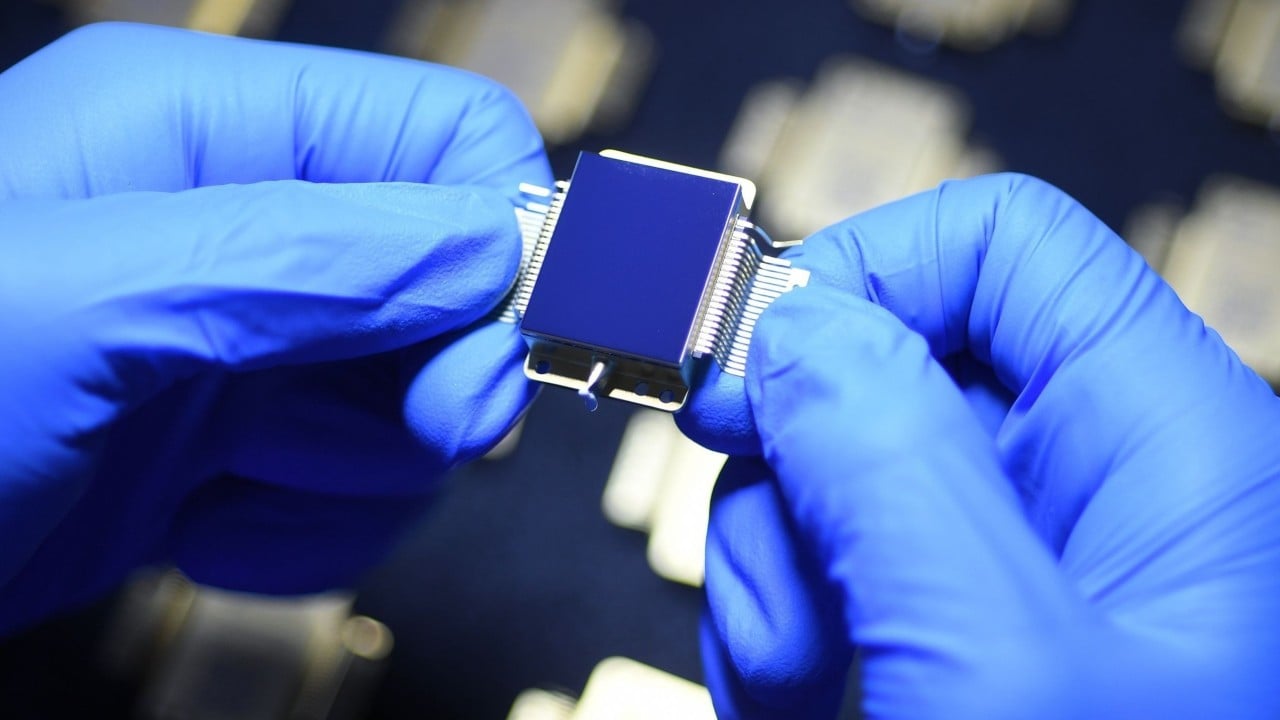
The traditional economics of military hardware just hit a wall. For decades, short-wave infrared (SWIR) sensors were the crown jewels of tactical surveillance, costing thousands of dollars per unit because they relied on exotic materials like indium gallium arsenide (InGaAs). These chips allowed drones to see through thick fog and missiles to lock onto targets in total darkness, but their price tag kept them locked away in elite arsenals. Now, a research breakthrough at Xidian University has effectively neutralized that cost barrier. By successfully migrating infrared production to a silicon-germanium process compatible with standard commercial semiconductor manufacturing, Chinese researchers have reduced the cost of these chips to a few dozen dollars.
This is not a marginal improvement. It is a 99% reduction in price that fundamentally alters the utility of thermal imaging. When a component moves from being a specialized military asset to a commodity priced like a smartphone chip, the strategic advantage of the "high ground" shifts to whoever can manufacture at the greatest scale. If you enjoyed this piece, you should check out: this related article.
The Death of Exotic Materials
The technical bottleneck for high-end infrared has always been the material science. Traditional SWIR sensors require complex "flip-chip" bonding, where the light-sensing material is grown separately and then painstakingly attached to the silicon readout circuit. This process is plagued by low yields and astronomical costs. If one connection in thousands fails, the chip is often junk.
The Xidian University team bypassed this by integrating the sensing layer directly onto silicon using germanium. This allows the chips to be fabricated on the same Complementary Metal-Oxide-Semiconductor (CMOS) lines that churn out billions of consumer electronics. For another look on this event, see the recent update from CNET.
Standard SWIR Chip Costs
- Traditional (InGaAs): $1,000 – $5,000 per sensor
- New Chinese Si-Ge Process: $10 – $50 per sensor
By making the manufacturing "boring" and compatible with existing fabs, China has turned a boutique craft into a mass-market utility. This isn't just about making better cameras; it is about the saturation of the battlefield and the consumer market alike.
The Tactical Saturation Effect
In modern warfare, thermal imaging is a binary advantage: you either have it and see your enemy, or you don't and you die. Until now, that advantage was rationed. High-end sensors were reserved for expensive platforms like the F-35, MQ-9 Reaper drones, or advanced main battle tanks. Individual soldiers might have thermal optics, but they were often lower-resolution "uncooled" versions with significant limitations.
A $30 military-grade chip changes the math for disposable attrition warfare. We are looking at a future where every $500 kamikaze drone is equipped with high-fidelity SWIR sensors that can pierce through the smoke screens and atmospheric haze that currently blind low-cost optics.
When sensors are this cheap, camouflage becomes nearly impossible. The "transparency" of the battlefield reaches a point where movement in any weather condition is instantly detectable. For Western militaries that rely on technological superiority to offset smaller troop numbers, the democratization of high-end sensing is a localized crisis. You cannot hide a multi-million dollar vehicle from a swarm of $500 drones if each drone has the eyes of a predator.
Breaking the Consumer Ceiling
Beyond the barracks, the implications for the automotive and smartphone industries are immediate. Level 3 and Level 4 autonomous driving systems currently struggle with "edge cases"—heavy rain, dense fog, or blinding glare from oncoming traffic. LiDAR and traditional cameras have blind spots that physics simply won't let them overcome.
Infrared is the solution, but it was always too expensive for a mid-market sedan. With chips costing a few dozen dollars, thermal imaging becomes a standard safety feature, not a luxury add-on.
Key Commercial Disruption Points
- Automotive Safety: Night vision and fog penetration become standard in entry-level EVs.
- Smartphone Evolution: Integration of true thermal sensing into mobile devices for home inspection, medical screening, and enhanced photography.
- Industrial IoT: Mass deployment of sensors in factories to detect overheating components before they fail, at a fraction of current costs.
Wuhan Guide Infrared and InfiRay are already moving to capitalize on this. These companies aren't just looking at the Chinese domestic market; they are positioned to become the global foundry for thermal components.
The Self-Sufficiency Feedback Loop
This breakthrough didn't happen in a vacuum. It is the direct result of Beijing’s aggressive push for semiconductor autonomy following US export restrictions. When you cut off a country’s access to high-end foreign chips, you force their R&D budget into fundamental material science.
China has mandated that its domestic chipmakers use at least 50% locally produced equipment. This has created a massive, captive testing ground for new processes. The Xidian University team didn't just invent a chip; they built a "full development chain" including the design tools and the production equipment. They are scheduled to have a dedicated production line operational by the end of 2026.
The West is now facing a paradox. Export controls were intended to slow down China's military modernization. Instead, they have catalyzed a manufacturing shift that could lead to Chinese dominance in the next generation of sensing technology. While Western firms like FLIR and Raytheon continue to produce high-margin, low-volume sensors for government contracts, Chinese firms are preparing to flood the world with low-margin, high-volume equivalents.
Scale has a quality all its own. In the world of semiconductors, the player who makes the most chips usually ends up making the best chips, simply because they have more data and more opportunities to refine the process. By the time Western competitors realize the "toy" sensors on $300 Chinese smartphones are as good as their military-grade hardware, the market share will already have shifted.
The barrier hasn't just been lowered; it has been demolished. We are entering an era where darkness and fog are no longer tactical layers, but transparent environments accessible to anyone with a few dollars to spare.
The strategic silence is over. The era of the ubiquitous thermal eye has arrived. Every vehicle, every drone, and eventually every pocket will have the ability to see the invisible. The competitive advantage no longer belongs to the inventor of the technology, but to the nation that can print it at the lowest cost. China just placed its bet.