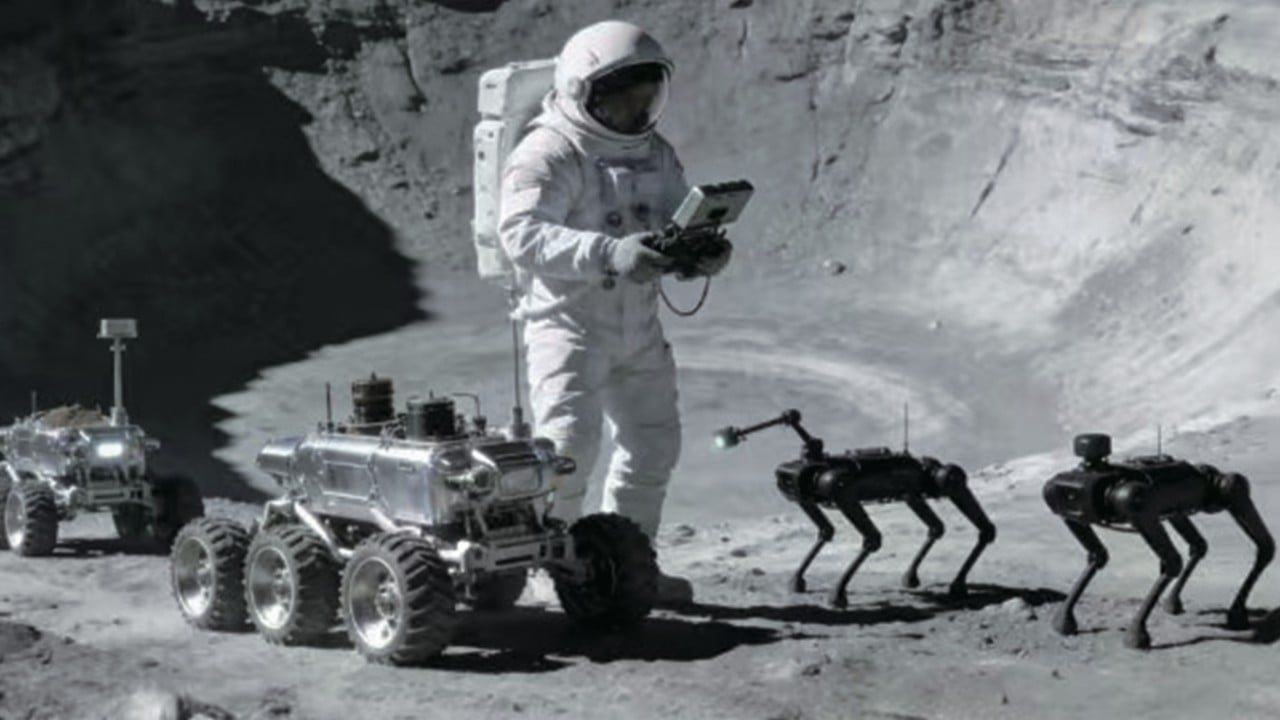
Autonomous security systems and automated robot watchdogs are set to patrol China’s planned lunar research station, signaling a fundamental shift in how spacefaring nations protect off-world assets. The International Lunar Research Station, spearheaded by China, faces unprecedented environmental and geopolitical vulnerabilities that demand active mechanical defense rather than passive observation. For decades, the conversation surrounding space exploration focused entirely on survival against the vacuum, extreme temperatures, and cosmic radiation. Now, the conversation has violently pivoted toward security, resource protection, and territorial assertion on the lunar surface.
When you look at the architecture of modern space programs, security is rarely discussed as an engineering constraint. We obsess over propulsion efficiency, life support redundancy, and thermal shielding. Yet, as governments and private entities cast their eyes toward the south pole of the Moon, the calculus changes. The South Pole-Aitken basin is a finite piece of real estate rich in water ice. Where there are scarce resources of strategic value, conflict inevitably follows.
The Harsh Realities of Lunar Infrastructure
Building a permanent habitat on the Moon is an exercise in managing catastrophic risk. The lunar environment is hostile to electronics, mechanical actuators, and human physiology. Regolith—the abrasive, electrostatically charged dust covering the lunar surface—gets into every seal, fouls solar panels, and destroys moving parts. Designing a robot watchdog that can operate in this abrasive vacuum without breaking down is an engineering nightmare.
Traditional wheeled rovers like Yutu-2 move at a snail's pace, controlled by human operators millions of miles away with a communication delay of several seconds. That latency is fatal in an emergency. Autonomous defense and monitoring systems require local edge computing capable of processing sensory data in real time. If a structural seal fails, a thermal grid drops, or an unauthorized foreign payload approaches within a contested zone, waiting for ground control in Beijing or Houston to parse telemetry is not an option.
The proposed watchdogs must possess onboard artificial intelligence capable of making binary survival decisions independently. They must distinguish between a thermal anomaly caused by solar flare activity and a localized system failure or physical tampering. This level of autonomy represents a profound departure from traditional space exploration protocols, where every single action is meticulously scripted and verified on Earth.
Geopolitics in the Dust
The push for lunar automation cannot be separated from the escalating space race between the United States and China. NASA's Artemis program has established the Artemis Accords, a framework for lunar governance that critics argue heavily favors American commercial interests and strategic positioning. China, shut out of the Artemis coalition by legislative mandate, has countered with its own multilateral alliance, primarily anchored by partnerships with nations like Russia.
As these competing coalitions stake claims on lunar peaks of eternal light and shadowed craters containing water ice, the risk of close-proximity operations increases. If two rival stations are established within a few kilometers of each other—which is entirely plausible given the limited number of prime locations with continuous solar power and water access—friction is guaranteed.
A robot watchdog is not merely a tool for sniffing out gas leaks or structural fatigue. In a geopolitical vacuum, automated systems serve as tripwires. They establish a persistent physical presence without risking human lives during early-stage posturing. They monitor perimeter integrity, record approaching vehicles or astronauts from rival nations, and deter opportunistic sabotage.
This militarization of lunar science is happening whether the public wants to acknowledge it or not. The Outer Space Treaty of 1967 bans weapons of mass destruction in orbit or on celestial bodies, but it leaves a massive grey area regarding conventional security measures, defensive perimeters, and the protection of sovereign infrastructure. Stationing a mechanical guard dog outside an inhabited habitat to protect against unauthorized intrusion technically falls under self-defense and asset protection. It is a loophole wide enough to drive a lunar rover through.
The Engineering Hurdles of Mechanical Sentinels
Creating a reliable lunar security robot requires solving three nearly intractable technical problems: power distribution, thermal management, and mobility across extreme terrain.
Solar power is insufficient during the lunar night, which lasts for roughly fourteen Earth days. While small nuclear reactors, such as the kilowatt-scale fission systems currently under development, could provide reliable baseline power, routing that energy across rugged terrain to a mobile patrol unit is inefficient. Battery technology must undergo a generational leap to survive freezing lunar nights without degrading completely.
Thermal management is equally brutal. Temperatures on the Moon fluctuate from one hundred twenty degrees Celsius in direct sunlight down to negative one hundred thirty degrees Celsius in the shade. Standard lubricants freeze solid, and metals warp under extreme thermal gradients. Engineers cannot rely on conventional cooling fans because there is no atmosphere to move. Heat must be dissipated entirely through radiation, which complicates the design of high-performance computing units required for autonomous navigation.
Mobility is the final frontier. Wheeled vehicles struggle in deep, loose regolith. Walking robots, inspired by biological quadrupeds, offer superior terrain adaptability over boulders and steep crater rims. However, multi-legged systems require complex kinematics and hundreds of actuators, each representing a potential point of failure. A single jammed servo motor on a quadrupedal watchdog stranded ten kilometers from the base station means the loss of a multi-million-dollar asset.
The Cost of Exclusion and Escalation
The deployment of autonomous security units on the Moon sets a dangerous precedent. Once one nation normalizes armed or heavily guarded outposts, others will follow suit. We are exporting terrestrial paranoia into the heavens. The pristine scientific frontier of space is rapidly transforming into an extension of earthly rivalries.
The financial burden alone is staggering. Launch costs per kilogram to translunar space remain prohibitively high, meaning every gram dedicated to a security system is a gram denied to scientific instruments or life support consumables. That governments are willing to shoulder this financial weight underscores the strategic imperative they place on lunar dominance.
As these mechanical watchdogs take up positions along the rims of lunar craters, they will stand as silent sentinels over a fractured future. They will patrol the dust not to protect humanity as a whole, but to guard narrow national interests against the dark backdrop of an indifferent cosmos. The exploration of space was founded on the idealistic notion of uniting humanity under a common banner. The reality on the ground is far colder, shaped by steel, sensors, and the enduring impulse to build walls even in the stars.