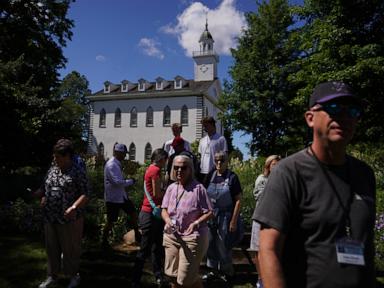
The morning air in Kirtland, Ohio, carries a sharp, distinct chill in the autumn months. Frost grips the blades of grass along the Chagrin River, and the trees shed their amber weights onto the historic soil. Walk down the quiet lanes here, and the past does not feel like a distant textbook chapter. It feels like breathing.
Consider a man named Arthur, standing outside a heavy wooden door in the early 1830s. He is wearing rough-hewn wool, his hands calloused from hauling limestone under a relentless Midwestern sun. He is part of a fragile community of early believers who have poured every ounce of their meager savings, every aching muscle, and every fragile hope into constructing a massive, three-story stone building that glows pale against the hillside. To Arthur, this structure is not merely an architectural feat. It is an anchor thrown into a chaotic world, a physical manifestation of eternity built with sandstone and sweat.
That building is the Kirtland Temple. It is the oldest operating house of worship for the historic Latter Day Saint movement, a survivor of nearly two centuries of theological schisms, westward migrations, economic collapses, and the quiet erosion of time.
Now, jump forward across vast stretches of highway, past the sprawling suburbs of Columbus, to a place called Tarlton Road in Lancaster, Ohio.
Here, the air smells less of ancient riverbeds and more of freshly turned suburban earth and newly cut timber. Trucks idle in the distance. Cranes pivot against a pale blue sky. Workers in high-visibility vests guide massive steel beams into place with calibrated precision.
Ohio now holds a fascinating geographical and historical paradox. It houses the oldest surviving temple of this global faith, and it is rapidly shaping one of the newest.
To understand why this matters, you have to step away from the blueprints and look at the human cost of waiting.
For generations, Latter-day Saints living in the heartland of America experienced a quiet kind of displacement. Yes, their faith originated in these very fields and valleys during the early nineteenth century. The ghosts of their theological ancestors walked these roads. Yet, as the decades rolled on, the institutional center of gravity drifted steadily westward, eventually settling into the desert valleys of Utah. Temples—sacred buildings distinct from ordinary Sunday meetinghouses, designed for covenant-making and eternal ordinances—rose predominantly in the West.
If an Ohio family wanted to enter a temple in the mid-twentieth century, they packed suitcases, piled into station wagons, and drove for days across the flat expanse of the American heartland. They watched cornfields blur into badlands, crossing state lines until the distant silhouette of a granite spire pierced the western horizon.
Faith requires endurance. But exhaustion is a heavy tax.
Communities change slowly, then all at once. Over the past twenty years, the demographic map of the United States shifted. Families moved away from traditional coastal hubs and the mountain West, seeking affordable land, thriving tech corridors, and quiet neighborhoods in the Midwest. Central Ohio became a magnet.
Into this vibrant, growing mosaic stepped thousands of Latter-day Saints. They took jobs at hospitals, universities, and burgeoning tech hubs. They coached little league teams, bought groceries at local co-ops, and sat in traffic on the I-270 loop.
Yet, every time they sought the quiet sanctuary of a temple, the commute remained a daunting barrier. Driving hours just to perform sacred family ordinances meant that temple attendance was reserved for rare, carefully planned vacations rather than a regular, grounding rhythm of weekly or monthly life.
Distance creates hunger.
When church leadership announced in April 2023 that a temple would be built in the Columbus area, the reaction among local congregants was not casual satisfaction. It was an exhale.
I remember talking to a lifelong member who had lived in Delaware County for thirty years. She described the announcement with tears welling in her eyes, not because of stone or mortar, but because of what it meant for her grandchildren. No longer would faith require an overland expedition. The sacred would finally sit right next to the mundane.
Building a modern temple is an intricate dance between ancient symbolism and hyper-modern zoning laws.
Take a walk through the planning phases of the Columbus Ohio Temple. It is a striking exercise in contextual architecture. Planners do not simply drop a standardized corporate box onto a plot of land. They study the vernacular of the region. They look at the rolling hills, the historic brick farmhouses, the classical revival details of nineteenth-century civic buildings, and the quiet dignity of rural Ohio.
The exterior utilizes fine stone, chosen not just for durability, but for how it catches the shifting Midwestern light. In the dead of winter, when the Ohio sky turns the color of brushed pewter, the stone needs to hold warmth. At sunset, when the horizon erupts in bruised purples and fiery oranges, the building needs to reflect that temporary glory.
Inside, the philosophy shifts from exterior landscape to interior sanctuary. Artisans craft hand-tufted carpets featuring floral motifs native to Ohio. The woodwork showcases rich, warm tones. Art glass windows filter harsh daylight into soft, celestial hues of amber, blue, and gold.
Every detail whispers a single message: you belong here.
There is a profound historical symmetry happening in Ohio right now that deserves deeper reflection.
In March 2024, a monumental administrative transition took place. Ownership of the Kirtland Temple, along with several historic properties and documents, transferred from the Community of Christ to The Church of Jesus Christ of Latter-day Saints. For over a century, these sites had been managed separately, physical testaments to a shared, sometimes turbulent past.
When the keys changed hands, historians held their breath. But on the ground, something much quieter and more powerful occurred. Pilgrims from both traditions walked through the heavy oak doors of the Kirtland Temple, side by side, looking up at the pulpit built by pioneers in 1836. They realized that the building had outlived their divisions.
Now, less than a two-hour drive south, the steel frame of the Columbus temple climbs toward the clouds.
History is not a straight line. It is a loop, doubling back on itself, asking if we have learned how to build better shelters against the cold.
Consider the contrast between the two structures.
The Kirtland Temple was built by hand with borrowed tools, green timber, and ground-up china mixed into the stucco to make it sparkle in the moonlight. The workers were poor, frequently harassed, and operating on an impossible deadline dictated by their own impending exile. It is raw. It is asymmetrical in subtle ways. It bears the thumbprints of humans who were terrified, faithful, and fiercely determined.
The Columbus temple is built with laser-guided cranes, computer-aided design, and global supply chains. It is polished, symmetrical, and engineered to withstand seismic shifts and brutal freeze-thaw cycles for centuries to come.
Yet, beneath the surface, the impulse driving both buildings is identical.
Human beings are fragile creatures. We live brief, noisy lives defined by loss, ambition, fatigue, and an overwhelming desire to connect with something larger than our own mortality. We build monuments because we are terrified that we will be forgotten. We build sanctuaries because our souls get battered by the daily grind and require a quiet room where the noise finally stops.
Arthur finished his work on the Kirtland Temple and was soon driven out into the snow, walking west toward a bitter uncertainty.
The modern worker tightening a bolt on the Columbus temple climbs down from the scaffold at five o'clock, gets into an electric sedan, stops at a grocery store to pick up milk, and drives home to watch the evening news.
Yet, if you stood Arthur next to that modern ironworker, they would share a look of absolute, unshakeable mutual recognition. They both know what it means to lift heavy things for a future they may only partially see. They both know the weight of sacred architecture.
Ohio holds the oldest, and Ohio holds the new. Between those two points on the map lies a living bridge of faith, endurance, and human longing that time cannot erode.
The sun dips below the horizon in central Ohio, painting the skeleton of the new temple in silhouette against the darkening sky. A mile away, traffic hums along the highway, indifferent and relentless. But inside the hearts of thousands who call this place home, a profound stillness settles in. The wait is nearly over. The anchors are holding.