The Record Profit Mirage
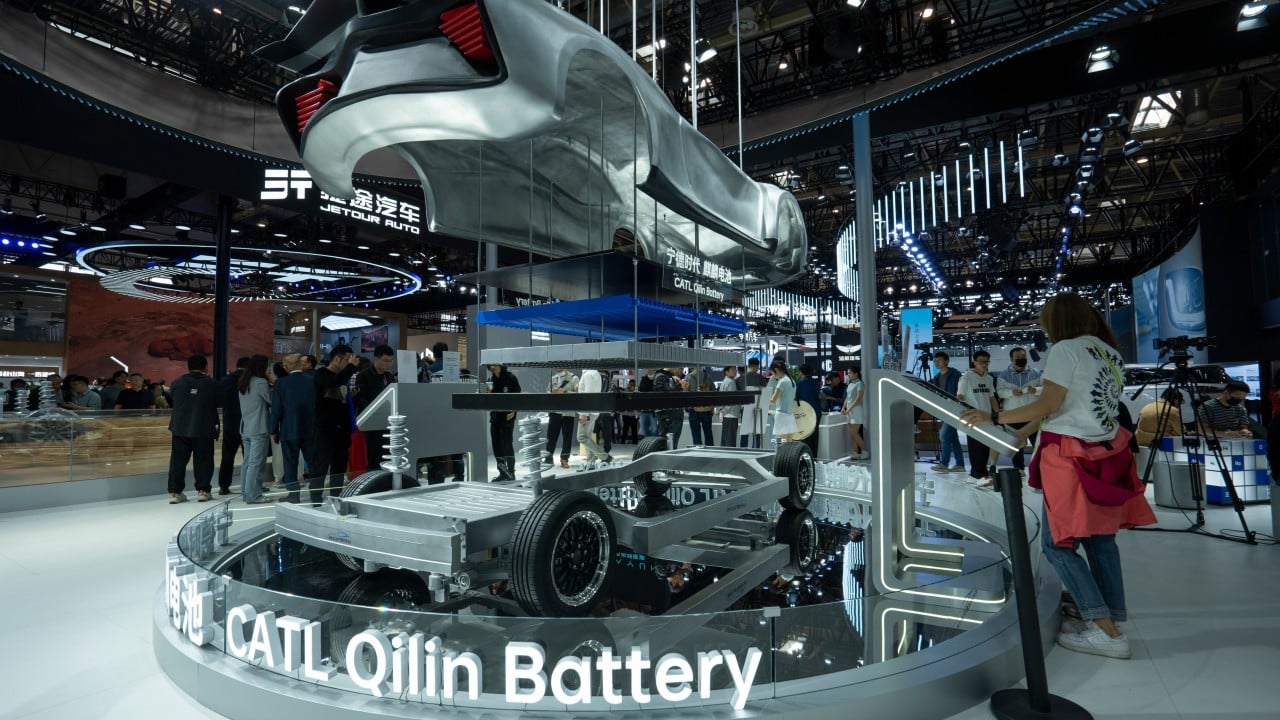
Financial media loves a simple narrative. Headlines trumpet CATL’s massive quarterly net income numbers as proof positive of a unstoppable green shift. Wall Street analysts nod along, pointing to surging market share and fat margins as indicators of an unbreakable monopoly.
They are looking at the wrong ledger. Recently making headlines lately: The Mechanics of Sub-Treaty Bilateralism and Asymmetric Trade Friction.
What the consensus views as structural dominance is actually the peak of a cyclical price-fixing window. CATL didn't crush the competition last quarter through revolutionary physics or sheer manufacturing genius. They did it by squeezing raw material suppliers on the way up, locking automakers into rigid long-term off-take contracts, and letting margin compression hit everyone else in the supply chain first.
I have watched hardware hardware executives fall into this trap for two decades. When a single component supplier captures the vast majority of an industry's total profit pool, it isn't a sign of sector health. It is a sign of systemic failure. Automakers aren't partners with CATL; they are becoming low-margin assembly plants for CATL's battery packs. That dynamic is unsustainable, and the pushback has already begun. More information into this topic are covered by The Wall Street Journal.
The Economics of a Squeezed Supply Chain
To understand why these earnings numbers are a warning light rather than a green light, you have to look at how lithium iron phosphate (LFP) cost structures actually function.
+-------------------------------------------------------+
|                THE BATTERY VALUE TRAP                 |
+-------------------------------------------------------+
|  Automaker Margins:   [ 3% - 6% ]  <-- Compressed     |
|  CATL Profit Share:   [ 60% - 70%] <-- Unbalanced     |
|  Mining/Refining:     [ Volatile ] <-- Volatile       |
+-------------------------------------------------------+
When raw lithium carbonate prices swung wildly over the past two years, mainstream coverage assumed battery makers would take the hit. Instead, CATL used its scale to dictate terms. They launched preferential pricing schemes—like the "LFP Option"—offering discounted cells to select automakers in exchange for exclusive supply commitments over multi-year horizons.
This maneuver did two things simultaneously:
- It starved competing battery startups of volume, effectively killing off prospective European and North American cell manufacturers before they achieved yield maturity.
- It transferred input cost volatility directly to original equipment manufacturers (OEMs), who were left carrying inventory risks while CATL protected its cash flows.
Here is the brutal truth: an EV OEM making a 4% operating margin while paying a 20% margin to its primary battery vendor will eventually do one of three things. They will build their own cells, force government intervention via tariffs, or go bankrupt. None of those outcomes support CATL’s current valuation multiples over a ten-year horizon.
The Sodium-Ion Distraction
Ask an optimist how CATL maintains its edge, and they will immediately point to sodium-ion chemistry or condensed matter batteries. The popular take claims these alternative chemistries will permanently eliminate cobalt and nickel dependency overnight.
That is wishful thinking disguised as technical progress.
Sodium-ion technology is not an immediate replacement for high-density EV powertrains. The gravimetric energy density of commercial sodium-ion cells hovers around 160 Wh/kg. Compare that to premium nickel-manganese-cobalt (NMC) cells pushed past 250 Wh/kg, or even advanced LFP variants hitting 190 Wh/kg.
Sodium-ion is heavier. It takes up more physical space. For urban commuters and stationary energy storage systems (ESS), it works brilliantly. For a two-tonne family SUV requiring 400 miles of highway range, it is physics non-viable.
Promoting sodium-ion as an immediate EV silver bullet is a defensive marketing strategy. It creates an illusion of perpetual technical disruption, convincing investors that if lithium costs spike again, CATL can simply flip a switch and run on cheap salt. In reality, scaling sodium cell manufacturing to gigawatt-hour levels requires entirely separate supply chains, modified anode coating equipment, and years of field reliability data that simply do not exist yet.
The Geopolitical Trap Door
The mainstream media treats CATL’s global expansion as an inevitable victory march. They point to plant investments in Germany and Hungary as proof that Chinese battery power transcends trade friction.
This ignores political realities.
Battery packs are not consumer electronics. They are the strategic core of national transportation grid electrification. Western governments are actively rewriting trade rules to ensure battery IP and manufacturing capacity do not remain concentrated in a single geopolitical jurisdiction.
The Policy Wall
- The US Inflation Reduction Act (IRA): Explicitly designed to exclude batteries with components sourced from specific foreign entities. Licensing deals—like Ford using CATL technology in Michigan—face constant legislative threats and regulatory uncertainty.
- European Subsidies & Tariffs: The EU’s anti-subsidy investigations into Chinese electric vehicles extend logically to the underlying supply chain. Carbon footprint regulations and battery passport mandates are designed to favor localized European production curves over imported supply lines.
If you assume CATL can replicate its 35%+ global market share inside North America and Europe without severe margin erosion, you are ignoring how regulatory moats are built. To operate in Western markets, CATL will be forced to accept joint venture structures, technology transfers, and local supply chain requirements that will steadily dilute its earnings purity.
The Hidden Cost of Scale: Yield and Recycle Loops
There is a technical reality that glossy corporate reports never mention: manufacturing yield loss at massive scale.
When operating at hundreds of gigawatt-hours, a 1% failure rate in cell assembly translates to thousands of tons of hazardous scrap material every month. The consensus assumes that larger factories automatically deliver lower per-unit costs. That is true for stamping sheet metal; it is not consistently true for chemical processing under cleanroom conditions.
+-------------------------------------------------------+
|           THE SCALE DISCONNECT IN CELL MFG            |
+-------------------------------------------------------+
| Factory Size  --> Yield Complexity --> Scrap Overhead |
| 10 GWh        --> Low Contamination--> Manageable    |
| 100 GWh+      --> Micro-Particulates-> Exponential   |
+-------------------------------------------------------+
As battery plants scale, maintaining strict purity standards against micro-particulates becomes exponentially harder. A single stray metallic particle inside a cell stack can cause micro-shorts, thermal events, or rapid capacity degradation over time.
Furthermore, the secondary market for recycled battery materials is broken. Current hydrometallurgical recycling processes are energy-intensive and expensive. When virgin lithium prices crash, recycled black mass becomes economically uncompetitive compared to newly mined material. CATL is building an empire on the assumption that closed-loop recycling will cushion raw material shocks. But until recycling yield economics outpace extraction economics, those massive recycling facilities are balance sheet liabilities, not growth drivers.
Rethinking the Battery Investment Thesis
If you are evaluating the battery sector using standard tech software playbooks, stop. This is heavy chemical processing masquerading as high-tech hardware.
What Actually Matters Going Forward
- Cell-to-Pack (CTP) Efficiency is Peak Engineering: Mechanical pack integration has reached diminishing returns. You cannot strip away structural housing forever without sacrificing crash safety and thermal containment integrity.
- Solid-State is Not Around the Corner: High-throughput manufacturing of thin, durable ceramic separators at scale remains an unsolved industrial problem. Stop modeling solid-state revenue for 2027. It is a post-2030 reality for mass-market vehicles.
- Automaker Vertical Integration is Real: BYD’s vertical integration model works because they build the car and the cell. Western OEMs are learning this lesson. They are moving away from total dependence on external suppliers toward joint-venture gigafactories where they control the process IP.
The Uncomfortable Outcome
CATL’s record quarter is not the beginning of an endless era of market dominance. It is the absolute peak of their leverage over global automakers.
As OEMs diversify their supplier bases, as trade barriers harden across North America and Europe, and as raw material pricing normalizes, the supernormal profits will evaporate. The giant will not collapse, but its margins will be forced back down to earth, aligning with standard automotive component suppliers.
The market is treating a temporary structural squeeze as a permanent competitive moat. History shows us that in the industrial manufacturing sector, the supply chain always bites back.