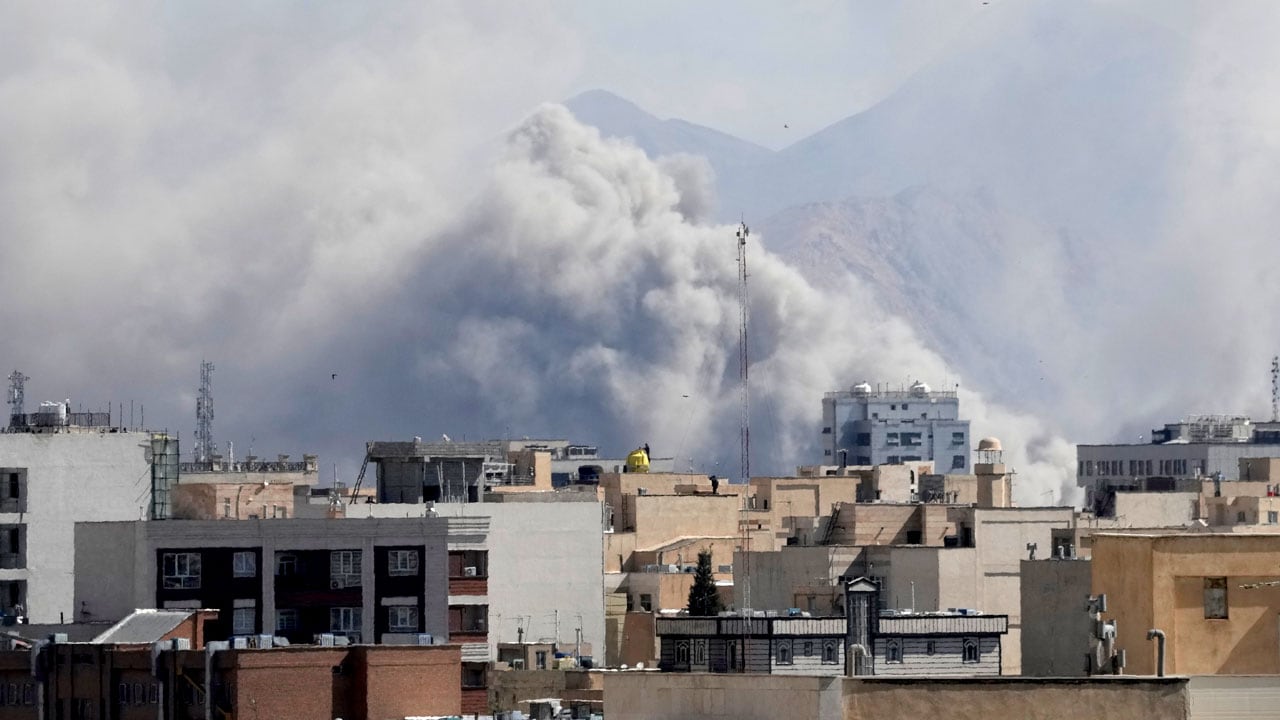
The environmental impact of high-intensity kinetic conflict is traditionally relegated to "collateral damage," a term that obscures the massive, unaccounted-allotment of carbon debt generated before, during, and after a single missile strike. When examining the escalation between the United States, Israel, and Iran, the "liveable planet" discourse often misses the structural reality: modern warfare is a carbon-intensive industrial process. To quantify this, one must move beyond the visible destruction of infrastructure and analyze the Triple-Phase Emission Cycle: the emissions of mobilization, the chemical release of high-explosive impact, and the multi-decadal carbon cost of reconstruction.
The Energy Density of Escalation
Modern military operations are built on the rapid consumption of high-density hydrocarbons. Unlike civilian sectors that can transition to intermittent renewables, military readiness requires energy density that only petroleum products can currently provide. The logistical tail required to maintain a carrier strike group in the Eastern Mediterranean or to sustain long-range bomber sorties from Diego Garcia creates a baseline of emissions that exists even in the absence of a "hot" war.
The carbon footprint of a conflict between major regional powers is governed by three primary variables:
- Logistical Friction: The fuel burned by tankers, transport aircraft, and support ships to move hardware across oceans.
- Operational Burn: The direct consumption of Jet A-1 fuel and ultra-low sulfur diesel by combat platforms.
- Destructive Release: The release of sequestered carbon from burning infrastructure (oil refineries, chemical plants, and urban centers).
In the context of an Israel-Iran engagement, the geography dictates a reliance on long-range aviation and maritime maneuvers. A single F-35 lightning II sortie generates roughly 2.3 metric tons of $CO_{2}$ per flight hour. When multiplied by the hundreds of sorties required for a sustained campaign, the atmospheric debt exceeds the annual output of many small nations within weeks.
The Cost Function of Kinetic Impacts
When a missile hits a target, the environmental "cost" is not merely the propellant used. We must calculate the Replacement Carbon Burden. If a precision strike destroys a power plant in Tehran or a desalination facility in Haifa, the environmental toll includes the total carbon required to mine, smelt, manufacture, and transport the materials to rebuild that facility from scratch.
Most observers fail to account for the Atmospheric Opportunity Cost. The capital and industrial capacity diverted to the production of munitions—which are designed for a one-time release of energy—is capital stripped from the global energy transition. Each billion dollars spent on interceptor missiles represents a direct subtraction from the global investment in grid-scale battery storage or carbon capture technology.
Chemical Alteration and Soil Toxicity
Beyond carbon, the kinetic exchange between Israel and Iran involves the deployment of specialized chemicals. High explosives like RDX and HMX, when detonated, release nitrogen oxides ($NO_{x}$) and other greenhouse gases with higher global warming potential (GWP) than $CO_{2}$.
The long-term environmental degradation includes:
- Perchlorate Contamination: Often found in rocket propellants, these chemicals leach into groundwater, rendering agricultural land in the Levant or the Iranian plateau non-viable for generations.
- Heavy Metal Aerosolization: The destruction of hardened targets often involves depleted uranium or tungsten alloys, which become airborne upon impact, posing a biological risk that transcends borders.
The Resilience Paradox
There is a flawed assumption that regional conflicts are "local." In reality, the interconnectedness of global energy markets means that a strike on Iranian oil infrastructure creates a Global Emission Spike. If Iranian crude is removed from the market, higher-intensity extraction methods (such as US fracking or Canadian oil sands) often scale up to meet the deficit. These alternative sources frequently have a higher carbon intensity per barrel than traditional Middle Eastern wells, leading to a net increase in global emissions despite a drop in total production.
Furthermore, the destruction of civilian infrastructure forces populations to rely on "emergency energy"—primitive, highly polluting sources like wood fires, diesel generators, or low-grade coal. This regression in the energy ladder creates localized "smoke blankets" that alter regional albedo and accelerate local warming trends.
Breaking the Feedback Loop
If the objective is a "liveable planet," the strategy must shift from mitigation to the prevention of kinetic escalations that trigger these feedback loops. The current data suggests that even a "limited" exchange between Israel and Iran would negate the annual carbon savings of the entire European Union's green transition within sixty days.
To assess the true risk, analysts should use the Conflict-Carbon Matrix:
- Phase I: Pre-emptive Mobilization. High-altitude surveillance and carrier positioning. Low intensity, high duration.
- Phase II: Kinetic Exchange. Missile barrages and aerial bombardment. High intensity, short duration. Massive spikes in particulate matter and $NO_{x}$.
- Phase III: The Reconstruction Tail. 10–30 years of cement and steel production. The most significant, yet least discussed, carbon driver.
Strategic Imperative
The only viable path forward for regional stability is the decoupling of national security from hydrocarbon dependence, but this is a long-term goal that cannot solve the immediate crisis. In the short term, the strategic play is the implementation of Environmental Deterrence.
International bodies must begin quantifying "Carbon Reparations"—a framework where the aggressor in a conflict is held financially liable for the total atmospheric and reconstruction debt incurred. By pricing the environmental cost into the "war room" logic, the cost-benefit analysis of a strike on critical infrastructure changes. The goal is to move the environment from a "silent victim" to a "hard constraint" in geopolitical modeling.
The data confirms that the planet cannot afford the luxury of a localized war in the Middle East. The atmospheric math simply does not close. Therefore, the strategic priority must be the immediate freezing of kinetic options and the transition toward a diplomatic framework that treats regional ecology as a shared strategic asset rather than a theater of operations.
Would you like me to model the estimated carbon recovery timeline for a 30-day regional conflict scenario?