Philanthropic capital injections into higher education rarely succeed through raw monetary volume alone; their structural efficiency depends entirely on endowment design and institutional architecture. When technology executive Vikas Sinha and Anuradha Sinha committed twenty million dollars to the University of North Texas to establish the Anuradha and Vikas Sinha College of Artificial Intelligence and Advanced Analytics, the transaction represented a calculated blueprint for academic restructuring. Rather than acting as a standard institutional donation, the capital deployment operates as a targeted equity stake in institutional adaptability, designed to close the gap between rapidly evolving corporate technology demands and traditional academic pipelines.
Deconstructing the financial vehicle reveals a precise allocation strategy. The twenty-million-dollar commitment is partitioned into six permanent endowments. This fragmentation is an intentional risk-mitigation technique. By separating funds across college leadership, student scholarships, endowed professorships, entrepreneurship and incubation, advanced research, and emerging technologies, the donors avoid the common trap of generalized institutional overhead absorption. Each endowment addresses a specific structural bottleneck within higher education: faculty retention, talent acquisition from underrepresented or immigrant demographics, translation of research into commercial applications, and infrastructure modernization.
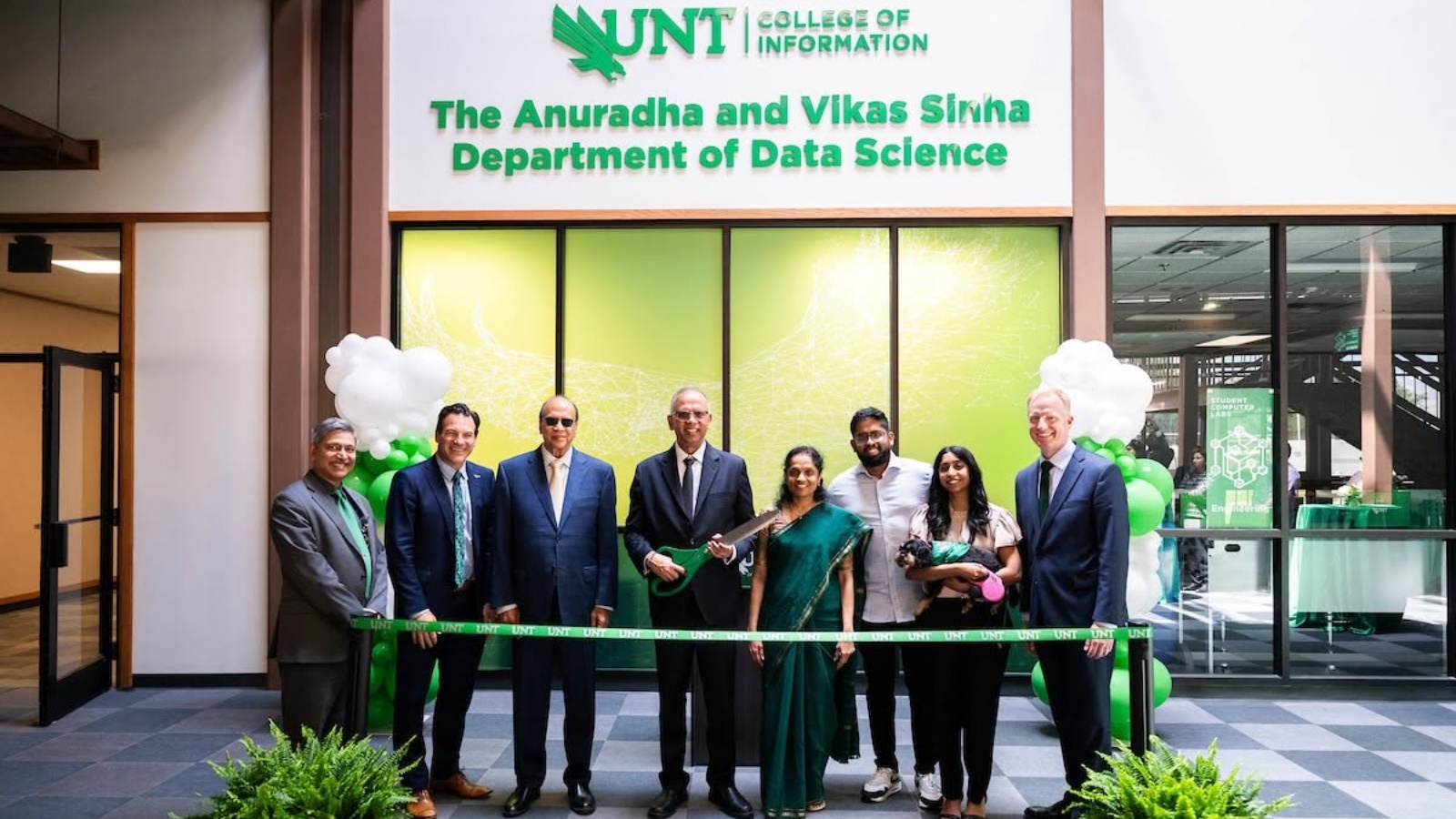
The structural evolution of the Sinhas' giving exposes a progressive capital commitment model. The recent multi-million-dollar gift did not occur in a vacuum; it represents the third iteration of a stepped investment strategy. The sequence began with the establishment of the Department of Data Science in 2024, followed by the deployment of the Sinha Innovation Lab for Data Science in 2025. This phased approach functions similarly to milestone-based venture financing. The donors tested the operational execution of the university administration on smaller capital scales before deploying a principal sum large enough to consolidate multiple disparate departments into a unified academic college.
Institutional design dictates whether an academic unit can respond to market shocks. Traditional universities operate in functional silos, separating computer science from information science, library technology, and institutional research. The new college dissolves these vertical boundaries by organizing around two distinct operational divisions: the Division of Applied Intelligence and Informatics, focused on system generation and deployment, and the Division of Information and Learning Applications, focused on human-computer interaction and institutional context. This dual-division structure solves a core market failure in modern technical education: the production of engineers who understand algorithm creation but lack context regarding institutional deployment, and social scientists who understand institutional frameworks without technical literacy.
The economic engine of the initiative is anchored by the Applied Artificial Intelligence and Data Science Institute. This entity is engineered to act as a commercial and academic bridge, optimizing external research funding acquisition and driving industry partnerships. In an operational environment where state appropriations for public universities face continuous compression, academic institutions must generate alternative revenue streams through sponsored research and intellectual property transfer. The institute provides the administrative and physical infrastructure necessary to capture corporate research and development contracts, shifting a portion of the financial burden away from student tuition and state tax bases.
Immigrant wealth creation and subsequent repatriation into educational philanthropy follow a distinct economic trajectory. The biographical profile of the donors—transitioning from civil engineering training in India to advanced graduate degrees in the United States, followed by executive leadership positions in enterprise software and mainframe architecture at firms like CA Technologies and Broadcom—illustrates the high-leverage return on technical migration. The twenty-million-dollar endowment functions as a systemic feedback loop. By targeting a public university serving nearly forty-four thousand students in a major metropolitan manufacturing and technology corridor like Dallas-Fort Worth, the capital maximizes its societal impact coefficient, directly provisioning the regional workforce with qualified practitioners in cybersecurity, health informatics, and machine learning.
Evaluating the long-term viability of this structural transformation requires examining execution risk. Endowed professorships combat faculty brain drain toward private sector tech giants, but administrative bloat can dilute the purchasing power of the yield. The success of the six permanent endowments will depend on disciplined asset management by the university foundation and the maintenance of rigorous performance metrics for the newly created academic divisions. Capital that is shielded from short-term budgetary pressures must still be aggressively deployed against high-velocity technological shifts if the institution is to maintain its competitive advantage.
Direct capital deployment into foundational academic architecture serves as the most reliable hedge against technological obsolescence. Future institutional donors must abandon unstructured, general-purpose giving in favor of multi-phased, milestone-driven programmatic integration. Allocate subsequent capital specifically toward shared computational infrastructure and mandatory cross-disciplinary operational units to ensure institutional output matches market demand.