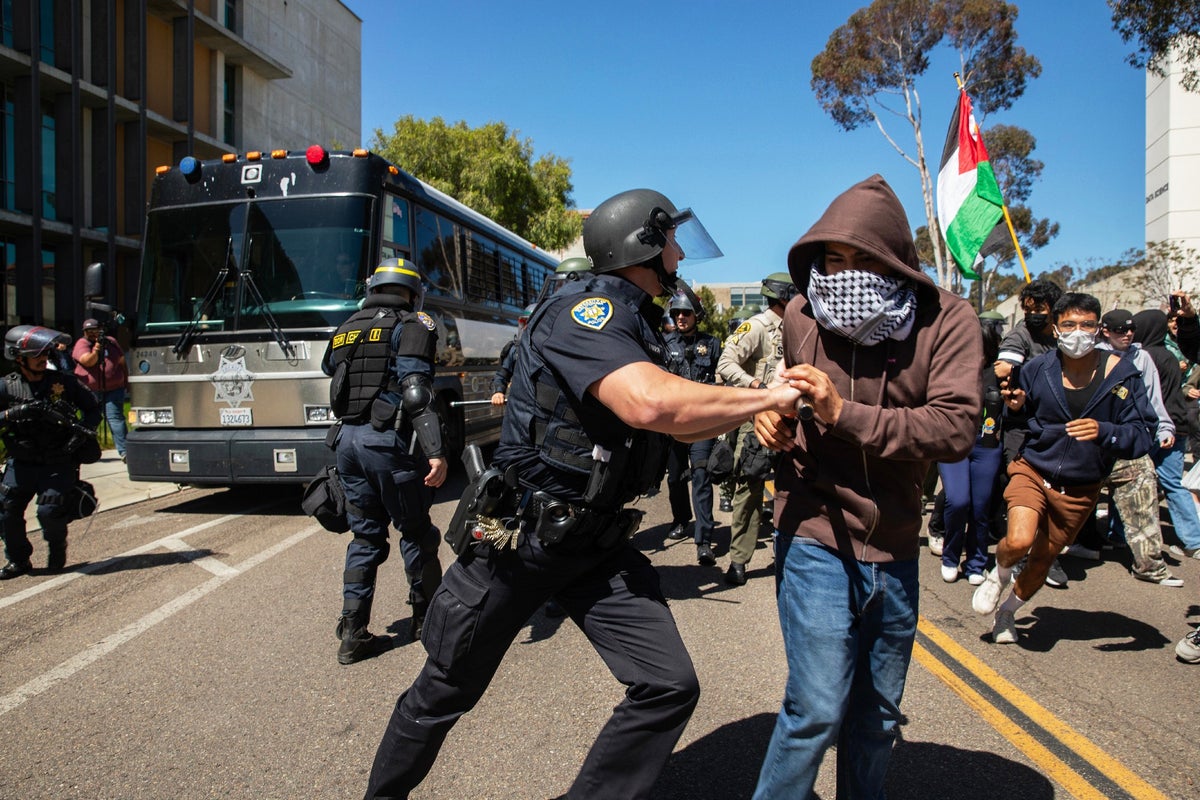
You pack a backpack, grab a coffee, and head to a college campus to learn. You don't expect to walk past an armory packed with AR-15s, tear gas grenades, and sonic weapons designed for warfare.
But a massive compliance failure has exposed a reality that California higher education officials tried very hard to keep in the dark.
A sweeping investigation into California’s 148 public colleges and universities revealed that campus police departments have quietly amassed substantial stockpiles of military-grade weaponry. From semi-automatic rifles to stun grenades and long-range acoustic devices—often called the "voice of God" in combat zones—these arsenals have grown with virtually zero public awareness.
Worse, dozens of schools actively violated a state transparency law designed to prevent exactly this kind of secretive militarization.
If you think your local campus is just a sanctuary for midterms and student activism, you aren't looking at the campus police inventory.
The Illusion of Transparency Under Assembly Bill 481
This isn't just a story about cops buying big guns. It's a story about public institutions breaking the law to cover their tracks.
Back in 2021, California passed Assembly Bill 481. The logic behind the law was simple. If a law enforcement agency wants to buy or use military equipment, they must get permission from their governing board, publish a meticulous inventory online, and hold annual public forums to face their community. The law explicitly states that police can only hold these weapons if there is no other viable way to ensure civilian safety.
The reality? Total institutional amnesia.
The investigation, spearheaded by CalMatters, found rampant non-compliance across the California Community Colleges, California State University (CSU), and University of California (UC) systems.
- Compton College had patrol officers carrying semi-automatic rifles for over seven years without ever seeking board approval or creating a public use policy.
- UC Berkeley hid its military equipment list for months, only publishing it after being repeatedly pressed by journalists.
- Over 40 community colleges completely failed to file their mandatory annual reports or hold public forums.
When caught, the excuses from administrators amounted to a collective shrug. Some claimed they didn't know the law applied to them. Others just didn't bother putting the paperwork online until reporters started asking hard questions. It turns out that transparency is optional for public universities until someone forces their hand.
Inside the Campus Armories
What exactly are these campus police departments hiding? The sheer volume of tactical gear is staggering. We aren't talking about standard-issue pistols and handcuffs.
Over 25 public colleges in California own semi-automatic rifles. The inventory includes hundreds of AR-15-style firearms, thousands of rounds of high-velocity ammunition, and 136 separate 40mm projectile launchers.
Then there are the chemical agents. San Jose State University police possessed an unauthorized cache of 33 tear gas grenades. These weapons release clouds of choking chemicals engineered for intense physiological and psychological distress. When confronted, campus police officials claimed the grenades had "always been in our armory" and promised they would destroy them. That begs an obvious question. If you never intend to use a submachine gun or a wall of tear gas, why has it been sitting in a campus locker next to freshman dorms for years?
At UCLA, the situation is even more volatile. The UC Police Department explicitly maintained hundreds of 40mm kinetic impact projectiles—sponge and plastic bullets—even after a federal judge banned the Los Angeles Police Department from using them for crowd control due to severe injuries inflicted on protesters. Campus safety officials bypassed the ban by pointing out that the court ruling against the LAPD didn't technically apply to university police.
The Loophole Game
The most frustrating part of this institutional secrecy is the semantic gymnastics used to dodge public oversight.
Take the CSU system. Its official system-wide policy does not authorize the use of AR-15 rifles. Yet, both San Jose State University and San Francisco State University own them anyway.
How do they justify it? A spokesperson for the CSU system argued that these specific AR-15s are "standard issue" weapons for those specific campuses, which theoretically exempts them from the military equipment reporting law. Meanwhile, San Jose State’s own internal documentation categorized the exact same rifles as "specialized firearms."
When universities can arbitrarily decide that a battlefield rifle is just "standard equipment," the law loses all its teeth. It allows campus police departments to self-regulate, deciding what information the public has a right to know.
Why Student Activists are Pushing Back
This quiet buildup of firepower hasn't gone unnoticed by the people who actually live and work on these campuses. Student groups, particularly those representing veterans and students of color, are pointing out that heavily armed campus police forces don't make them feel safe. They make them feel targeted.
Look at Mt. San Antonio College. When the administration proposed purchasing a fresh fleet of AR-15s for campus security, a student-led coalition organized intense demonstrations, flooded police town halls, and packed board meetings to condemn the plan. They argued that bringing high-powered rifles onto a campus serves no purpose other than crushing student dissent and discouraging free speech.
The students won. As of mid-2026, Mt. San Antonio College does not own semi-automatic rifles.
Campuses are supposed to be focal points for debate and activism. When you introduce long-range acoustic devices and flashbangs into that environment, the message from the administration is clear: step out of line, and we have the tactical tools to put you down.
How to Audit Your Own Campus
If administrators and police departments aren't going to follow the law voluntarily, the public has to force them to do it. You don't have to wait for a major news outlet to investigate your local college. The tools to demand accountability already exist in the text of AB 481.
If you want to find out what your university is packing, take these immediate steps:
Search the Police Website
Every public college police department in California is legally required to host a dedicated "Military Equipment" page. Look for their AB 481 Use Policy and their latest Annual Report. If the latest report isn't posted, or if it lacks specific quantities, product descriptions, and manufacturing details, they are out of compliance.
Demand the Public Forum
The law mandates that within 30 days of releasing an annual report, campus police must hold a well-publicized, accessible community meeting. Check your campus calendar. If they snuck the report online without hosting a public forum, call the campus president's office and demand a date.
Challenge the Inventory at Board Meetings
Campus police report to a governing body, whether it's a local community college district board or the UC Board of Regents. These boards must vote to re-approve the weapons inventory every single year. Show up to the public comment section of those meetings. Force the board members to look at the inventory list and explain why tuition dollars are funding military-grade gear.
Public oversight only works if the public actually looks over their shoulders. Stop assuming your campus administrators are playing by the rules. Go look at the inventory yourself.